
On this pageThe answer changes with the context
Yes—you can call yourself German when you are talking about German ancestry, family heritage or cultural background. But the clearest wording depends on the setting. In a casual American conversation, “I’m German” often means “my family has German roots.” In a legal, international or present-day national context, it may be heard as “I am a citizen of Germany” or “I grew up in Germany.” Those are different claims.
The useful question is not whether one label is universally allowed. It is what you want the label to communicate, and whether your listener is likely to understand it that way.
Four ideas that are easy to mix together
- German ancestry
- Family descent or ethnic origin connected to Germany or German-speaking ancestors.
- German-American
- An American identity that acknowledges German family roots, culture or community connection.
- German citizenship
- A legal nationality governed by German law, documents and date-specific eligibility rules.
- Cultural participation
- The traditions, language, food, stories, relationships or community practices a person actually engages with.
The answer changes with the context
In the United States, ancestry is a common part of everyday identity language. The U.S. Census Bureau asks people to report the ancestry or ethnic origins with which they identify. It also makes an important distinction: ancestry is not the same as birthplace, and an ancestry answer does not measure how strongly someone participates in a culture.
That helps explain why an American whose grandparents came from Germany may naturally say, “I’m German,” even though the person was born in Ohio, Texas or California. The sentence is usually shorthand for a family story, not an application for a passport.
The same wording may land differently in Germany. A listener there may reasonably hear “German” as a current nationality, upbringing or lived connection to German society. Neither interpretation is foolish. They simply come from different habits of speech.
A little precision prevents most of the tension:
- At a family gathering: “We’re German” may be perfectly natural shorthand.
- Talking with someone from Germany: “I’m German-American” or “my grandparents were from Germany” gives useful context.
- Filling out an official form: use the citizenship or nationality that the form actually asks for.
- Discussing culture: name the connection you have—family traditions, ancestry research, language learning or community life.
Precision is not a surrender of heritage. It is a way to make the heritage legible.

Choose wording for the setting
Casual family context
Best for: Conversation where ancestry is already understood
'We're German' may work as ordinary shorthand when everyone understands that the subject is family background.
Add one family detail if the meaning is unclear.
Public or international context
Best for: Introductions, profiles and cross-cultural conversation
'I'm German-American' or 'I'm American with German roots' names the American setting and the German family connection together.
Use the label that matches what you actually know and live.
Legal or official context
Best for: Forms, eligibility questions and government processes
State only an established citizenship or nationality. Heritage language cannot substitute for documents or an individual legal assessment.
Check current official guidance for citizenship questions.
Birthplace and citizenship answer one question, not every question
For most people born in the United States and subject to its jurisdiction, the Fourteenth Amendment provides U.S. citizenship at birth. That legal fact does not erase family origins. It tells you where your citizenship begins; it does not settle every cultural description you may use for the rest of your life.
German citizenship is another legal question. German law generally transmits citizenship through a German parent, but the outcome can depend on the date of birth, whether citizenship was retained or lost in an earlier generation, and other family-specific facts. The law also changed on June 27, 2024, to make multiple citizenship more broadly possible, but that reform did not retroactively reverse every loss that occurred under older rules.
This is why “my grandparents were German” and “I am a German citizen” cannot be treated as interchangeable sentences. The first is a family-history statement. The second is a legal status that needs evidence.
It is also why a heritage article should not tell an individual reader that they do or do not qualify for citizenship. Old records, dates and the legal status of each generation matter. For that question, use official German guidance and obtain an individual assessment when needed.

What you can claim honestly
A strong identity statement does not need to be inflated. You can speak warmly and still stay exact.
You can reasonably say:
- “I have German ancestry.”
- “My grandparents came from Germany.”
- “I’m German-American.”
- “German heritage is part of my family.”
- “I’m reconnecting with my German roots.”
Each sentence leaves room for a different level of knowledge and participation. Someone may have a documented family line but know little about regional customs. Someone else may have grown up with German words, recipes and church traditions but lack a complete paper trail. Another person may be beginning from a surname and one old photograph.
None of those situations requires pretending.
The claim becomes less fair when ancestry is used to borrow experience that a person has not had. German roots do not automatically provide firsthand knowledge of living in Germany, navigating German institutions, speaking for Germans today or representing every regional tradition. Saying “my family is from Germany” is not smaller than claiming experience you do not possess. It is more trustworthy.

“German-American” is often the most useful middle ground
“German-American” can hold two truths at once: American nationality or upbringing, and a German family connection. It does not tell the whole story, but it usually reduces the main ambiguity.
The label also has room for variation. One German-American family may have arrived in the nineteenth century and preserved only a few foods and names. Another may have parents who emigrated recently and still speak German at home. A third may have mixed ancestry and choose to honor several family lines. The term does not need a single percentage, immigration date or checklist.
It should not become a gatekeeping tool either. A person who uses “German-American” is not automatically more authentic because they know more German words, own older documents or celebrate more holidays. Those things may deepen a connection; they are not a universal admission test.
When “I’m German” may need an extra sentence
The phrase works best when the listener already understands the ancestry context. Add detail when the setting is likely to create a different assumption.
When nationality matters
Use “U.S. citizen,” “German citizen” or “dual citizen” only when that legal status is established and relevant. Heritage language should not replace official terminology.
When birthplace or upbringing matters
“I was born and raised in the United States, and my family is German” is clearer than making the listener guess. It honors both parts of the story.
When discussing present-day Germany
Family ancestry can motivate interest, study and care. It does not automatically make someone an authority on contemporary German politics, regional identities or daily life. Listen before generalizing.
When the family history is still uncertain
Use the evidence you have. “We believe one branch came from Germany” is a good sentence. Honest uncertainty is not an identity failure.
A respectful answer when someone asks, “Are you German?”
There is no need to give a lecture every time. One clear line is enough:
“I’m American, with German family roots.”
Or:
“I’m German-American—my grandparents came from Germany.”
If you hold German citizenship, you can say so. If you do not know, do not let a family surname make the legal claim for you.
The goal is not to find a phrase that no one could ever challenge. Identity words carry different expectations in different places. The goal is to describe your real connection without shrinking it and without making it larger than the evidence.
The most accurate answer is allowed to be personal
You may prefer “German-American,” “of German ancestry,” “American with German roots,” or simply “my family came from Germany.” Another person with a similar family tree may choose differently. That variation is normal.
What matters is the distinction beneath the wording:
- birthplace describes where you entered the world;
- citizenship describes a legal relationship;
- ancestry describes family descent;
- culture describes what is practiced, remembered, learned and shared;
- identity describes how a person understands and communicates those connections.
They can overlap. They do not have to be identical.

For the umbrella identity definition, read what it means to be German-American. For the boundary between descent and lived connection, continue with German ancestry vs. German heritage.
An expression can follow the explanation
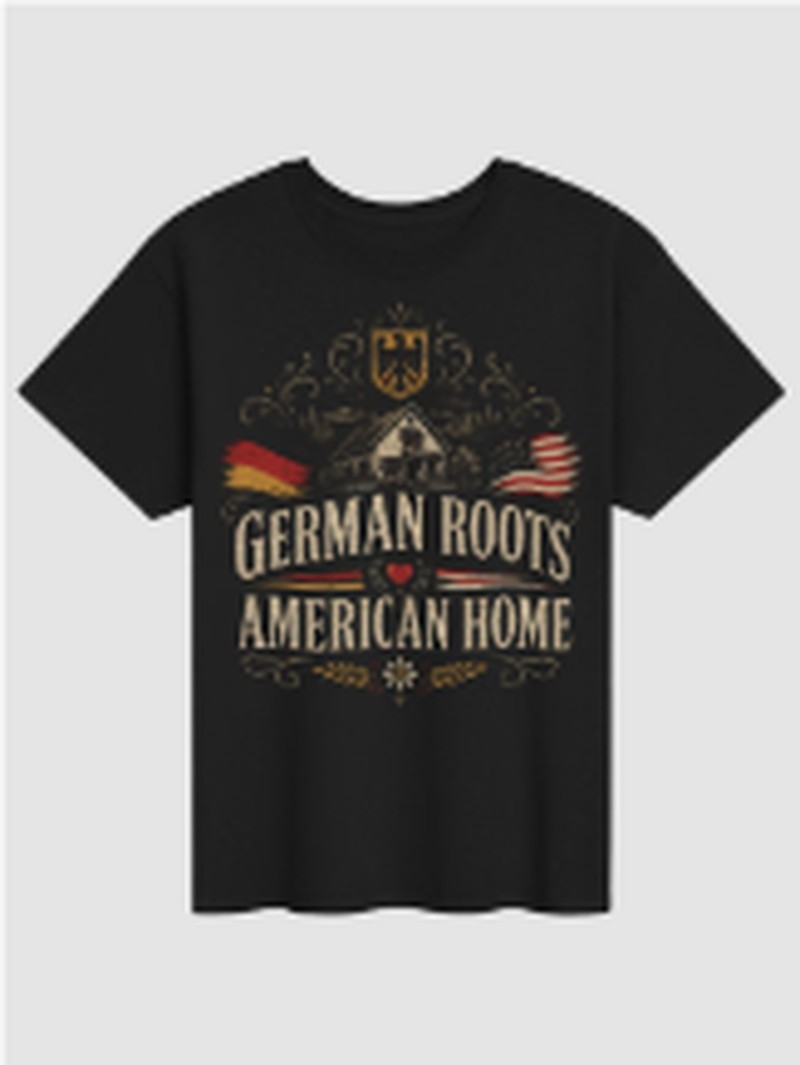
Once the wording is clear, a shirt or keepsake may express the same two-part story. “German Roots, American Home” fits because it names ancestry and present home without presenting either as proof of citizenship.
The product below is optional. The accurate answer remains contextual: “German” can be understandable ancestry shorthand in an American conversation, while “German-American” or “American with German roots” is usually clearer when nationality, upbringing or audience expectations matter.
An optional way to phrase the connection
German roots, American home
This design names family origin and present home together. It expresses heritage; it does not imply citizenship or legal status.
Frequently asked questions
Common questions
Is it wrong for an American to say “I am German”?
Not necessarily. In the United States, people often use that wording to describe family ancestry. It can become confusing when the listener understands “German” to mean German citizenship, birth or current national experience, so context matters.
Does having German grandparents make you a German citizen?
Not automatically. German citizenship often passes through a German parent, but the result depends on dates, the citizenship status of each generation and other legal events. A German mission or qualified authority must assess an individual case.
What is the clearest way to describe German roots?
“I am German-American,” “my family is from Germany,” or “I have German ancestry” is usually clear. Each phrase says something slightly different, so choose the one that matches what you actually know.
Can someone value German heritage without claiming to be German nationally?
Yes. Family history, traditions, language learning and cultural connection do not require a claim of German citizenship or present-day German lived experience.