
On this pageGerman culture in America was once highly public
German-American culture became less visible because several changes accumulated across generations. English gradually replaced German in many homes. Families moved, married across language groups and joined wider American institutions. Then World War I brought a much sharper break: German schools, newspapers, books and public speech faced restrictions, boycotts and hostility. Later changes in neighborhoods, churches, clubs and media kept shifting culture away from a clearly German public form.
“Less visible” is the important phrase. German-American culture did not simply vanish. Some practices moved into private family life. Some institutions survived. Some customs became so familiar in the United States that people stopped noticing their German connections.
For the larger identity framework, start with the German heritage and German-American identity guide. This article stays with the narrower historical question: why public cultural visibility declined.
What changed—and what did not
- Public visibility
- How clearly a culture appears through language, newspapers, schools, clubs, signs, institutions and civic events.
- Language shift
- A generational move from German toward English as the main language of home, school and work.
- Integration
- Participation in wider American institutions and identities; it can involve choice, pressure or both.
- Anti-German pressure
- Legal, economic and social actions directed at German language and institutions, especially during World War I.
The causes are easiest to understand in layers. Long-term integration reduced the daily need for German. Wartime hostility damaged the institutions that made German public and ordinary. Afterward, national media, suburban movement and changing community organizations made the older network harder to rebuild. No layer explains every family, but together they explain the national pattern better than a single story about assimilation.
German culture in America was once highly public
It is difficult to understand the later quietness without seeing what came before it.
German was not confined to a few household phrases. German-language newspapers served communities across the country. The Library of Congress describes the German-American press as the most extensive press network of any immigrant group. German publishing had deep roots in colonial America, and German businesses, books, broadsides and public debate were visible parts of city life.
By the nineteenth and early twentieth centuries, many communities supported German churches, schools, singing societies, mutual-aid organizations, athletic clubs and newspapers. The exact mix varied by place and denomination. A town in Pennsylvania, a farming community in Texas and a neighborhood in Milwaukee did not express German identity in one uniform way.
Still, the public infrastructure mattered. A family could speak German at home because it also encountered German in worship, school, news, shops and social life. When those institutions weakened, household language became harder to maintain.
The press connected several parts of community life at once. A newspaper carried national and local reporting, but it also printed church schedules, club notices, business advertisements, obituaries and political arguments. The Library of Congress calls the German-American press the most extensive press network created by any immigrant group in the United States. That description refers to institutional reach, not to a single unified German-American viewpoint.
Public culture extended beyond print. A singing society, mutual-aid lodge or parish school could give newcomers a place to find work, worship, socialize and help one another. These organizations differed sharply in politics, religion and regional background. Their shared significance was practical: they created places where German did not need to be explained.

Ordinary language shift had already begun
Even without a national crisis, immigrant languages often become less common over generations.
Children spend much of their day in schools and workplaces where English is useful or required. Families move away from concentrated neighborhoods. People marry partners from different language backgrounds. A parent may understand German but find English easier with children. Grandchildren may inherit foods, names and stories after the grammar has faded.
These changes should not be reduced to indifference. Families often make practical decisions under the conditions around them. Some want children to avoid discrimination. Some believe English will widen opportunity. Some simply lack enough speakers in daily life to keep German active.
Language transmission depends on repetition. A child who hears German only from one grandparent is in a different position from a child who also uses it at school, church, the corner store and a neighborhood club. Once several of those settings switch to English, the burden moves onto individual households. Even committed parents may struggle to maintain a language that their children rarely need outside the home.
This gradual shift explains part of the story. It does not explain the speed or severity of the break that followed World War I.
World War I turned difference into suspicion
When the United States entered the war against Germany in 1917, German-American public life became vulnerable in a new way. Loyalty was questioned. German-language newspapers lost advertising, subscriptions and access to newsstands. The Library of Congress records boycotts, declining circulation, government raids and threats surrounding the German-language press.
German books were removed or burned in some communities. German instruction was discontinued, restricted or outlawed in various states and localities. People who spoke German could face boycotts, intimidation or violence. Streets and institutions with German names were renamed. Some families anglicized surnames or stopped displaying a public connection to Germany.
The pressure was not identical everywhere. A legal restriction is different from a private decision; a boycott is different from physical violence. But together these pressures changed the cost of being publicly German-American.
For many families, English was no longer only the practical language of advancement. It also became a form of protection.
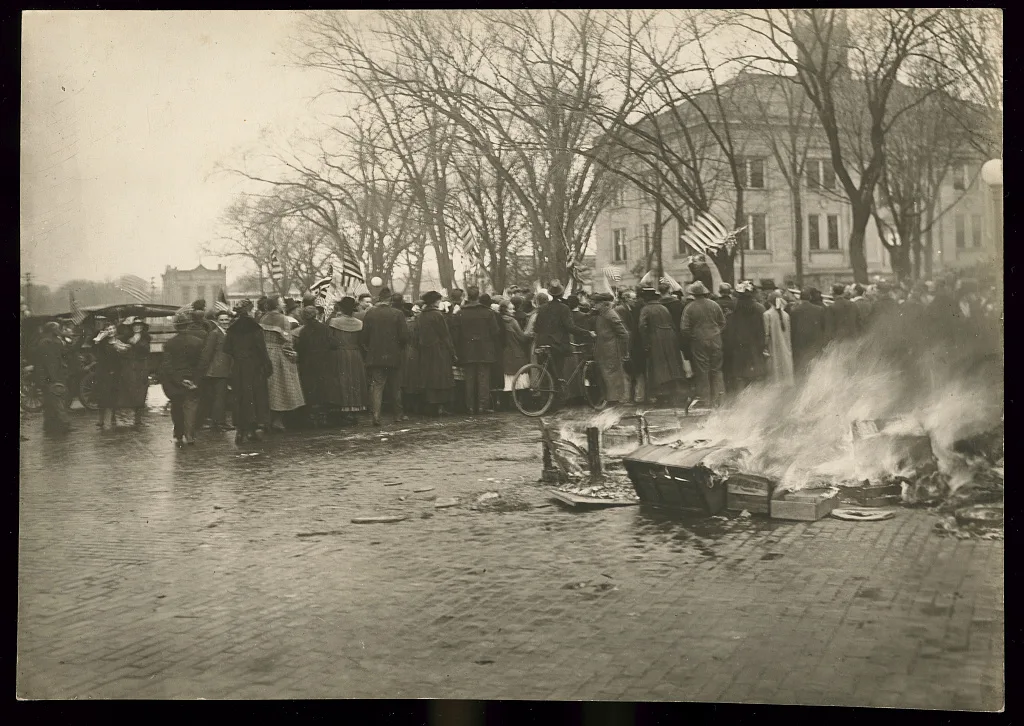
The attack on public institutions could also encourage private self-censorship. A family did not need to receive a direct threat to notice what happened to a newspaper advertiser, teacher or neighbor. In that climate, dropping a subscription, changing the language used with children or avoiding a public label could feel prudent. The historical record supports those pressures broadly, but it does not reveal the reason behind every individual family’s choice.
Meyer v. Nebraska shows how far the pressure reached
Nebraska passed a law in 1919 that prohibited teaching modern languages other than English to children who had not completed the eighth grade. Robert Meyer, a teacher at a parochial school, was convicted after teaching a ten-year-old child to read German from a Bible storybook.
In 1923, the U.S. Supreme Court struck down the law in Meyer v. Nebraska. The decision recognized that the restriction interfered with protected liberty, including the role of parents in directing a child’s education.
The ruling ended that law. It could not rebuild every classroom, newspaper or habit that had already been lost.
This distinction matters. A court victory can remove a restriction while the social effects continue. Teachers may have changed careers. Schools may have dropped programs. Parents may have decided that transmitting German was no longer worth the risk. Children who missed years of instruction did not automatically regain them.
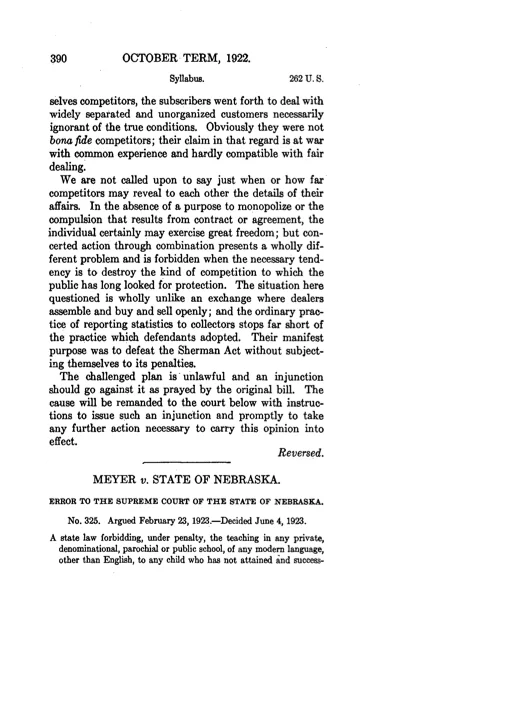
The case is also a warning against overstatement. It demonstrates that a state law reached into language teaching at a parochial school. It does not establish a single nationwide ban on speaking German, nor does it explain every decline in German instruction. Laws, school-board decisions, informal pressure and household choices must be kept distinct even when they reinforced one another.
The institutions did not fully return to their old scale
After the war, some German-language papers continued, and German-American organizations remained active. Yet the earlier network did not simply restart.
English had gained more ground in schools, commerce and family life. Immigration patterns changed. Radio and later television favored broad national audiences. Urban neighborhoods changed as families moved outward and new populations arrived. Churches consolidated or changed language. Clubs that had once served an immigrant community competed with many other forms of association and entertainment.
The result was not one dramatic disappearance date. It was a thinner network.
When a newspaper closes, a reader loses more than news. The community loses advertisements, obituaries, event notices, political debate and a place where its language feels ordinary. When a school stops teaching German, children lose both instruction and a public signal that the language belongs. When a club closes, traditions may continue in homes but become harder for newcomers to find.
Visibility is built by repeated public spaces. It declines when those spaces no longer reinforce one another.
The change also affected newcomers differently from established families. An immigrant arriving into a dense German-speaking neighborhood could enter an existing web of services and relationships. A later descendant living far from that neighborhood might inherit a surname and a recipe but have no local newspaper, school or club through which to interpret them. Culture had not necessarily vanished from the family; the supporting network around it had grown thinner.
Some German-American culture became “just American”
Another part of the story is success through absorption.
German immigrants and their descendants influenced American food, brewing, music, education, farming, labor, architecture and civic organizations. Some contributions remained attached to a German label. Others became ordinary features of American life.
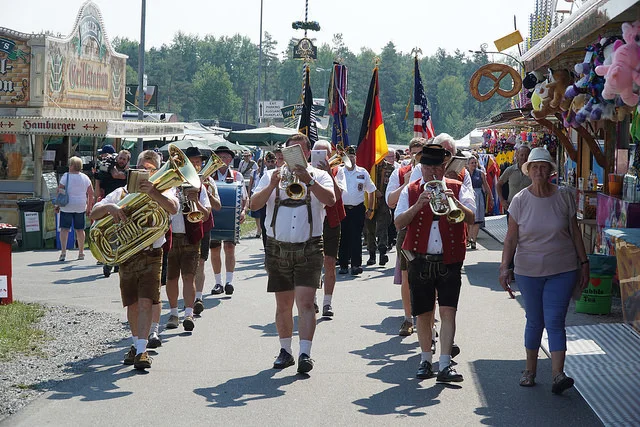
That can make heritage harder to see. A custom may survive while the explanation disappears. A family serves a certain cake, keeps a Sunday meal pattern or uses a familiar surname without calling any of it German-American. A city festival may preserve music and food but operate mainly as a general local event.
Absorption is not the same as preservation, and it is not the same as erasure. It often contains both. Something survives, but its original language, regional context or community meaning may become less clear.
The quieter culture was not simply a failure of caring
Later generations stopped caring about their German heritage.
Families made choices within changing schools, workplaces, neighborhoods and social pressures.
Some protected traditions, some left them behind and many retained selected practices after the language or public label faded.World War I alone erased German-American culture.
The war caused a severe rupture, but language shift and institutional change began before it and continued afterward.
If a custom became American, its German history disappeared completely.
A practice can survive while its origin becomes less visible, though survival without context is not the same as full preservation.
Why one explanation is not enough
It is tempting to choose a single story:
- German-Americans assimilated voluntarily.
- World War I destroyed the culture.
- Later generations stopped caring.
- German customs became mainstream and therefore invisible.
Each statement catches something and misses something.
Families differed by immigration date, class, religion, region and local politics. A recently arrived household in 1917 faced different choices from a family whose ancestors had lived in Pennsylvania for generations. A rural church community could preserve German differently from an urban newspaper readership. Some families consciously protected traditions; others deliberately left them behind; many did both in different parts of life.
A responsible history leaves room for that variation.
When reading your own family history, treat the national pattern as context rather than a verdict. A gap in German-language use may fit the broader history, but the reason still needs family-level evidence: letters, school records, church minutes, newspapers, census entries or testimony from relatives. Avoid turning a plausible explanation into a fact about a particular ancestor.
What remained
German-American identity continued in visible organizations, archives, festivals, churches and clubs. It also continued quietly through recipes, grave markers, family Bibles, regional words, holiday practices and stories about where a grandparent came from.
Today, renewed genealogy access and digitized newspapers allow descendants to recover parts of that public world. Learning that the culture was once more visible can change how a person understands a family silence. The silence may reflect ordinary distance. It may reflect a deliberate decision made under pressure. It may reflect both.
The useful lesson is not that every German-American family has a hidden tragedy. It is that quietness should not automatically be mistaken for absence.
If you want to investigate what changed in your own family, begin with one concrete institution: the church an ancestor attended, the newspaper available in the town, the school the children entered or the club named in an obituary. That narrower question is more likely to produce evidence than asking why the family “lost its culture” all at once.
A present-day shirt or keepsake can make a connection visible again, but it should remain expression rather than proof. “German Roots, American Home” fits this page because it names continuity across generations without claiming to restore the institutions described above.
For the identity question created by language loss, read Can You Be German-American Without Speaking German?. For clearer language around ancestry and nationality, read Can You Call Yourself German If You Were Born in America?.
A quiet expression of continuity
German roots can remain visible in new forms
German Roots, American Home names a present-day family connection without treating a shirt as historical evidence.

Frequently asked questions
Common questions
Did German-American culture disappear because families wanted to assimilate?
Voluntary integration and generational language shift mattered, but that is incomplete. World War I brought targeted hostility, restrictions and economic pressure against German-language institutions, and later community changes continued the shift.
Was speaking German illegal in the United States?
There was no single nationwide ban on ordinary speech, but states and communities imposed different restrictions. Nebraska, for example, restricted teaching modern languages to younger children until the Supreme Court struck the law down in 1923.
Did German-American institutions recover after World War I?
Some survived and new forms developed, but German-language newspapers, schools and other public institutions did not return to their earlier national scale.
Is German-American culture still present today?
Yes. It remains in families, churches, clubs, regional festivals, foods, names, archives and renewed heritage work. Some elements are clearly labeled German-American; others have become familiar parts of American life.