
On this pageSelection method
There isn’t one best German beer stein, because “stein” covers five genuinely different objects that only share a family resemblance. If you want something to actually drink from at home on a regular basis, a sturdy ceramic or stoneware stein is the right call. If you’re hosting a casual Oktoberfest party for a crowd, a cheap, dishwasher-safe glass mug beats anything fancier, because you need enough of them and you don’t want to hand-wash two dozen pieces afterward. If you want the classic image most people picture — a hinged pewter lid, a thumb-lift, an etched or embossed body — that’s a distinct traditional-style category with its own care requirements. If you’re buying for someone specific, a personalized or engraved stein solves a gift problem that none of the other categories solve. And if the goal is a piece that sits on a shelf rather than in a cabinet, a collectible or display stein is judged on entirely different criteria: rarity, maker marks, and condition, not durability or capacity.
Most “best beer stein” roundups treat this as a single ranked list, which quietly assumes a shelf piece and a dishwasher-safe party mug are competing for the same job. They aren’t. This guide splits the decision by what you actually need the stein to do, tells you which category answers that need, and is specific about the trade-off each one carries — including the one thing every version of this article seems to repeat as settled history that isn’t actually settled.
Selection method
What separates the stein categories
Primary job
Regular drinking, group service, traditional styling, gifting and collecting require different objects.
Material and care
The body, lid and decoration determine weight and cleaning requirements.
Listing evidence
Capacity, material and maker information must be verified on the exact listing.
Limitation
Every category gives up convenience, traditional appearance or collector value somewhere.
This roundup covers stein categories, not a single overall winner, because everyday durability, party economics, traditional authenticity, gift-ability, and collector value don’t trade off against each other in any consistent way. A stein that’s excellent for one of those jobs is often a poor fit for another. Here’s how MottoFox sorted the options before naming any recommendations.
Scope. This guide covers drinkware realistic for a US-based reader outfitting a home bar, a party, an outfit, or a gift — not museum-grade antiques, and not novelty items (inflatable boot glasses, plastic “costume” mugs) that don’t hold up as a real recommendation in any of the five categories.
Eligibility. A category made this list only if it answers a distinct, real reader need cleanly: daily-use durability, party-scale affordability and easy cleanup, traditional pewter-lid styling, gift-specific personalization, or collector-grade rarity and craftsmanship. A stein that’s mediocre across all five didn’t get a slot over one that’s genuinely strong at one.
Ranking criteria, in order:
- Fit for the stated use case first. An everyday stein is judged on durability and easy care, not how ornate it looks. A collector’s piece is judged on maker marks and craftsmanship, not dishwasher safety.
- Material honesty. Stoneware, ceramic, glass, and pewter behave differently in weight, durability, and required cleaning method, and buying guidance across specialty stein retailers is reasonably consistent on those differences, even where it disagrees on smaller details.
- Care requirements stated plainly. Anything with a pewter lid or pewter body gets flagged as hand-wash territory, because that’s where the sources agree; plain glass or stoneware gets a more qualified “often, but check the listing” rather than a blanket claim.
- Honest limitations. Every category here has a real trade-off — the cheapest party mug won’t look traditional, the pewter-lid stein needs hand care, the collector’s piece isn’t meant to be used at all. We say so instead of implying one stein does everything.
None of this is based on MottoFox purchasing and hand-testing a specific stein. It’s category-level guidance built from specialty stein retailers’ published material and care guidance, general reference sources on stein history and construction, and how those sources agree or disagree with each other — more on that in the methodology section below.
Individual recommendations

Pick the stein by its job
Plain ceramic or stoneware
A practical drinking vessel when the maker's care instructions fit your routine.
Simple glass mugs
Easy to buy in multiples and simpler to inspect for cleaning guidance.
Pewter-lid stein
A specialized mixed-material choice that usually requires hand washing.
Personalized stein
Useful when the recipient and occasion matter more than everyday practicality.
Documented collectible
Judge maker marks, craftsmanship and condition rather than capacity.
Everyday drinking stein
What it’s for: a stein you’ll actually reach for on a regular basis — at home, with dinner, or just because you like drinking from something with more presence than a pint glass.
Stoneware and ceramic are sensible materials for regular use because their fired bodies are non-porous, though glaze, decoration and construction still affect durability. Browse current ceramic steins(paid link) while checking capacity, lid hardware and care instructions rather than relying on decorative photos.
The honest limitation is weight and looks. Stoneware and ceramic are noticeably heavier than glass of the same capacity, and a plain everyday piece won’t have the traditional silhouette a pewter-lid stein has. That’s a fair trade for something meant to survive years of actual use rather than a shelf.
Casual party mug
What it’s for: outfitting a group — a house party, a tailgate, a backyard Oktoberfest — where you need enough mugs for everyone and don’t want breakage or a full sink of hand-washing to be the cost of hosting.
Glass is the right material for this job precisely because of what it gives up elsewhere. Compare current glass beer mugs(paid link) after deciding how many guests the party-supplies checklist actually needs to serve. Plain glass without a pewter lid, gold rim, or printed decoration is the easiest configuration to evaluate for group cleanup.
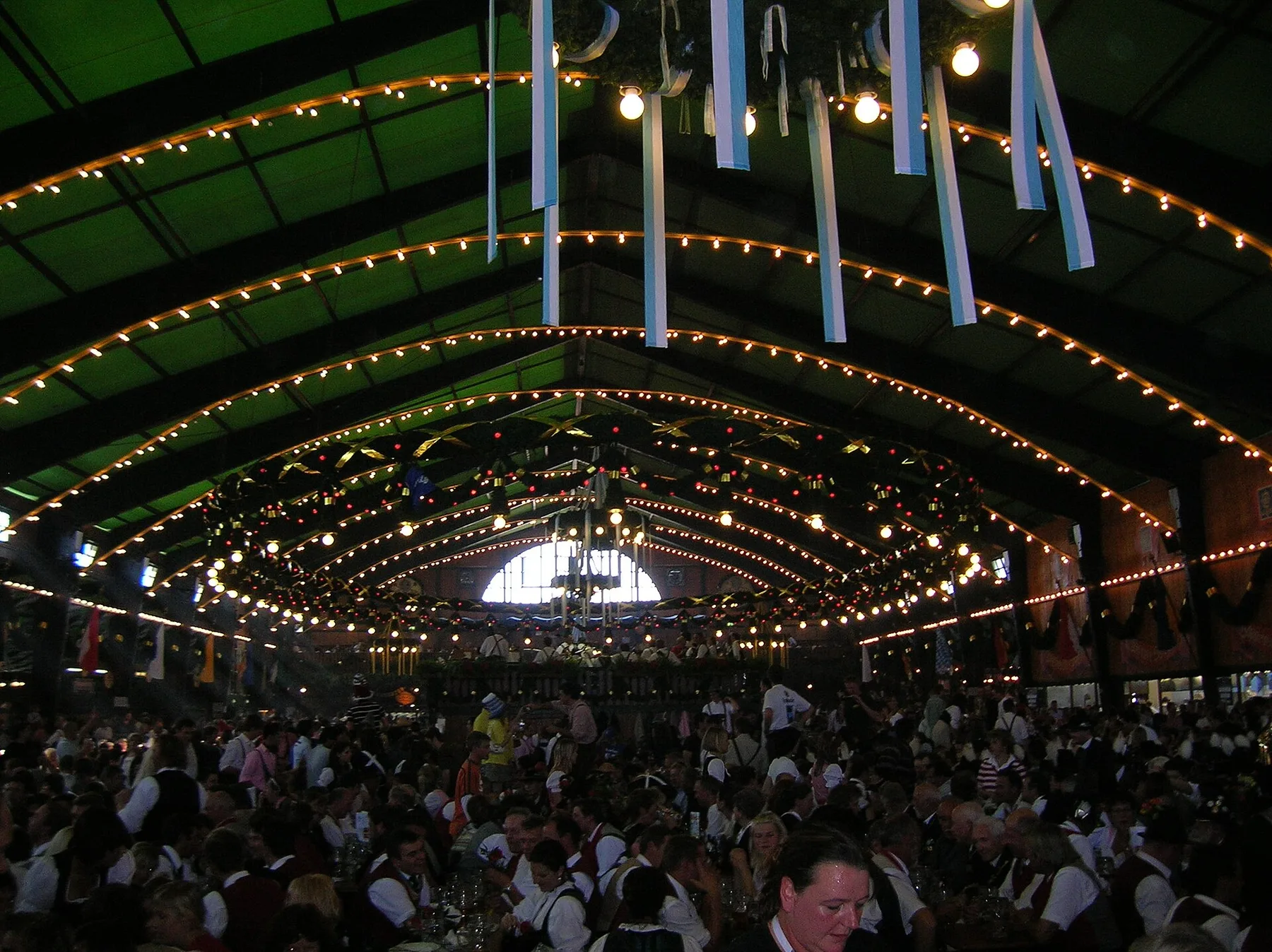
There’s a real hygiene angle behind glass mugs, not just a modern cost argument: Munich’s own Oktoberfest switched to glass mugs back in 1892 for sanitary reasons, and ordinary German beer mugs used for daily drinking today are typically glass rather than stoneware or pewter. A cheap glass mug bought in bulk isn’t a compromise version of a “real” stein — it’s the material most German beer drinkers actually use.
The honest limitation: glass won’t read as traditional the way a pewter-lid stein does, and it’s the most breakable option here if it gets dropped or someone bangs it too hard during a toast.
Classic pewter-lid stein
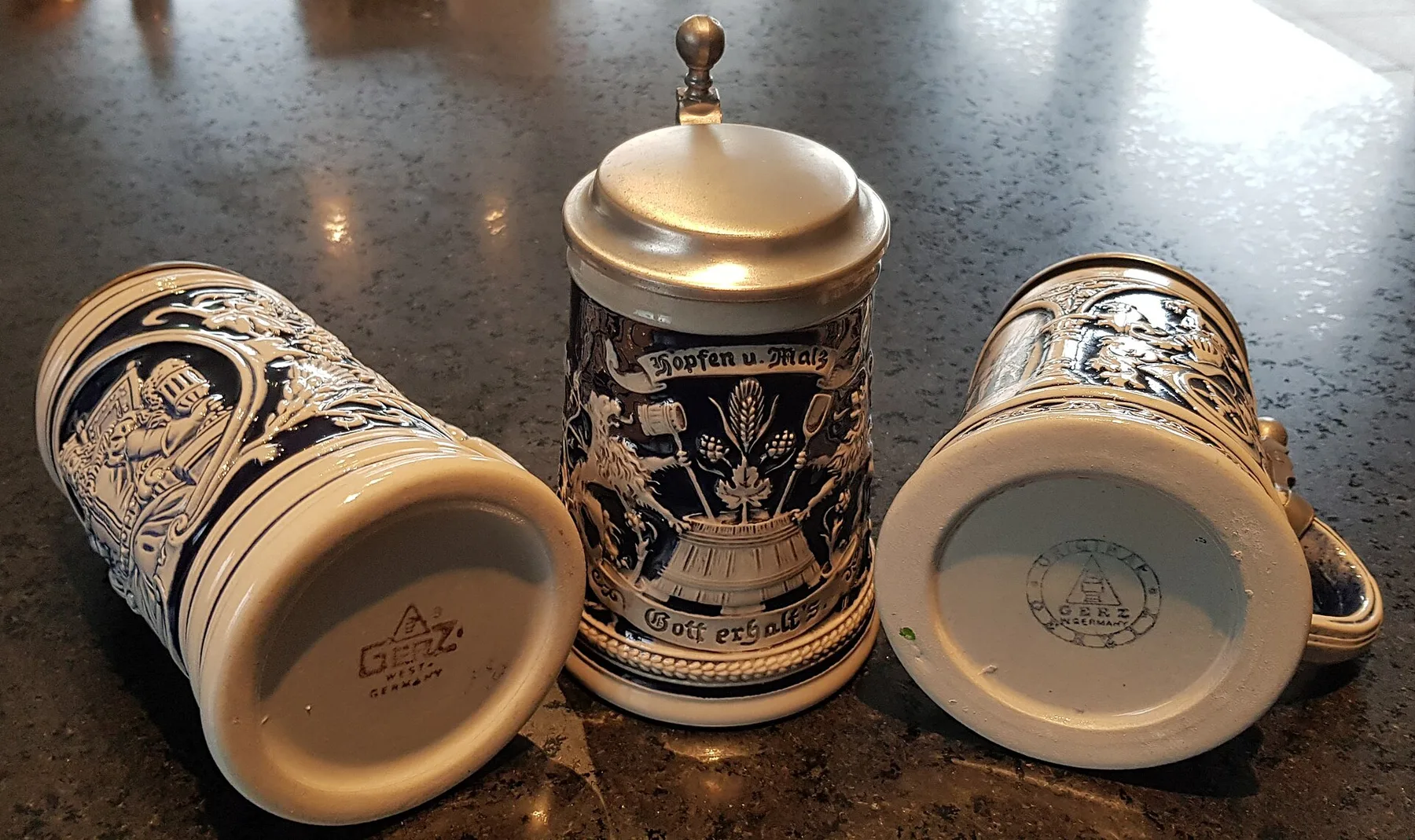
What it’s for: the look most people actually picture when they hear “German beer stein” — a hinged, thumb-operated pewter lid, an etched or embossed stoneware or ceramic body, and the traditional silhouette that reads as authentic rather than novelty.
The lid is the defining feature, and its purpose is consistently described the same way across historical and reference sources: keeping insects and debris out of an open drinking vessel. Modern pewter-lid steins keep the same hinge-and-thumb-lift design largely because that hygienic function became a fixed part of what a “real” stein looks like, even in a kitchen where the original problem no longer applies. (More on where that lid tradition actually comes from — including the part of the story repeated as fact more often than it should be — in the next section.)
Because the lid and body are usually different materials, care is simpler than the mixed guidance on plain stoneware or glass: sources agree that anything with a pewter lid or pewter body should be hand-washed, full stop, since dishwasher heat and detergent can damage pewter’s finish and degrade decoration on the body over time. That’s not a minor footnote — it’s the single most consistent piece of care guidance across every source checked for this article.
The honest limitation: this is the least practical category for daily use of the five. Hand-wash-only care and a heavier build than a plain glass or stoneware mug make it a better fit for occasional or ceremonial use — a holiday table, a themed party where it’s the centerpiece, a gift — than for a mug that gets run through the dishwasher every night.
Personalized gift stein
What it’s for: buying for a specific person rather than a general use case — a wedding, a retirement, a graduation, a German-heritage gift for someone who already knows what a stein is supposed to look like.
An engraved name, date, or short message is what separates a gift stein from the other four categories. Inspect current personalized stein options(paid link) only when the date leaves enough margin to verify the proof and delivery estimate. The underlying material and care guidance still apply after personalization.
The practical thing to check before buying is the seller’s stated engraving and dispatch time. Personalization adds a production step, but the actual lead time belongs to the listing; do not infer it from the category alone.
Collector’s display stein
What it’s for: a piece bought to be looked at, not used — a shelf, a cabinet, a themed collection — where rarity and craftsmanship matter more than capacity or dishwasher safety.
Collectible and antique stein value runs on a different set of criteria than the other four categories. Production rarity or a limited, numbered run matters. Identifiable maker marks matter — the Villeroy & Boch/Mettlach castle mark and post-1892 “Germany” export stamps are two examples specialty sources point to because they help authenticate where and roughly when a piece was made. Craftsmanship matters: hand-painted, etched, or sculpted work is treated as more collectible than a mass-produced, screen-printed souvenir piece. And condition matters as it does for any collectible — chips, repairs, and a replaced or mismatched lid all reduce value.
The honest limitation: none of the everyday-use criteria from the first category apply here, and that’s the point. A collectible piece is judged on the same terms as any other collectible object, not on capacity, dishwasher safety, or how it holds up to daily handling.
Where the pewter-lid tradition actually comes from
It’s worth pausing on the lid specifically, because most articles about beer steins repeat one version of its origin as flat fact, and that version deserves more scrutiny than it usually gets.
The story goes like this: during and after the Black Plague, flies swarmed the huge numbers of corpses across Europe, and German cities responded by passing laws requiring that food and drink containers be covered — which is supposedly why steins got hinged lids in the first place. It’s a tidy story, and it shows up on museum pages and specialty retail sites alike, often stated without any hedge at all.
The trouble is the timeline. The Black Plague swept Europe roughly between 1340 and 1380. The covered-container laws that multiple stein-history sources actually cite were passed by various German principalities in the early 1500s — over a century later, following reported fly infestations closer to the late 1400s. Wikipedia’s entry on the beer stein states plainly that the plague-linked version of the story is “unlikely to be true,” for a more fundamental reason than the timing gap: people in that era didn’t understand that insects transmit disease in the first place, so a law passed specifically to stop plague-carrying flies doesn’t fit what anyone at the time actually believed about how disease spread. Even beerstein.net — a specialty stein-history site that otherwise tells a version of the fly-law story — includes a footnote acknowledging that “some question exists” about whether covered-container laws actually caused the lidded stein, or whether the timeline just happens to line up with a design that was becoming customary anyway.
What’s on firmer ground: hygiene-motivated covered-container laws in German cities in the early 1500s are cited repeatedly enough across sources to treat as a real, recurring account, even without a primary legal text turned up in this research pass. The practical function of the lid — keeping insects, dust, and debris out of an open vessel — is consistent across every source checked, regardless of which version of the backstory they tell. What isn’t well supported is the specific, dramatic causal chain from “Black Plague” to “pewter lid law,” which conflates two events roughly 130 years apart and assumes a level of germ-theory understanding that didn’t exist yet. Treat the plague-and-flies version as a popular legend worth knowing, not as documented history — the more defensible version is that covered drinkware became a sanitary norm in German cities in the 1500s, for reasons that predate any real understanding of why it helped.
Side-by-side comparison
The five categories trade off in predictable, consistent ways. Here’s how they compare on the criteria that actually separate them — not on brand or price, which vary too much by specific listing to compare fairly at the category level.
| Category | Primary material | Dishwasher-friendly | Traditional look | Best for |
|---|---|---|---|---|
| Everyday drinking stein | Stoneware or ceramic | Often, if plain and undecorated — check the listing | Moderate | Regular home use over years |
| Casual party mug | Glass | Most consistently dishwasher-tolerant of the four drinkable categories | Low | Hosting a group; cheap, replaceable |
| Classic pewter-lid stein | Stoneware/ceramic body, pewter lid | No — hand wash only | Highest | Occasional or ceremonial use, themed gatherings |
| Personalized gift stein | Varies (usually stoneware, ceramic, or pewter-lid) | Depends on base material — same rules as above apply | Moderate to high | A specific person and occasion |
| Collector’s display stein | Varies; often porcelain, ceramic, or pewter | Not applicable — not meant for regular washing or use | Highest (or deliberately artistic) | Shelf display, not daily use |
No category wins across every column, and that’s the actual finding here: “best beer stein” isn’t a single ranking, it’s five different shopping problems that happen to share a product name.
Current offers
Current stein categories to compare
Browse Ceramic Beer Steins
Search Amazon for ceramic beer steins and compare capacity, detail, dishwasher safety, and seller.
Browse Dimpled Glass Beer Mugs
Search Walmart for dimpled glass beer mugs and compare capacity, set size, and seller.
Browse Pewter-Lid Beer Steins
Search Amazon for pewter-lid beer steins and compare capacity, lid hinge quality, and painted detail.
Browse Personalized Engraved Beer Steins
Search Amazon for personalized or engraved beer steins and compare turnaround time, capacity, and base material.
Browse Collectible Display Steins
Search Walmart for detailed collectible beer steins and compare relief detail, size, and fragility.
Editor’s spotlight
Traditional-style spotlight: pewter-lid stein
Choose this for the distinctive silhouette, not for dishwasher convenience. Verify the maker's current material and care instructions.
Browse Pewter-Lid Beer Steins
Search Amazon for pewter-lid beer steins and compare capacity, lid hinge quality, and painted detail.
Stein category tradeoffs
| Criteria | Primary job | Care | Main limitation |
|---|---|---|---|
| Ceramic or stoneware | Regular use | Follow maker guidance | Heavier than glass |
| Glass mug | Serving a group | Varies by decoration | More fragile |
| Pewter-lid stein | Traditional styling | Usually hand wash | Mixed-material care |
| Personalized stein | Gift | Depends on base item | Production lead time varies |
| Collectible | Display | Conservation over convenience | Requires documentation |
A pewter-lid stein is a good fit when
Best for
- The traditional silhouette is the main goal
- Hand washing is acceptable
- The listing clearly states lid and body materials
Not for
- Dishwasher convenience is essential
- You need several inexpensive mugs for a crowd
- The material description is vague
The offer block uses current registered catalog entries, but the decision still begins with the category. Confirm material, capacity, care guidance, seller and availability on the live listing before buying.
Methodology

This roundup is built on published stein-history, material, and care guidance, not on MottoFox purchasing and hand-testing a specific stein in each category. Being direct about that distinction matters more than implying otherwise.
What we drew on:
- Specialty stein retailer and reference guidance. Buying guides and FAQs from stein-focused retailers describe material differences (stoneware, ceramic, glass, pewter) and care requirements in reasonably consistent terms, though not perfectly consistent with each other — where sources disagreed, we said so rather than picking the more convenient version.
- General reference and stein-history sources. A general encyclopedia entry, a university museum’s object description, and a specialty stein-collecting site were checked against each other for the lid’s origin story, terminology, and the 1892 switch to glass mugs at Munich’s Oktoberfest. Where sources disagreed on how confidently to state the lid’s origin, we followed the more skeptical, better-supported account.
- Collector-specific guidance. A specialty stein-collecting reference explains what drives collectible value — rarity, maker marks, craftsmanship, condition — a different set of criteria than the material and care guidance used for the drinkable categories.
- Current FTC endorsement guidance and MottoFox’s own commerce policy, which shape how this article discloses that its recommendations are category-level judgments rather than hands-on product tests.
Limitations, stated plainly:
- This is category-level editorial judgment, not a hands-on comfort or durability test of specific purchased steins.
- Care and dishwasher-safety guidance is not fully consistent across sources, especially for plain glass and stoneware without decoration — check the specific product listing rather than assuming a blanket rule.
- The covered-container-law backstory for the pewter lid is repeated widely but not confirmed against a primary historical or legal source in this research pass; it’s presented here as a commonly cited but not fully verified account, and the more dramatic plague-and-flies version specifically is flagged as disputed.
- Exact capacity, current stock, material specifics, and pricing always need to be confirmed on the actual product page before buying, not assumed from category-level guidance.
How the stein categories were evaluated
Use-case fit
40%Each category was judged against the job it is supposed to perform.
Material and care evidence
35%Specialty care guidance informed cleaning and mixed-material cautions.
History and collecting context
25%Museum, reference and collecting sources informed terminology, lid history and collectible criteria.
Limitations
- No specific stein was purchased or tested.
- Dishwasher guidance varies by maker and decoration.
- The popular plague-and-flies lid origin remains disputed.
- Current material, capacity, seller and price require live verification.
MottoFox does not claim to have purchased or hand-tested any specific stein referenced in this guide. Recommendations reflect category-level research and are disclosed as such, consistent with FTC guidance on endorsements and with MottoFox’s own commerce policy of keeping recommendations reader-first rather than testing-based when no real testing occurred.
Verdict
Verdict
Choose the job before the stein
Plain ceramic or stoneware suits regular use, glass works for serving a group, a pewter lid provides a traditional look with more care, personalization serves a gift, and collectible pieces require documentation rather than drinking features.
Shop within the category that matches the actual use, then verify the maker's material and care instructions.
- Mixed-material and decorated pieces often require hand washing.
- A collectible should not be evaluated as ordinary drinkware.
If you’re choosing one default, choose based on what you’re actually going to do with it, not on which stein looks the most “authentically German” in a product photo. For a stein you’ll reach for regularly, a plain stoneware or ceramic piece is the strongest everyday pick — durable, reasonably easy to care for, and not precious about being used. For a party, cheap glass mugs bought in a set beat a single premium piece every time, because the job is serving a group and surviving cleanup, not impressing anyone.
Choose differently when a specific priority overrides “most practical.” If the traditional pewter-lid look matters to you — for a themed gathering, a heritage connection, or just because that’s the image you actually want on your table — accept the hand-wash-only care as the cost of that look, and don’t expect to run it through the dishwasher like an everyday mug. If you’re buying for a specific person and occasion, a personalized stein solves a gift problem the other categories don’t, but order early enough to allow for engraving time. And if the goal is a shelf piece rather than a drinking vessel, judge it as a collectible — rarity, maker marks, craftsmanship, condition — not as drinkware, and don’t expect it to double as either.
Frequently asked questions
Are pewter-lid beer steins dishwasher safe? Treat a pewter lid or body as hand-wash-only unless the maker explicitly says otherwise. The care sources checked warn that dishwasher heat and detergent can damage pewter finishes or decoration. A plain glass or stoneware piece may be easier to clean, but its own instructions still control.
Is it true that beer stein lids were invented because of the plague and flies? That’s the popular version, but it’s disputed, not confirmed. The dramatic telling links hinged lids directly to Black Plague-era hygiene laws, but the plague dates to roughly 1340–1380, while the covered-container laws sources actually cite were passed in German cities in the early 1500s — over a century later — and people of that era didn’t yet understand that insects spread disease. The better-supported account is simply that covered drinkware became a hygiene norm in German cities in the 1500s; treat the plague-and-flies version as a widely repeated legend, not settled history.
What’s the difference between a stoneware, ceramic, glass, and pewter stein? Stoneware and ceramic are fired at high heat, making them non-porous, durable, and reasonably chip-resistant, though heavier than glass. Glass is lightest and most likely to be dishwasher-tolerant, but the most fragile under repeated daily use. Pewter is very durable and hard to break, but heavier, more ornamental, and hand-wash only. Most traditional steins combine a stoneware or ceramic body with a pewter lid, which is why the lid — not the whole stein — usually determines the care instructions.
What makes a beer stein a good gift? Personalization: an engraved name, date, or short message that makes it specific to the recipient rather than a generic purchase. Order earlier than you would for an in-stock item, since engraving adds production time.
What should I look for in a collectible or display stein? Rarity or a limited, numbered production run; identifiable maker marks (the Villeroy & Boch/Mettlach castle mark and post-1892 “Germany” export stamps are two worth recognizing); hand-painted, etched, or sculpted craftsmanship rather than mass-produced screen printing; and overall condition, including whether the lid is original. None of that overlaps with what makes a stein good for everyday drinking, which is why a collectible pick and an everyday pick are different recommendations, not the same stein in a nicer box.
For the rest of an Oktoberfest table or outfit, see MottoFox’s guides on Oktoberfest party ideas and what to wear to Oktoberfest.
Frequently asked questions
Common questions
Are pewter-lid beer steins dishwasher safe?
Treat them as hand-wash-only unless the maker explicitly says otherwise. Mixed materials and decoration can be damaged by dishwasher heat or detergent.
Were stein lids invented because of the plague?
The direct plague story is disputed. Covered drinkware became associated with hygiene, but the dramatic causal account should not be presented as settled history.
What makes a stein collectible?
Maker marks, rarity, craftsmanship, condition and whether the lid and body belong together matter more than drinking capacity.