
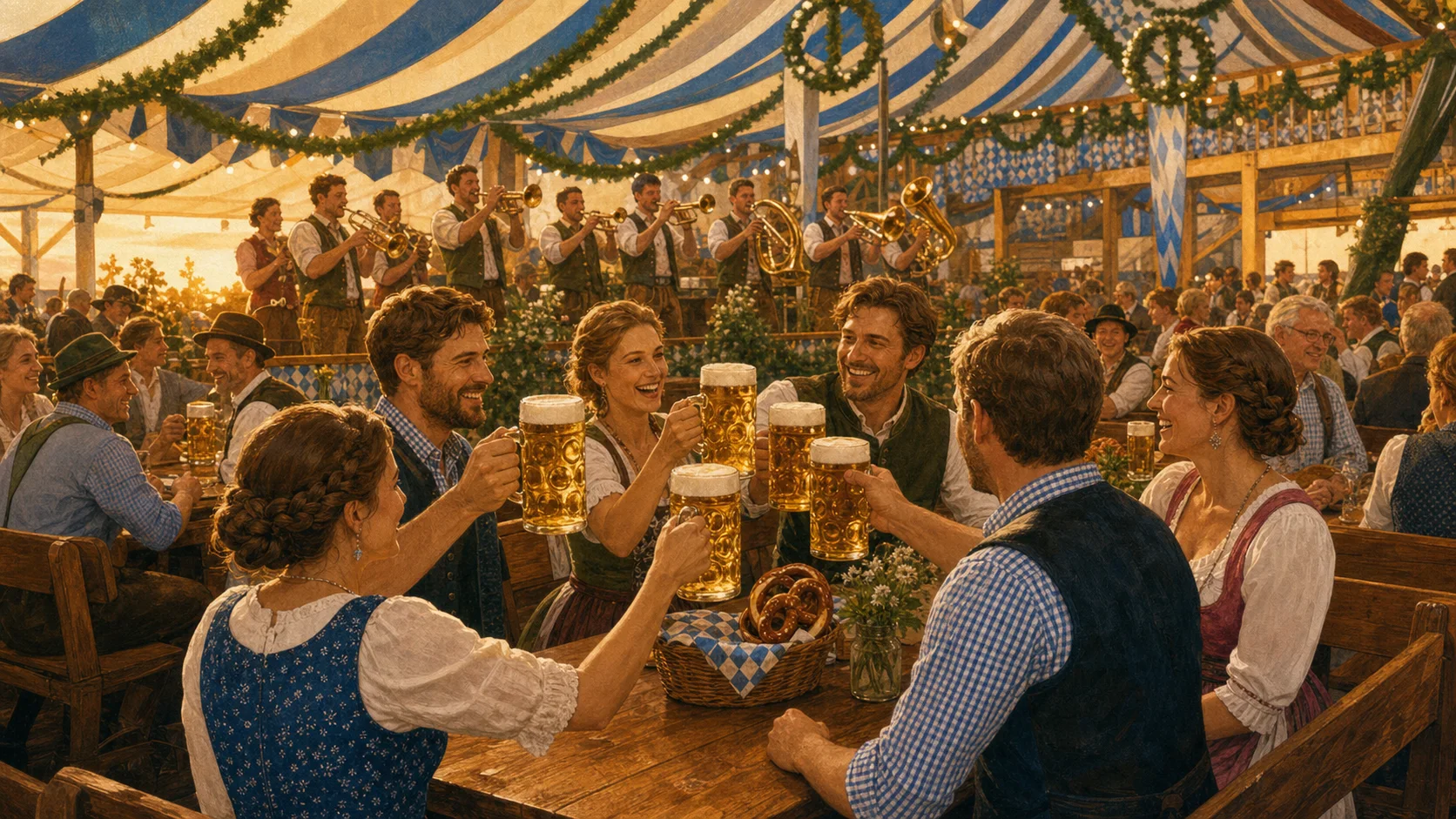
On this pageThe opening keg tap
Oktoberfest may look like one enormous party, but the day has a rhythm to it.
There is a moment when the festival officially begins. There are songs everyone recognizes, tables shared by strangers, clothes worn with pride, and small habits that make a crowded tent feel less chaotic than it should.
Those are the traditions that hold the whole thing together.
Four terms behind the traditions
- Wiesn
- Local shorthand associated with the Theresienwiese grounds and Oktoberfest.
- Tracht
- Traditional regional clothing, including forms of lederhosen and dirndl.
- Maß
- A one-liter serving measure and the mug associated with Oktoberfest beer.
- Gemütlichkeit
- A sense of warmth, ease, good company, and belonging.
How familiar Oktoberfest traditions took shape
The first celebration
A public celebration and horse race for a royal wedding created the origin story of Oktoberfest.
The festival becomes more organized
Processions, larger tents, music, and civic ceremony became more visible parts of the event.
The mayoral keg tapping begins
The first official mayoral tapping established the opening ritual and famous announcement.
Tradition and adaptation coexist
Tracht, music, shared tables, food, rides, and family programs remain part of a changing public festival.
Tradition does not mean every custom is ancient
Every familiar Oktoberfest ritual dates to 1810.
Specific practices developed at different times.
The official mayoral keg-tapping tradition dates to 1950.Everyone must wear Tracht.
Tracht is widely worn and meaningful, but respectful ordinary clothing is also accepted.
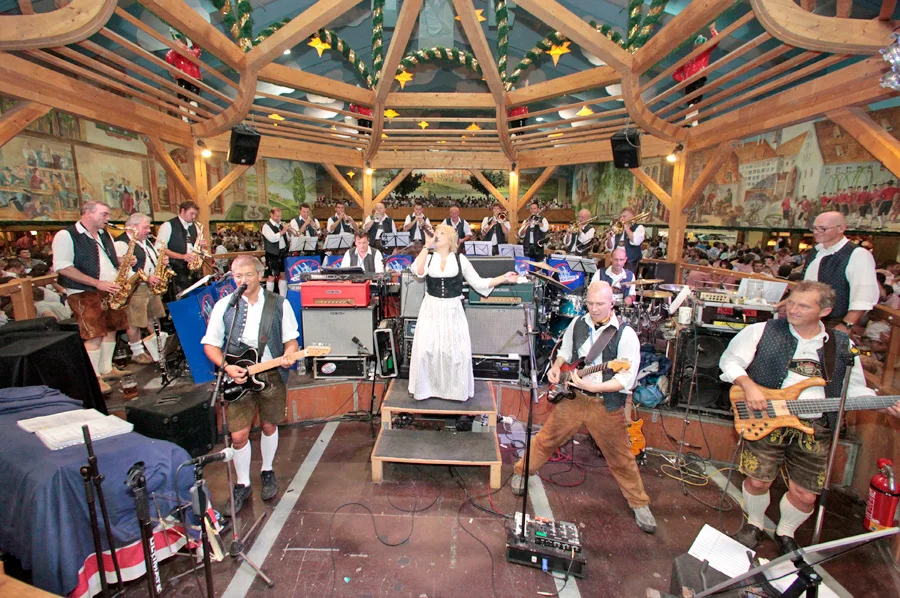
The opening keg tap
Oktoberfest does not officially begin until the first keg is tapped.
On opening day, the mayor of Munich performs the ceremony and calls out:
O’zapft is!
The Bavarian phrase means, roughly, “It is tapped.”
The moment is brief, but it matters. Before the announcement, the festival is waiting. After it, the first beer can be served and the celebration is underway.
The ceremony is one of the clearest examples of how Oktoberfest turns an ordinary action into a shared ritual. Opening a keg is simple. Opening the festival in front of a waiting crowd is something else entirely.
The opening-day parades
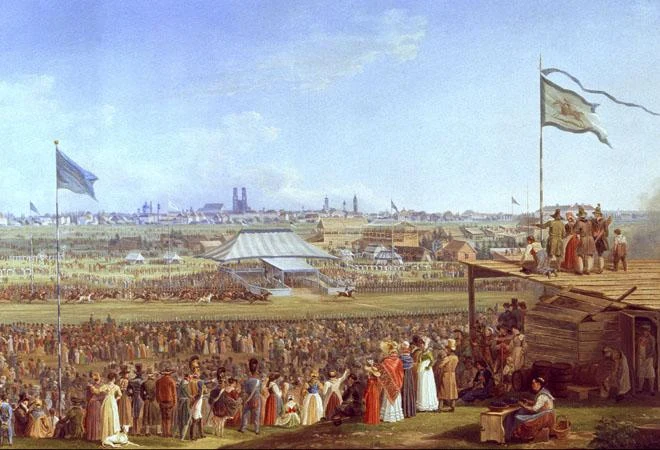
The first weekend is also shaped by processions and ceremonial arrivals.
Decorated horse teams, brewery wagons, bands, traditional clothing groups, and festival hosts help mark the beginning of the season. The parade connects the modern event to older Bavarian civic and regional traditions.
For visitors, it is also a reminder that Oktoberfest is not contained inside the beer tents. The festival begins in public, with people, music, uniforms, wagons, and streets becoming part of the occasion.
You do not need to understand every symbol to appreciate what is happening. The parade says, in a very visible way: the city is ready.
Shared tables inside the beer tents
Long communal tables are one of the most important Oktoberfest customs.
Guests often sit shoulder to shoulder with people they did not arrive with. A table may include local families, travelers, old friends, and someone who only asked whether the seat was free.
That closeness is not an accident. It shapes the whole mood.
At a shared table:
- Food is passed across
- Glasses are raised together
- Conversations begin quickly
- Songs spread from one group to the next
- Personal space becomes a little more negotiable
The unwritten rule is simple: make room when you can.
Oktoberfest works best when the table feels shared rather than claimed.
“Ein Prosit” as a group ritual
Several times during the day, the band begins the short toasting song:
Ein Prosit der Gemütlichkeit
The exact wording matters less than what happens next.
People stop talking, turn toward the music, join in where they can, raise their glasses, and toast together.
That repetition gives the tent a pulse. A room full of separate conversations becomes one crowd for a few seconds, then returns to normal until the next round.
The phrase is often translated as a toast to warmth, good company, and togetherness. The German word Gemütlichkeit carries more feeling than one English word can comfortably hold.
For pronunciation, meaning, and more useful festival phrases, see Funny Oktoberfest Sayings, Toasts & What “Prost” Means.
Saying “Prost” and making eye contact
When glasses are raised, Prost is the everyday word for “cheers.”
Many people also make eye contact during the toast. It is a small gesture, but it turns a room-wide ritual into a personal one.
You do not need to perform it perfectly. Lift the glass carefully, acknowledge the people around you, and avoid swinging a one-liter mug as if it were an empty paper cup.
A Maß has weight before the beer is added. Afterward, it has opinions.
Wearing Tracht
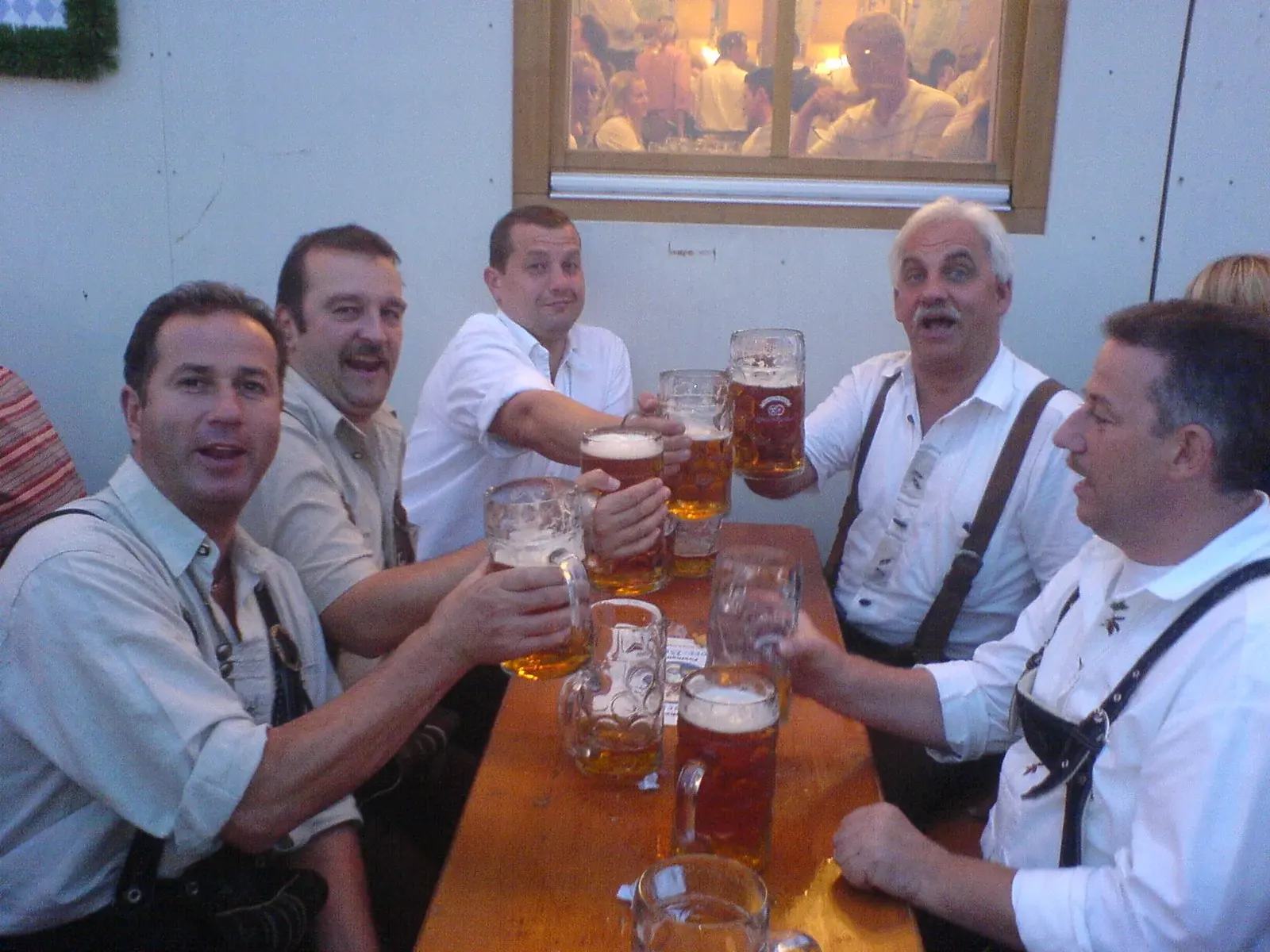
Traditional Bavarian clothing is one of the most visible parts of Oktoberfest.
Men may wear lederhosen. Women may wear dirndls. Together, these forms of regional dress are commonly described as Tracht.
For many wearers, Tracht is not a one-day costume. Good pieces may be chosen carefully, fitted properly, and worn across many festivals, weddings, family occasions, and community events.
Visitors are welcome to wear Tracht when they understand what they are buying and wear it respectfully. They are also welcome to attend in ordinary clothing.
The important distinction is not traditional versus casual. It is respect versus imitation.
Our Oktoberfest Outfit Guide explains both routes without treating one as a joke and the other as a requirement.
The Maß and the pace of the day
Visitors who want one respectful visual connection can compare a blouse-style top or suspenders without presenting either as a requirement. Authentic Tracht has regional context; broad merchant results should be judged by construction, fit, seller, and the setting where they will be worn.
Browse Women's Lace Oktoberfest Blouses
Search Amazon for lace and puff-sleeve blouses that can be used in dirndl-inspired or casual festival outfits.
Best for: Women who want one dirndl-inspired element without buying a full outfitBrowse Blue-and-White Oktoberfest Suspenders
Search Walmart for blue-and-white diamond-pattern suspenders suitable for casual and traditional-looking outfits.
Best for: Men and women who want a stronger visual than socks but less commitment than a costumeBeer at Oktoberfest is commonly served in a one-liter mug called a Maß.
The mug is part of the visual language of the festival. It appears in songs, photographs, contests, and nearly every crowded table.
It is also a full liter.
That is why pacing is part of the tradition whether people talk about it or not. Food, conversation, music, and long breaks between drinks all help shape the day.
A Maß is not a race. The festival lasts longer than the first toast.
Food as part of the ritual
Oktoberfest food is not a side note to the beer.
Pretzels, roast chicken, sausages, pork dishes, potato sides, cheese spreads, and cabbage dishes give the table its center.
People order, share, wait, talk, and eat between songs. The meal slows the day down and gives everyone something to do besides lift another glass.
Some dishes are practical. Others carry memory.
For Bavarian families and German-American communities alike, a familiar smell or recipe can connect the festival to home more quickly than any decoration.
Our Traditional Oktoberfest Food guide covers the best-known dishes and a simple menu for hosting your own gathering.
Music that changes the room
Music at Oktoberfest is not background noise.
Bands guide the mood from traditional brass and folk songs to familiar party music later in the day. Guests may sing from their seats, stand for a toast, or join a chorus they only half remember.
The best moments are not always the most polished ones.
A whole tent singing the same line slightly differently can still feel more unified than a perfect performance on a quiet stage.
Music turns the crowd into participants. That is one reason the same songs return year after year.
Dancing, standing, and knowing the limits
As the day becomes livelier, people may stand on benches to sing and dance.
That does not mean every surface is fair game.
Tables are for food, drinks, and the people trying to keep both upright. Benches are the safer place to stand when the atmosphere allows it.
The basic custom is common sense:
- Do not block servers
- Do not climb where you should not
- Do not turn a crowded table into your private stage
- Pay attention to the mood around families and older guests
- Sit down before your balance begins making decisions for you
Festive does not have to mean careless.
Daytime family traditions
Oktoberfest is not only an evening drinking event.
During the day, families come for rides, food, music, parades, games, and the fairground atmosphere. Children may care far more about sweets and attractions than anything happening inside a beer tent.
Older relatives may prefer the daytime as well, when the grounds are easier to navigate and conversation requires less shouting.
The festival changes character over the course of the day. Morning and afternoon can feel more like a family fair. Evening becomes louder, denser, and more focused on the tents.
Choosing the right time is part of enjoying the tradition.
Customs visitors should respect
You do not need a rulebook, but a few habits make the experience better for everyone:
- Share table space when seating is tight
- Listen to servers and staff
- Raise a glass carefully
- Treat Tracht as traditional clothing
- Pace alcohol with food and water
- Keep aisles clear
- Join the songs without making fun of the language
- Remember that locals are attending their own festival, not performing one for tourists
The best visitor is curious without treating everything as a novelty.
Oktoberfest welcomes enthusiasm. It does not require pretending to understand more than you do.
Why these traditions last
A tradition survives because people repeat it together.
Someone learns when to stand. Someone else remembers the song. A child watches a parade, a parent orders the same dish as last year, and an older guest raises a glass before anyone has to explain why.
That is how a festival keeps its shape across generations.
The customs do not stay alive because they are displayed behind glass. They stay alive because people continue to use them.
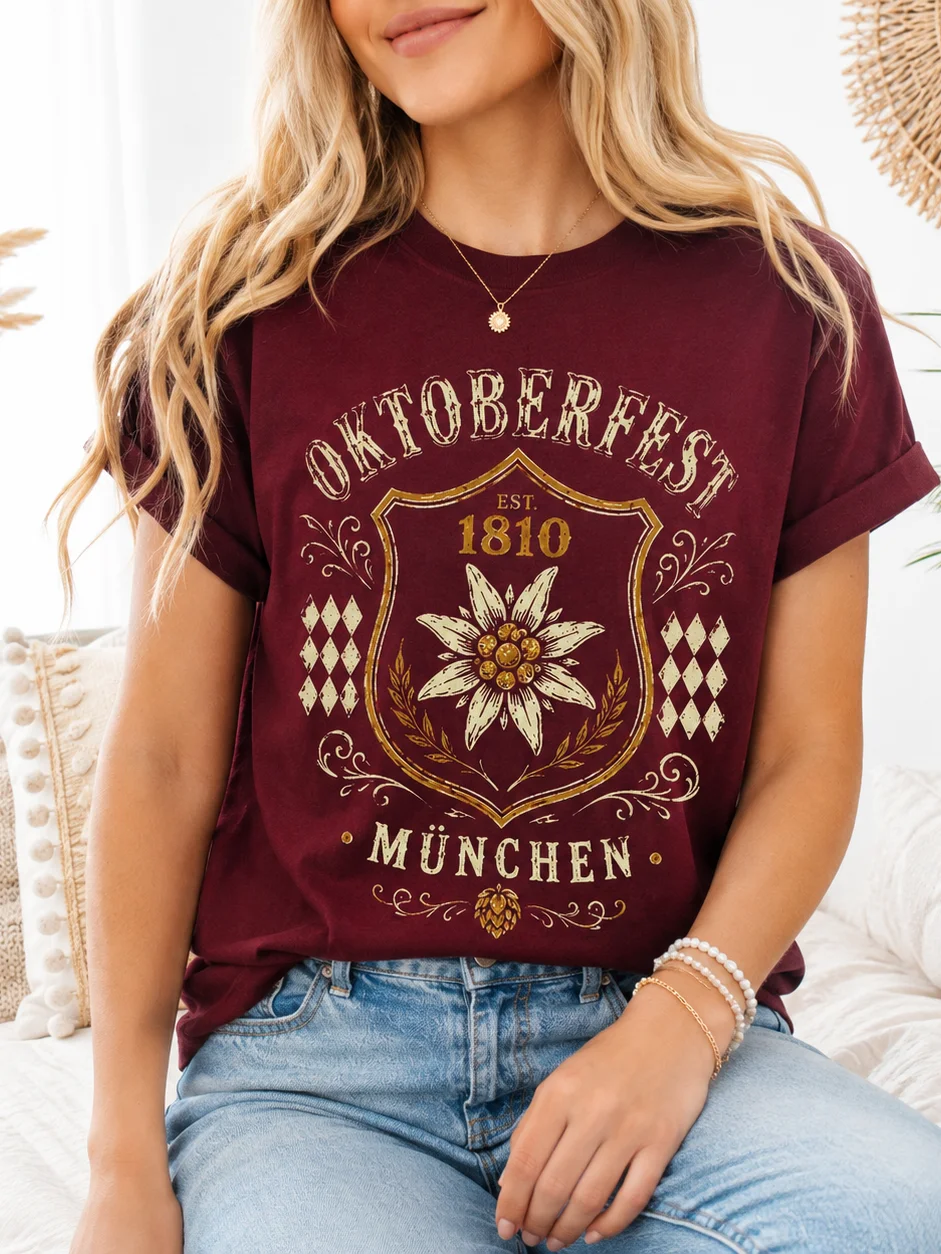
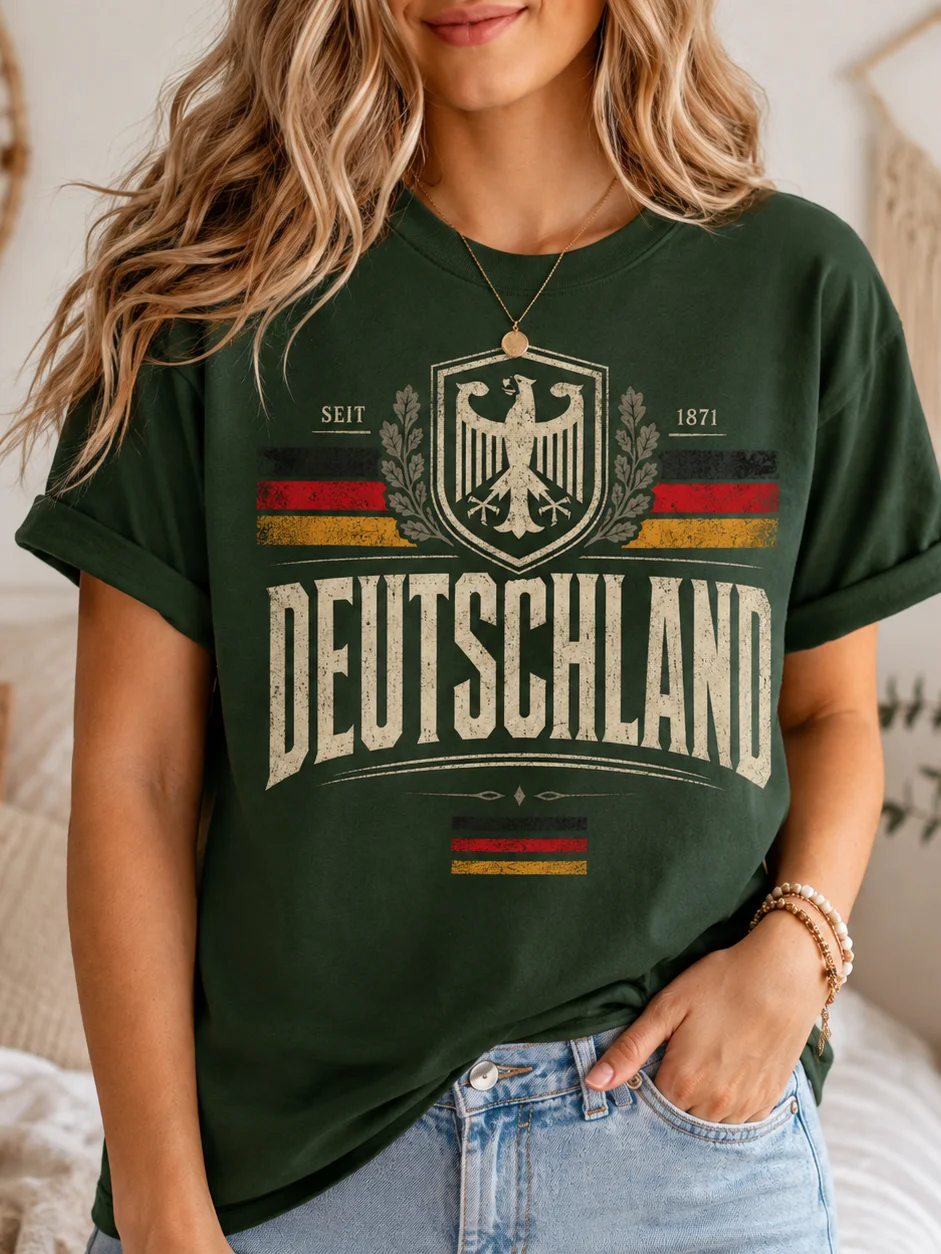
For anyone who wants to carry one small part of the celebration beyond the festival, a thoughtful German heritage design can keep the connection close without pretending the shirt is the tradition itself.
Browse Men's Bavarian-Style Checked Shirts
Search Amazon for checked shirts suitable for casual Oktoberfest outfits and traditional-looking layers.
Best for: Men who want a stronger Oktoberfest look without buying full TrachtBrowse Bavarian-Style Oktoberfest Hats
Search Walmart for blue-and-white, alpine, and Bavarian-style hats for Oktoberfest outfits.
Best for: A plain shirt-and-jeans outfit that needs one obvious festival cueFeatured German designs
Designs connected to German heritage
Wear the story with respect for the traditions, people and regional culture behind the celebration.
Frequently asked questions
Common questions
What does 'Prost' mean?
'Prost' means 'cheers.' At Oktoberfest it is said when glasses are raised, often after the band plays 'Ein Prosit.'
What is the Oktoberfest toasting song?
'Ein Prosit der Gemütlichkeit' is a short group toast to good company and togetherness. Bands play it throughout the day, and the whole tent is encouraged to join in.
What is a Maß?
A Maß is a one-liter beer mug. At Oktoberfest, it is part drink, part ritual, and part reminder to pace yourself.
Do you have to wear Tracht?
No. Lederhosen and dirndls are traditional and widely worn, but visitors can attend in ordinary clothing as well. Tracht should be treated as regional dress, not as a disposable costume.