
On this pageThe short answer
The best Oktoberfest accessory depends on how much of a statement you actually want to make, not on which item looks best in a product photo. A Bavarian-style hat gives the biggest visual change to a plain outfit. Blue-and-white suspenders add a traditional, recognizable shape without requiring lederhosen. German-color socks and traditional knee-high socks are quieter, more finishing-detail choices. An edelweiss pin is the smallest commitment and the easiest to keep wearing long after Oktoberfest ends. There is no single “best” accessory — there is a best accessory for how loud you want to be, how close to tradition you want to stay, and how often you expect to use it again.
This guide is not about how to build a coordinated group costume. If you’re assembling a look for a couple, family, or table of friends, our Oktoberfest costume ideas guide covers that ground already. This guide answers a narrower, more practical question: if you’re buying exactly one accessory, which category is actually worth the money, and why does that answer change depending on what you’re optimizing for?
The short answer
For most casual outfits, a Bavarian-style hat creates the most noticeable change for the least effort; browse current Bavarian-style hats(paid link) only after deciding that you want the accessory to lead the outfit. For readers who want something rooted in actual Bavarian dress rather than novelty costuming, blue-and-white suspenders or traditional knee-high socks worn with lederhosen come closer to genuine Tracht practice. Readers who want to keep the rest of their outfit completely ordinary do best with German-color socks, which stay hidden under pants until someone looks closely. And readers who want one small, reusable detail that outlives the festival should look at an edelweiss pin before anything else.
How we chose: scope and ranking criteria
How the accessory categories were judged
Visibility
How much the piece changes a plain outfit at normal viewing distance.
Traditional fit
Whether the category supports documented Tracht styling or works mainly as festival novelty.
Reuse value
How naturally the item can return at another event or in ordinary wear.
Commitment
How much the accessory dictates the rest of the outfit.
This roundup covers five accessory categories that MottoFox already tracks for Oktoberfest shopping: Bavarian-style hats, blue-and-white patterned suspenders, German-color crew socks, traditional knee-high Trachten socks, and edelweiss pins or brooches. We did not include full garments like lederhosen or dirndls — those get their own dedicated buying guides, linked below — and we did not include face paint, temporary tattoos, or plastic novelty items, which don’t hold up to the criteria below well enough to recommend.
We evaluated each category against four questions, in this order:
- Visibility and impact. How much does this accessory actually change the outfit at a glance? Something worn under pants and something worn on your head are not competing for the same job.
- Subtlety. Some readers want to be noticed. Others want one quiet detail and nothing more. Neither preference is wrong, but they call for different accessories.
- Traditional authenticity. Is this accessory grounded in real Bavarian dress — the kind described on Oktoberfest’s own visitor pages and in Trachtenschmuck (traditional costume jewelry) styling guidance — or is it closer to a generic festival novelty that happens to use Bavarian colors?
- Reusability beyond one event. Will this item plausibly get worn again — at a different festival, a themed party, or just as an everyday accessory — or is it functionally a single-use costume piece?
We are not ranking these five categories against each other on a single scale, because they are not solving the same problem. Instead, each category gets evaluated on its own terms, and the verdict at the end matches categories to the reader situations they actually fit.
A note on what “traditional authenticity” does and doesn’t mean here: none of the five categories below are formal Tracht in the way that a properly fitted dirndl or leather lederhosen are. Real Trachtenschmuck like an heirloom Charivari chain is historically a family piece, not something bought off a shelf, and Oktoberfest’s own guidance treats it as one of the more rustic, recognizable parts of a Wiesn outfit rather than as a costume accessory. What we’re actually comparing is how close each affordable, purchasable version comes to that tradition, and how far it drifts toward generic festival merchandise.
The five accessory categories, evaluated
Choose one accessory by the job
Bavarian-style hat
The fastest way to make a plain outfit read as festival clothing.
Suspenders or Trachten socks
Practical finishing pieces when they match the garment rather than generic novelty styling.
German-color socks
A casual national-color detail that should not be presented as Bavarian Tracht.
Edelweiss pin
A small Alpine motif that can move to a jacket, bag or hat after the festival.
The Bavarian-style hat: the most visible single choice
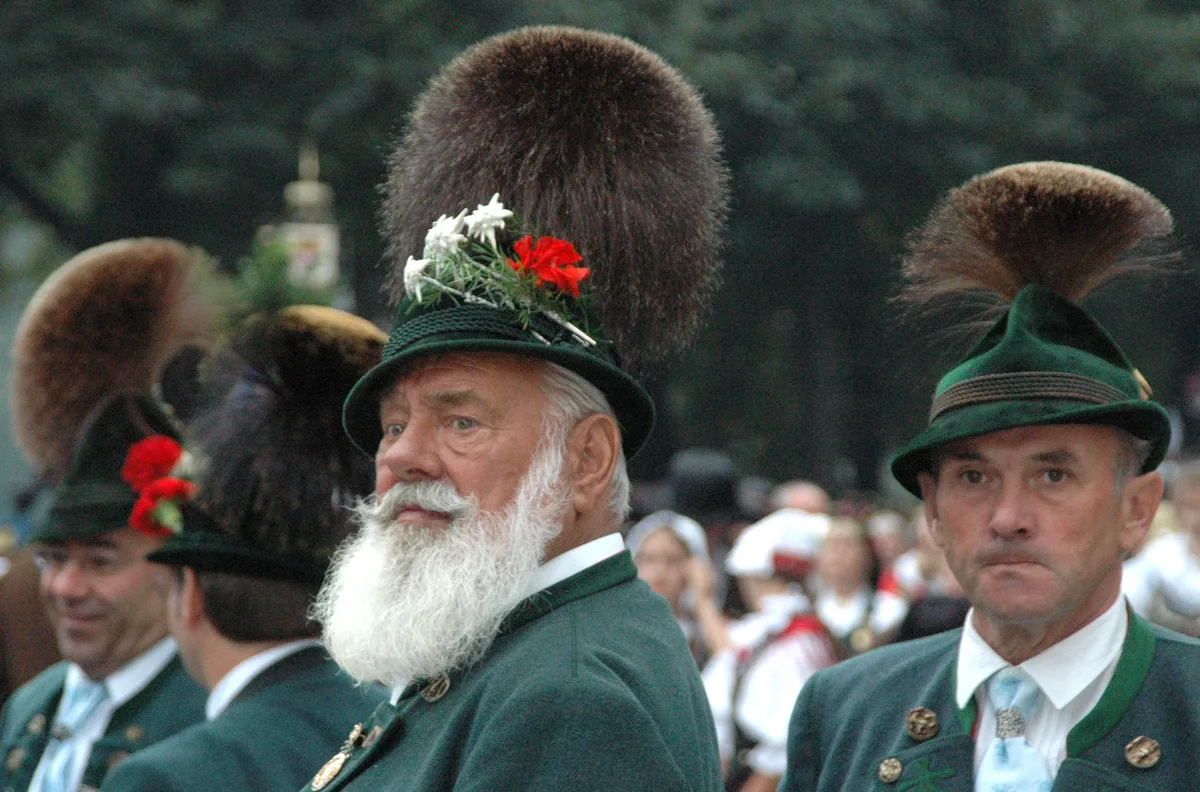
A blue-and-white or alpine-style felt hat is the fastest way to make a plain shirt-and-jeans outfit look Oktoberfest-ready. It doesn’t require any other wardrobe changes, and it’s the accessory most likely to register in a photo taken from across a beer tent. If the rest of the outfit is still undecided, settle that first with the practical what-to-wear guide so the hat does not compete with another statement piece.
Visibility and impact: highest of the five categories by a wide margin. A hat changes the silhouette and is visible from a distance, which matters if the goal is to look obviously festive without changing clothes.
Subtlety: lowest of the five. A hat is meant to be seen, and it will read as a deliberate costume choice rather than a quiet nod.
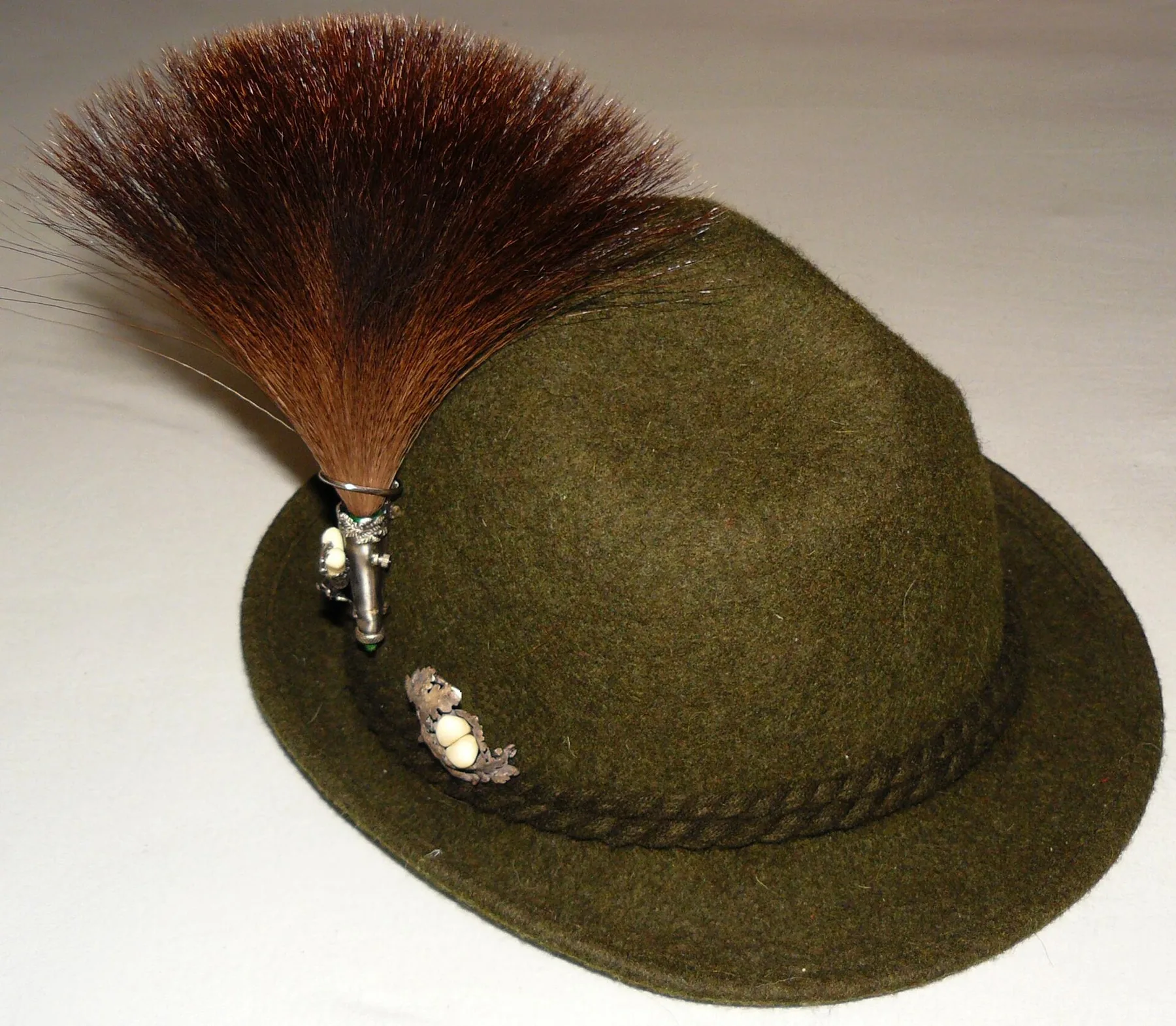
Traditional authenticity: mixed, and worth understanding before buying. The felt Trachtenhut is a real part of Bavarian dress, traditionally paired with lederhosen and sometimes finished with a hat pin or a Gamsbart tuft. But mass-market “Bavarian-style” hats sold for Oktoberfest costuming range from close approximations to bright novelty versions with printed patterns that a Bavarian retailer wouldn’t recognize as Tracht. Construction and material matter more here than in any other category on this list — a felt hat with a simple band reads differently than a stiff foam-and-plastic version.
Reusability beyond Oktoberfest: decent, if you buy a version sturdy enough to survive a closet for a year. A well-made hat works again at future Oktoberfest events, German heritage festivals, and general costume occasions. A flimsy one usually doesn’t survive to a second wearing.
Best for: readers who want the biggest visual return on one purchase and don’t mind being the most visibly “in costume” person in the room.
Blue-and-white suspenders: the traditional, structural choice
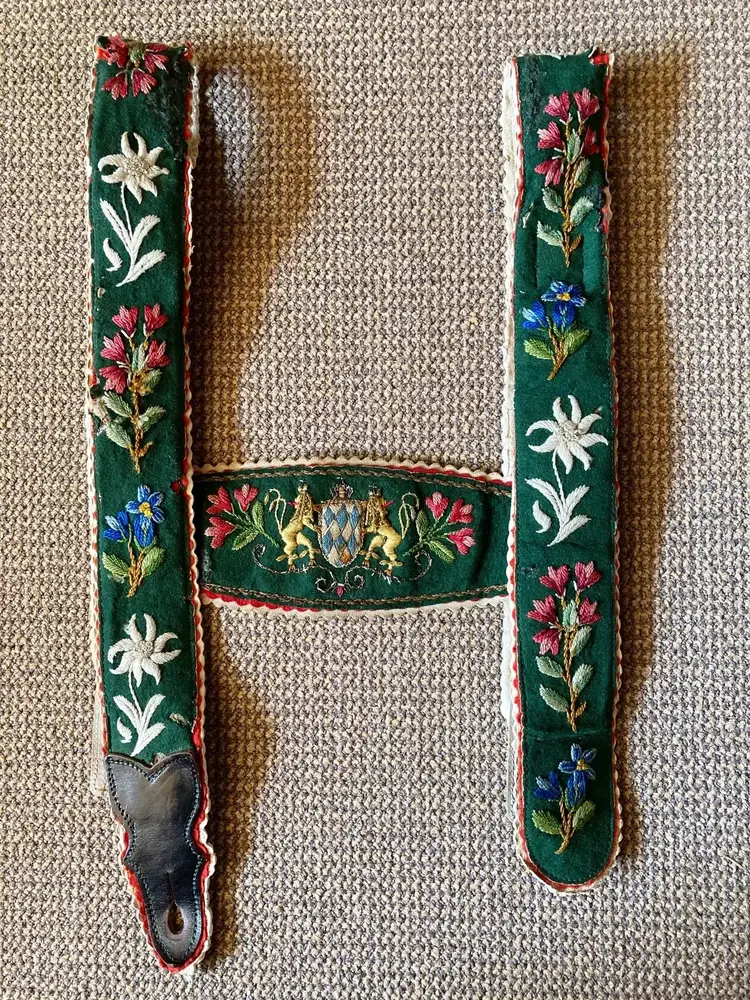
Patterned suspenders (Hosenträger in German) do double duty. Worn with lederhosen, they’re functional — genuine lederhosen are traditionally held up by suspenders rather than a belt. Worn over a plain shirt or T-shirt without lederhosen, they still read as a clear visual cue. Compare current patterned suspenders(paid link), then check how they work with the garment in the lederhosen buying guide.
Visibility and impact: high, though slightly less immediate than a hat. Suspenders change the vertical structure of an outfit and are easy to spot, but they read as “coordinated” rather than “costume” in a way a hat doesn’t.
Subtlety: moderate. They’re clearly a deliberate styling choice, not something you’d wear without noticing, but they don’t dominate an outfit the way a hat does.
Traditional fit: suspenders have a functional place in a lederhosen outfit, but the material and pattern matter. Bright blue-and-white costume suspenders should not be treated as equivalent to the leather or embroidered Hosenträger sold with traditional garments. For a casual outfit, judge them as a recognizable festival accent rather than proof of authenticity.
Reusability beyond Oktoberfest: good. Suspenders pack flat, work at any future festival with a similar theme, and don’t require any other specific garment to make sense.
Best for: readers who already have a plain shirt or lederhosen-style shorts and want a stronger visual than an accessory that hides under clothing, without going as far as a full costume.
German-color socks: the quiet option
Black, red, and gold crew socks are the accessory equivalent of a whispered detail rather than a stated one. Worn under jeans or chinos, they don’t change how an outfit reads at a glance — they reward someone who happens to notice.
Visibility and impact: low by design. This is the point, not a limitation. If the goal is visibility, this category is the wrong choice.
Subtlety: the highest of the five categories, alongside the edelweiss pin. Nobody sees German-color socks unless pant legs ride up or shoes come off.
Traditional fit: low. German flag colors signal a national theme, not specifically Bavarian Tracht. Treat these as casual novelty or heritage-themed socks, not as a traditional component of the outfit.
Reusability beyond Oktoberfest: very good. Ordinary crew socks in national colors work as everyday wear well outside festival season, which is unusual for anything on this list.
Best for: readers attending a work event, a family gathering with mixed enthusiasm levels, or any setting where an obvious costume piece would feel like too much, but who still want one small detail that’s genuinely theirs.
Traditional knee-high Trachten socks: the finishing detail
This is a different job from German-color socks, even though both are sock categories. Knee-high Trachten socks and Loferl calf warmers are sold as parts of lederhosen styling rather than as hidden novelty details. Exact combinations vary by garment and region, so match the sock to the lederhosen and shoe instead of treating one arrangement as a universal rule.
Visibility and impact: moderate, and highly conditional. On their own, with regular pants, they’re invisible. Worn with lederhosen shorts, as intended, they’re a necessary and noticeable part of a complete outfit — skipping them leaves a traditional look visibly unfinished.
Subtlety: low if worn as intended (with shorts), high if not visible at all (with pants). This category only makes sense for readers who are also wearing or planning to wear lederhosen-style shorts.
Traditional fit: stronger than the flag-color sock option when the socks are designed for Tracht and worn with lederhosen. The article does not rank one sock arrangement as universally correct because regional and outfit-specific practice varies.
Reusability beyond Oktoberfest: limited to occasions where lederhosen shorts are already part of the plan — future Oktoberfest events, German heritage festivals, or Bavarian-themed parties. They’re inexpensive, but they’re not a general-purpose wardrobe item the way German-color socks or an edelweiss pin can be.
Best for: readers who already own or are buying lederhosen shorts and want the outfit to look finished rather than half-assembled. This is not the right category for a casual, no-lederhosen outfit.
Edelweiss pin: the smallest commitment, the most reusable
A small edelweiss pin or brooch is the outlier on this list, and it earns its place for a specific reason: it’s the only category here that’s genuinely low-risk to buy, easy to wear anywhere, and just as much at home on a jacket collar in December as on a hat band in September.
The edelweiss itself carries real cultural weight in Alpine folklore — a flower historically associated with courage and devotion, traditionally sought out at real difficulty as a token between two people, and now protected across much of its range, which is part of why it shows up as embroidery, pins, and brooches rather than as an actual cut flower. That backstory is optional context, not a requirement — the pin works fine as a simple, tasteful detail even for someone who doesn’t know the folklore.
Visibility and impact: the lowest of the five categories. A pin is small by definition and won’t register from across a room.
Subtlety: very high, similar to German-color socks, but worn openly rather than hidden. It reads as “quiet detail” rather than “costume piece” even when visible.
Traditional fit: the edelweiss motif has documented Alpine symbolism and appears in contemporary Tracht jewelry and styling. That supports it as a culturally grounded motif, but the quality and context of an individual pin still determine whether it reads as jewelry or novelty merchandise.
Reusability beyond Oktoberfest: the best of the five categories, without much competition. A pin works on a jacket, a bag, a scarf, or a hat, in any season, for as long as the clasp holds up.
Best for: readers who want one authentic-feeling detail without committing to a hat, suspenders, or themed socks, and who would rather buy something they’ll actually keep using.
Methodology: how these were assessed
Current accessory categories to compare
Browse Bavarian-Style Oktoberfest Hats
Search Walmart for blue-and-white, alpine, and Bavarian-style hats for Oktoberfest outfits.
Browse Blue-and-White Oktoberfest Suspenders
Search Walmart for blue-and-white diamond-pattern suspenders suitable for casual and traditional-looking outfits.
Browse German-Color Crew Socks
Search Walmart for black, red, and gold crew socks that can add a subtle German detail.
Browse Traditional Knee-High Socks
Search Walmart for traditional knee-high socks suited to a lederhosen outfit and compare pattern, cuff style, and material.
Browse Edelweiss Pins and Brooches
Search Amazon for edelweiss-style pins and compare finish, size, clasp type, and seller.
Editor’s spotlight
Reusable spotlight: edelweiss pin
A small motif has the lowest outfit commitment and can move to a jacket, bag or hat after the event.
Browse Edelweiss Pins and Brooches
Search Amazon for edelweiss-style pins and compare finish, size, clasp type, and seller.
Accessory tradeoffs at a glance
| Criteria | Visual impact | Traditional fit | Reuse |
|---|---|---|---|
| Hat | High | Depends strongly on material and styling | Mostly festivals |
| Suspenders | Medium | Strongest with lederhosen | Outfit-specific |
| Socks | Low to medium | Depends on Tracht versus flag styling | Varies |
| Edelweiss pin | Low | Culturally grounded motif | High |
A themed accessory is useful when
Best for
- One item needs to carry the festival cue
- It completes a garment you already own
- You expect to reuse it
Not for
- Several loud accessories already compete
- The listing uses authenticity language without material detail
- The purchase exists only to fill space in the outfit
These recommendations are category-level editorial judgments, not the result of buying and testing every listing on the market. Nobody on the MottoFox editorial team wore all five accessory types side by side and rated them; that kind of individual-product testing isn’t something we claim, and we don’t want readers to assume it happened.
Instead, each category was assessed against the four criteria above — visibility and impact, subtlety, traditional authenticity, and reusability — using Oktoberfest’s own visitor-facing guidance on Tracht and accessories, historical and styling context on specific pieces like the Charivari chain and the edelweiss motif, and general Trachtenschmuck styling guidance on how traditional accessories are meant to be combined and scaled to an occasion. Where a claim about history, tradition, or styling appears in this article, it’s backed by one of those sources rather than asserted from general impression; the research sidecar for this article lists them individually.
This approach has real limits, and they’re worth stating plainly. Construction quality, sizing, colorfastness, and durability vary by specific listing and seller, sometimes significantly, even within the same accessory category. A “Bavarian-style hat” from one seller might be a well-made felt hat and from another might be a stiff, quickly-fading costume piece — the category judgment above doesn’t distinguish between individual listings, and readers should check current photos, materials, and reviews on the merchant page before buying. We also don’t have and don’t publish current pricing here, since prices, stock, and specific listings change independently of this article. Where MottoFox links to a retailer for one of these categories, that’s an affiliate relationship, disclosed per FTC guidance, and it doesn’t change which category we’d recommend for a given situation.
How the categories were evaluated
Reader job
40%Each item was judged on the specific outfit problem it solves.
Cultural grounding
35%Official Tracht context and sources on Charivari and edelweiss informed traditional-fit language.
Reuse and restraint
25%The review considered whether the item can be worn again and whether it competes with the rest of the outfit.
Limitations
- No individual accessory was purchased or wear-tested.
- Construction and colorfastness vary by listing.
- Current materials, sizing, seller and delivery terms require live verification.
Verdict
Verdict
Buy the smallest accessory that does the job
A hat creates the largest visual change, suspenders and Trachten socks make sense with lederhosen, German-color socks remain casual rather than traditional, and an edelweiss pin is the easiest choice to reuse.
Choose one main accessory first, then add another only when it completes a garment or practical need.
- Mass-market styling varies widely within every category.
- A motif or color does not by itself make an item authentic Tracht.
If you’re only buying one accessory and want the outfit to look obviously festive with the least effort, get the hat. If you want something closer to genuine Bavarian dress and don’t mind a moderate visual statement, get the suspenders — especially if lederhosen are already part of the plan, since traditional knee-high socks are the natural next purchase to finish that specific outfit. If you’d rather keep your outfit ordinary and add one detail only the observant will notice, get the German-color socks. And if you want the version of this decision that requires the least commitment and the most future use, the edelweiss pin is the easy answer: it’s small, it’s grounded in real Alpine symbolism, and it will still make sense on a jacket in a year when the festival shirts are in the back of a drawer.
None of these are wrong answers. They’re answers to slightly different questions, and the right one depends on how loud you want to be and how long you want the purchase to matter.
For the garments these accessories pair with, see our lederhosen buying guide and dirndl buying guide. For footwear, see best Oktoberfest shoes. If you’re planning a coordinated look for a couple, family, or group rather than shopping for one accessory, our Oktoberfest costume ideas guide is the better starting point.
Frequently asked questions
What is the most authentic Oktoberfest accessory? Of the categories covered here, blue-and-white suspenders and traditional knee-high socks worn with lederhosen come closest to genuine Bavarian dress, because both play a functional role in a real Tracht outfit rather than existing purely as decoration. An edelweiss pin is also grounded in real Alpine symbolism, even though it’s a smaller, more casual accessory than either.
Do I need a hat to look like I’m celebrating Oktoberfest? No. A hat is the highest-impact single accessory, but it’s optional. German-color socks, suspenders, or a pin can all signal the occasion without requiring a hat, and plenty of traditional outfits at Munich’s Oktoberfest don’t include one at all.
Can I wear these accessories again after Oktoberfest? It depends on the category. An edelweiss pin and German-color socks are the most reusable — both work as everyday accessories well outside festival season. A well-made hat or suspenders can be reused at future festivals or costume events. Traditional knee-high socks are the most occasion-specific, since they’re mainly useful when lederhosen shorts are also part of the outfit.
What’s the difference between a Charivari and an edelweiss pin? A Charivari is a chain-style accessory, traditionally a family heirloom for men worn near the lederhosen waist or as a charm bracelet for women, and historically not something bought off a shelf. An edelweiss pin is a much smaller, simpler accessory — a single motif rather than a full chain — and it’s the more practical, affordable, and easy-to-reuse option for most casual shoppers.
Should I buy more than one accessory? General styling guidance for traditional Bavarian accessories favors restraint — one main piece with a single subtle accent, rather than combining several statement pieces at once. Pairing a hat with suspenders is fine, but stacking a hat, suspenders, patterned socks, and a pin at the same time usually reads as costume overload rather than a deliberate look.
Frequently asked questions
Common questions
What is the most traditional option in this guide?
Trachten socks and suspenders designed for a lederhosen outfit have the strongest practical connection to traditional dress, but materials, regional practice and the rest of the outfit still matter.
Do I need an Oktoberfest hat?
No. A hat creates the largest visual change, but a pin, socks or suspenders can signal the occasion with less commitment.
Can I reuse these accessories?
An edelweiss pin and ordinary German-color socks are easiest to reuse casually. Trachten socks and suspenders are more closely tied to festival outfits.
Should I wear several accessories together?
Start with one main piece and add only what completes a practical job. Several loud themed pieces can compete with one another.