
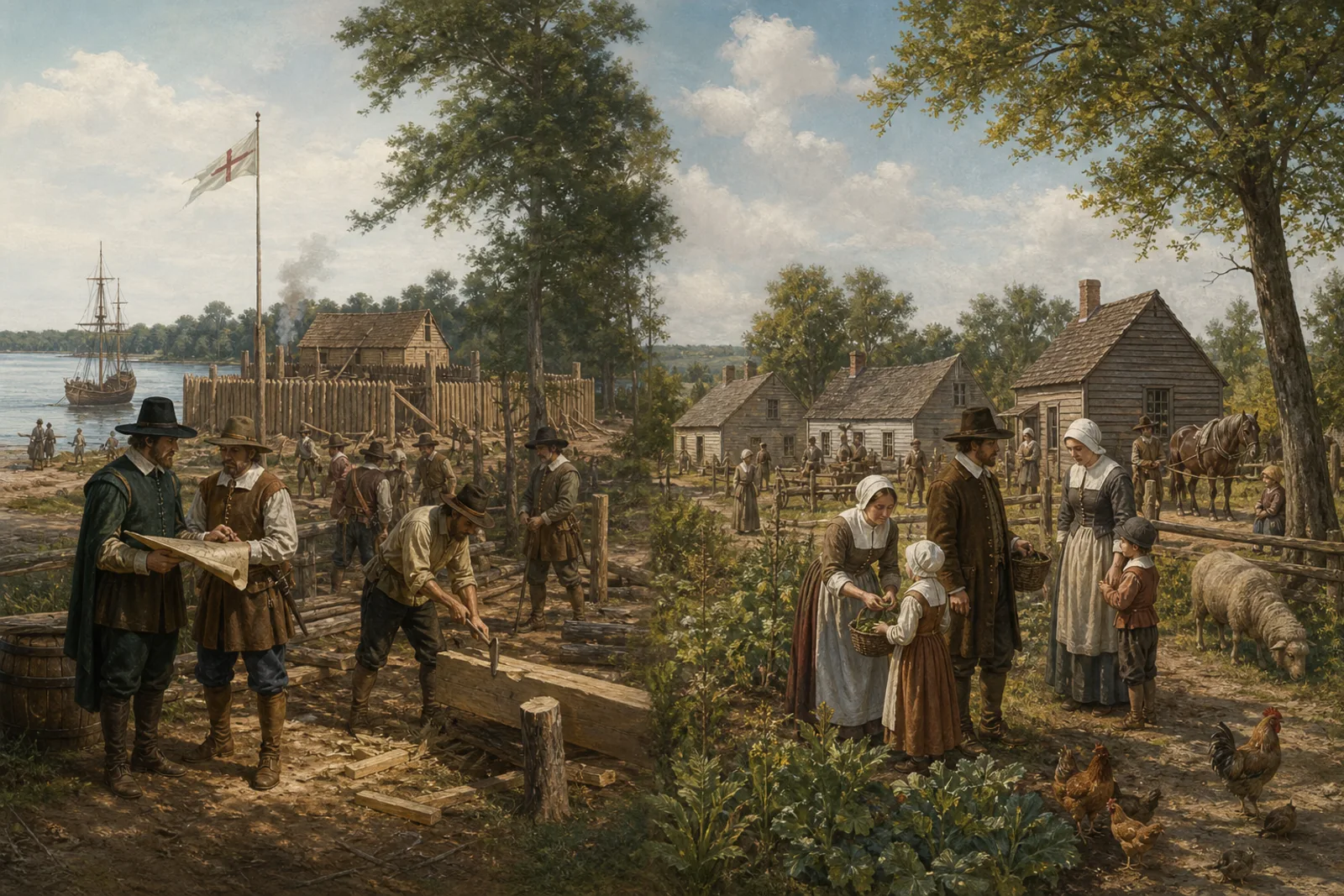
On this page1608: German individuals at Jamestown
Several Germans were among the settlers at Jamestown in 1608. Germantown, Pennsylvania, founded in 1683 by thirteen German Mennonite families led by Franz Daniel Pastorius, is the better-known date because it marks an organized community that endured. The large migration most people picture when they hear “German immigration” began much later, especially after 1830.
All three statements are true. The disagreement usually comes from using the word first without saying what kind of beginning is meant.
What does “first” mean?
- First documented presence
- Several Germans among the Jamestown settlers in 1608.
- First organized enduring settlement
- Germantown, founded near Philadelphia in 1683 by thirteen German Mennonite families.
- Beginning of mass immigration
- The nineteenth-century surge, especially from the 1830s through the decades before World War I.
This distinction is more than a wording exercise. It protects early history from two opposite errors: pretending no Germans were present before Germantown, or treating a few early individuals as though they already formed the large German-American communities of the nineteenth century.
1608: German individuals at Jamestown

The Library of Congress chronology begins with 1608, noting that several Germans were among the settlers at Jamestown. Their presence belongs to the early English colonial project in Virginia, not to a separate German colony. The entry establishes that people from German lands participated very early in English North America.
A short national overview should be cautious about turning that line into a detailed group biography. “Several Germans” does not tell us that they shared one origin, religion, occupation or plan to create a community. Person-level claims need person-level records. What the date safely proves is narrower: German presence predates 1683.
The wording German also needs historical care. In 1608 there was no unified German nation-state. People came from territories within the Holy Roman Empire and related German-speaking regions. Later records and histories often use German as a broad linguistic or cultural label, but a genealogist should look for the actual town, principality or jurisdiction.
1683: Germantown becomes the durable milestone
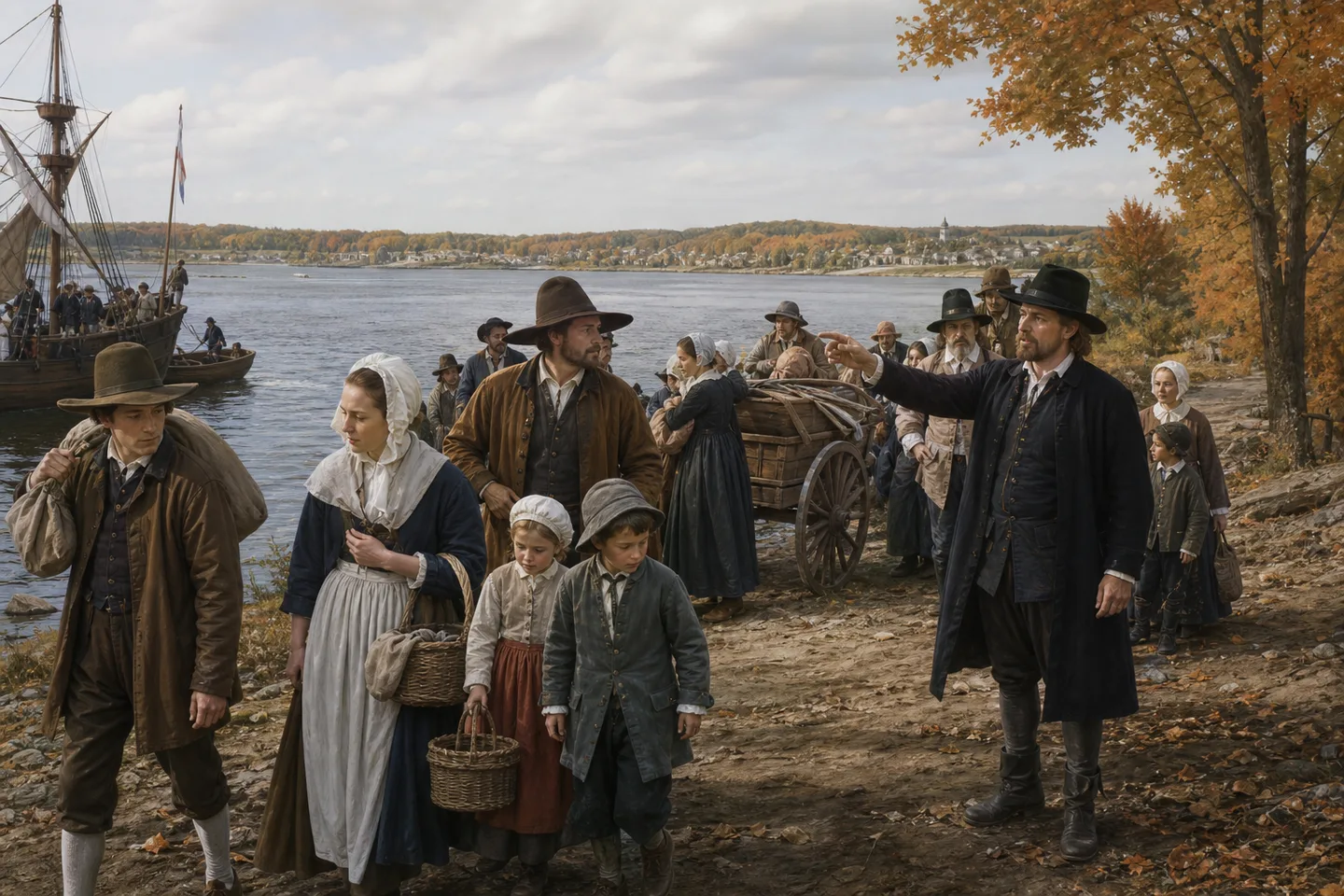
On October 6, 1683, thirteen German Mennonite families arrived in Pennsylvania and, under Pastorius’s leadership, founded Germantown near Philadelphia. The settlement is widely remembered because it was organized, family-based and lasting. It became part of a growing German-speaking presence in Pennsylvania rather than disappearing as an isolated expedition.
Pennsylvania’s reputation for religious toleration mattered. The colony offered dissenting groups more room to worship and organize community life than they expected in parts of Europe. Land and family opportunity also mattered, and later arrivals expanded well beyond the first Mennonite families.
The anniversary became central to German-American commemoration. That cultural importance helps explain why 1683 is often shortened to “the beginning of German immigration.” The phrase works when the writer means the beginning of an enduring organized settlement. It becomes inaccurate when it is used to deny earlier German individuals.
The three beginnings in context
Earliest highlighted presence
Several Germans are among the Jamestown settlers. The record shows presence, not yet a German community.
Germantown founded
Thirteen German Mennonite families establish an organized settlement near Philadelphia that grows into a durable community.
Pennsylvania settlement expands
German-speaking religious groups, farmers and artisans build communities across the colony and adjoining regions.
Federal passenger lists begin
A more consistent national arrival record becomes available, though coverage and indexing remain imperfect.
Mass immigration accelerates
Family networks, economic pressure and improved transport expand migration to a scale unlike the colonial period.
Why Germantown was different from an early individual arrival
A settlement changes migration in ways one person cannot. It creates a destination that can be named in a letter. It offers neighbors who may speak the same language, a congregation, work contacts and practical help. It can receive relatives and acquaintances, turning one migration into a chain.
Germantown also sat within a broader Pennsylvania German world that developed its own institutions, print culture, farms and religious diversity. The later label Pennsylvania German reflects a regional history, not a simple claim that everyone came from the modern country of Germany or spoke the same dialect.
The deeper history of Germantown belongs to its own future article. Here, the settlement’s job is to answer the date question cleanly: 1683 is the first organized enduring milestone, while 1608 remains the earlier documented presence.
The two dates do not cancel each other
If Germans were at Jamestown in 1608, calling Germantown the beginning in 1683 must be wrong.
1608 marks early individual presence. 1683 marks a planned family settlement that endured and became a center of community growth.
Mass immigration was a nineteenth-century story
Neither Jamestown nor Germantown resembles the later mass movement. German immigration increased sharply after 1830 and reached its greatest sustained scale in the nineteenth century. Steamships made crossings faster and more predictable. Relatives and neighbors sent letters and money. American farms and cities already contained German-speaking networks.
The failed revolutions of 1848 added political refugees, while economic pressure moved far larger numbers of workers, artisans and families. By the 1850s, arrivals were counted in hundreds of thousands across a decade rather than in a handful of colonial households. The complete immigration timeline shows those turning points without asking 1608 or 1683 to carry the whole story.
This is also why “first wave” can be confusing. Some writers call the colonial movement the first wave. Others reserve wave for the nineteenth-century mass flows. The major waves explainer states its model openly instead of implying that one numbering system is official.
Before 1820, the paper trail is uneven

Federal passenger arrival records generally begin in 1820. For a nineteenth-century immigrant, a researcher may find a manifest, naturalization, census, church record and other linked evidence. For a seventeenth- or eighteenth-century person, the trail is less standardized.
Earlier research can depend on colonial port documents, land grants, tax lists, court proceedings, congregation records, indenture papers, newspapers and private correspondence. Some records survive only as abstracts or later transcriptions. A missing passenger list does not prove a person was absent; it may mean no list was required, preserved or indexed.
Even after 1820, names can be difficult. A clerk may spell a German name phonetically. An immigrant may depart from Rotterdam, Le Havre, Liverpool or another port outside the territory of origin. A manifest may name the last residence rather than birthplace. The date gives the researcher a starting expectation, not a guarantee.
“Germany” did not mean the same thing in every period
Germany became a unified empire in 1871. Before then, the map contained kingdoms, duchies, principalities, free cities and other jurisdictions. An early immigrant might be connected to the Palatinate, Prussia, Bavaria, Württemberg, Hesse, Saxony or a specific town without ever possessing citizenship in a country called Germany.
This affects both language and evidence. A modern family story may say “from Germany” because that is understandable today. The original record may use a historical state, and the town may now lie in another country. Good research preserves both: the modern explanation and the period-specific place.
It also prevents identity gatekeeping. A German-speaking ancestor from a border region does not fit neatly into every later national category. History is clearer when it describes the jurisdiction and language that the sources support rather than forcing a modern label backward.
An early date does not establish a direct family connection
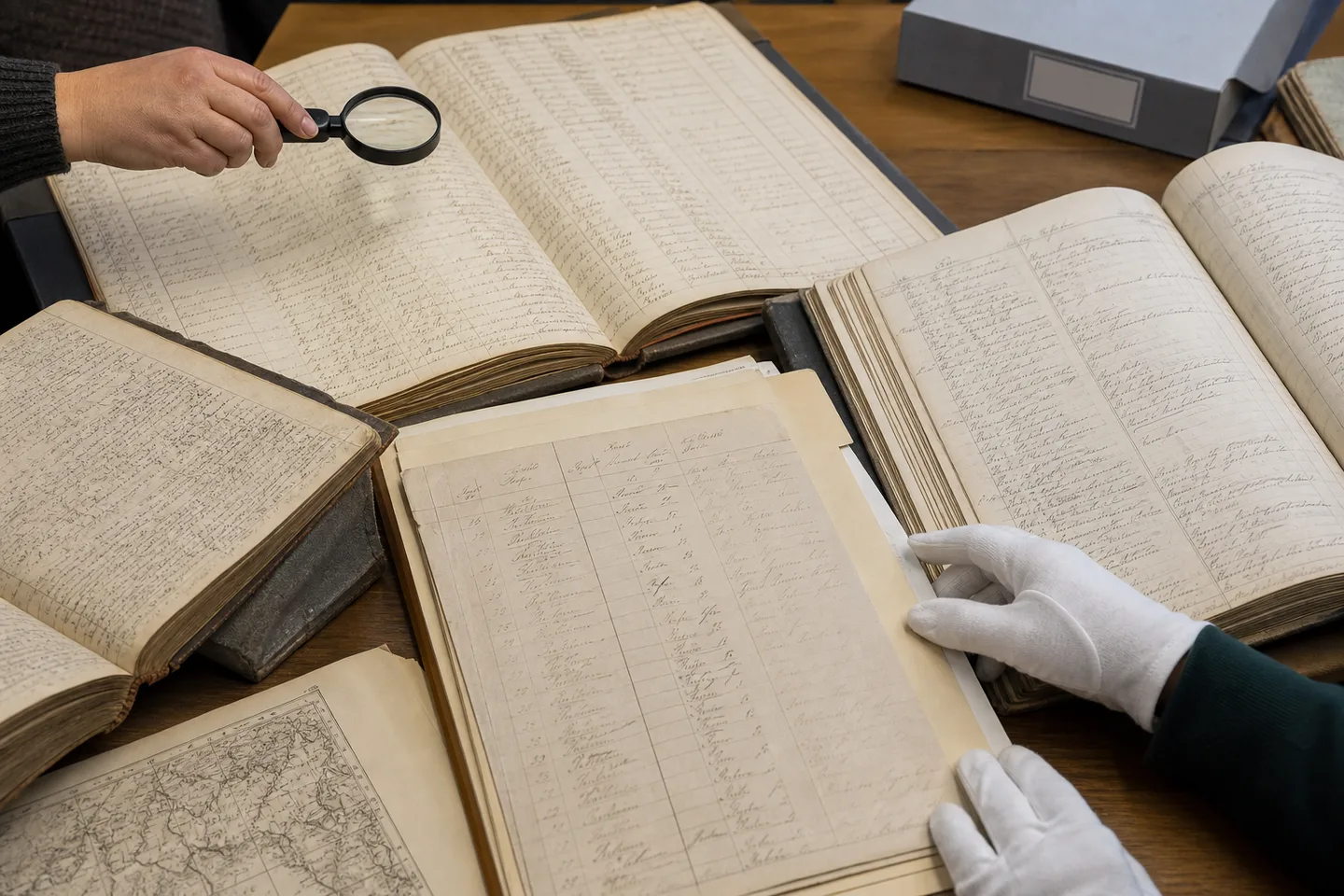
National milestones are useful orientation, but they are not lineage evidence. A family surname appearing in Pennsylvania does not prove descent from the Germantown founders. A German-sounding name in Virginia does not prove connection to the people noted in 1608. Repeated names, changing spellings and unrelated families make that shortcut especially risky.
A reliable family connection requires a chain of records from known relatives backward. The national date can tell a researcher which record systems might exist, which jurisdictions governed the place and what kind of migration was plausible. It cannot replace birth, marriage, death, church, land, probate, census, naturalization or passenger evidence.
This boundary also protects readers with later ancestry. A family that arrived in 1885 or 1955 is no less part of German-American history because it does not connect to 1683. “First” describes chronology, not a hierarchy of authenticity.
Why the answer matters to German-American families
The difference between 1608, 1683 and the nineteenth-century surge can orient a family story. A Pennsylvania line may connect to colonial congregations and land records. A Wisconsin or Missouri line may fit the mid-century movement through farms, trades and chain migration. A refugee arriving in the 1930s belongs to an entirely different legal and moral context.
The national dates do not identify an ancestor. They narrow the questions. Was the person part of an early religious community? Did the family arrive after federal manifests began? Does the birthplace refer to a pre-1871 state? Did relatives settle in a place that drew later newcomers?
For the geographic next step, see where German immigrants settled. For the larger human decision, the explanation of why Germans came separates religious, economic, political and refugee motives.
The most accurate one-sentence answer
Germans were present at Jamestown by 1608; Germantown in 1683 marks the first famous organized and enduring German settlement; and mass German immigration became a defining American movement in the nineteenth century.
That sentence is slightly longer than the popular version, but it keeps three different histories from being collapsed into one date. Readers connecting those dates to modern family identity can continue with the German Heritage starting guide, while keeping national history separate from proof about one lineage.
The safest wording depends on the question being asked
For a classroom or general-history answer, “Germans were present by 1608, and Germantown was founded in 1683” is both clear and accurate. For a heritage commemoration, 1683 may remain the central date because it represents community formation. For genealogy, neither date is enough without a documented line from the known family backward.
That flexibility is not evasive. It is what keeps one memorable date from doing work the evidence cannot support.
The same rule applies to descendants: an earlier arrival does not make one family more authentic than a later arrival. The date explains historical context, not the value of a person’s heritage.
An optional expression after the history
Carry the family story forward
These designs express a present-day connection to German-American roots; they are not historical evidence or a substitute for the sourced account.


Frequently asked questions
Common questions
Were there Germans in Jamestown?
Yes. The Library of Congress chronology notes that several Germans were among the Jamestown settlers in 1608, although this was not yet a permanent German community.
Why is 1683 often called the beginning of German immigration?
Germantown became an organized, durable settlement with families and institutions, making it a clearer community milestone than earlier individual presence.
Was Germany already a country in 1683?
No. A unified German Empire was formed in 1871. Earlier settlers came from distinct German-speaking territories, states and cities.
Can passenger lists prove an arrival before 1820?
Sometimes local or colonial records survive, but federal passenger arrival records generally begin in 1820. Earlier research often depends on land, church, court, tax and private records.