
On this pageGerman immigration timeline
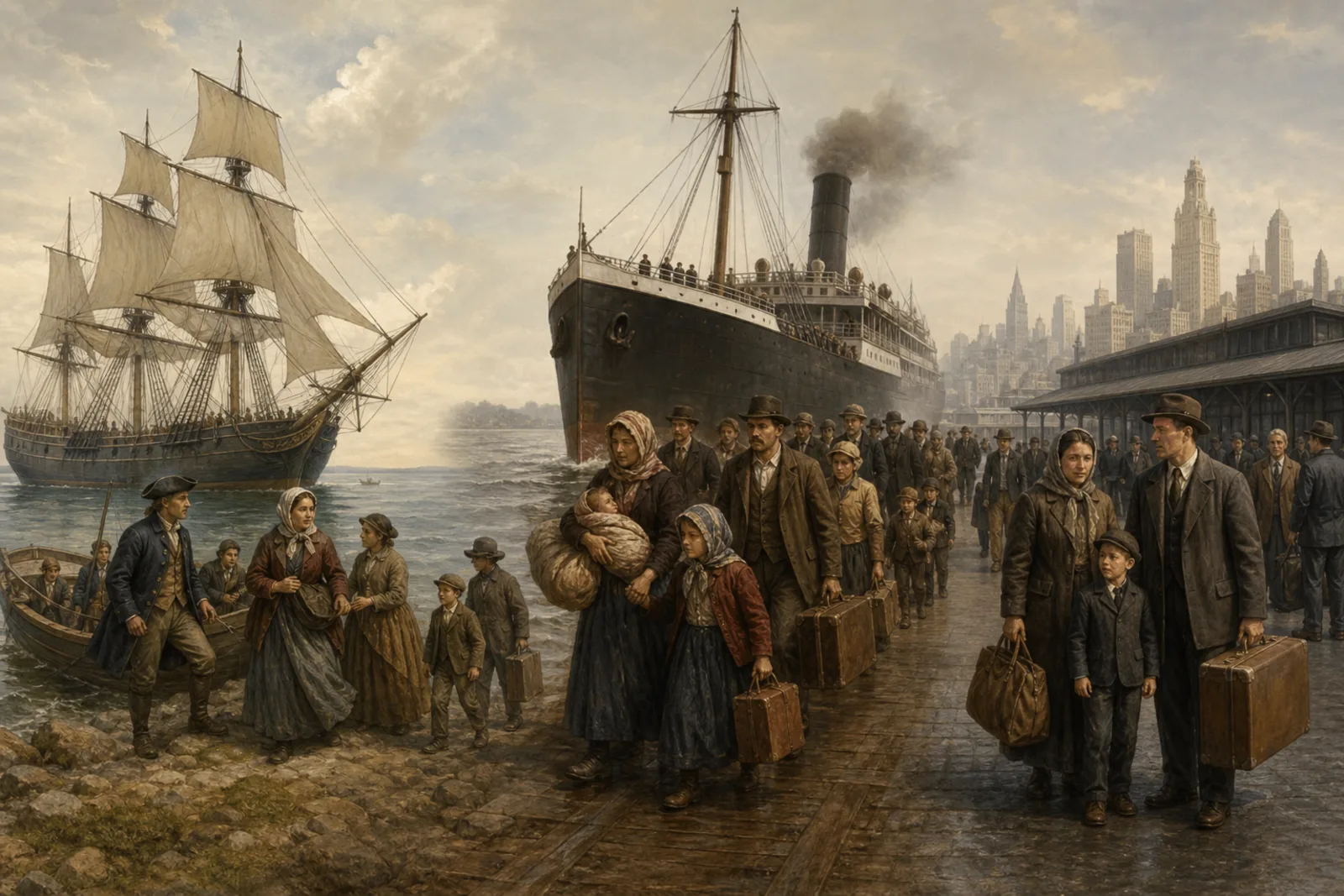
German immigration to America did not begin with one clean starting gun. Several Germans were among the settlers at Jamestown in 1608. Germantown, Pennsylvania, founded in 1683, is the more useful milestone for an organized community that endured. The largest movement came much later, when millions crossed the Atlantic during the nineteenth century. Refugees after 1933 and postwar immigrants then added very different chapters.
That layered answer matters. A family looking for an ancestor in 1710 faces different place names, records and migration conditions from a family tracing someone who arrived in 1854 or 1954. The timeline below supplies the chronological frame; the neighboring articles explain why people left, how historians group the major immigration waves, and where communities formed.
Three dates that answer three different questions
- 1608
- The earliest German presence highlighted in the Library of Congress chronology: several Germans among the Jamestown settlers.
- 1683
- The founding of Germantown, the best-known beginning of an organized and durable German settlement.
- After 1830
- The period when German immigration rose rapidly toward nineteenth-century mass migration.
German immigration timeline
Major turning points in German immigration to America
German presence at Jamestown
Several Germans are recorded among the settlers at Jamestown. This is early individual presence, not yet a sustained German colony.
Germantown founded
Thirteen German Mennonite families led by Franz Daniel Pastorius establish Germantown near Philadelphia, creating an enduring organized settlement.
Colonial Pennsylvania becomes the main center
German-speaking farmers, artisans and religious communities settle across Pennsylvania and adjoining areas, often through family and congregational networks.
A large colonial-era population is visible
The Library of Congress chronology estimates that as many as 100,000 Germans may have immigrated by this point, with especially strong concentration in Pennsylvania.
Federal passenger records begin
The federal government begins requiring passenger lists, giving later researchers a more consistent—though still incomplete—record trail.
A new surge begins
German immigration rises sharply as family networks expand and Atlantic transport becomes faster and more regular.
Revolution and political exile
Failed revolutions in the German states send political refugees, including the group later known as the Forty-Eighters, into a much larger economic migration.
Mass immigration reaches a crest
Roughly a million German immigrants arrive during the decade; 1854 alone brings about 200,000, depending on the historical series used.
A German nation-state is formed
The German Empire unifies many states. Earlier American records may name Prussia, Bavaria, Württemberg, Saxony, Hesse or a town rather than Germany.
High-volume migration continues
Economic insecurity, industrial change, family letters and established American communities continue to move people across the Atlantic.
War changes public German life
The United States' entry into World War I intensifies anti-German pressure. Immigration and visible German-language institutions are both disrupted.
Refugees flee Nazi persecution
Jewish families, political opponents, scholars, artists and others seek safety, though restrictive immigration rules prevent many from entering the United States.
Postwar immigration adds another chapter
Refugees, displaced persons, relatives and other migrants arrive in the war's aftermath; the 1950s bring a substantial but smaller flow than the nineteenth-century peak.
Immigration continues at lower levels
German immigration does not end, but it is no longer the mass national movement that shaped nineteenth-century America.
Before Germany was one country

A timeline can mislead when it puts the modern word Germany over every earlier century. The German Empire was created in 1871 as a federation of states. Before then, an immigrant might be recorded as Prussian, Bavarian, Württemberger, Hessian, Saxon, Hanoverian, from a free city, or simply from a named village. Some people lived in German-speaking territories whose later borders changed more than once.
This is not a minor terminology issue. It affects passenger indexes, census entries, church records and family stories. “Born in Germany” written decades after arrival can be a useful summary, but it may hide the historical jurisdiction needed to find the original record. A timeline should therefore use German-speaking when the political category is uncertain and preserve the place name a source actually gives.
1608 and 1683 are not competing answers
The question “When did Germans first arrive?” is often answered with 1683 because Germantown became a lasting community and later a national commemorative symbol. That does not erase the Germans at Jamestown in 1608. It means the two dates answer different questions.
1608 answers the earliest documented presence highlighted by the Library of Congress. 1683 answers the beginning of a well-documented, organized settlement whose institutions and descendants became part of a continuing German-American history. Neither date marks mass immigration. That came in the nineteenth century, after migration networks and transport had changed the scale of departure.
A timeline shortcut that creates confusion
German immigration began in 1683, and everything before that is irrelevant.
German individuals were present earlier. Germantown matters because it was organized and enduring, not because no German had ever crossed the Atlantic before.
Colonial settlement grew through communities, not one national program
The first colonial migrations were not a single campaign from a unified Germany. Religious dissenters, farmers, artisans and laborers came from different territories under different arrangements. Pennsylvania offered a reputation for toleration and land, but the journey could involve debt, indentured service, family separation and uncertain survival.
Once communities existed, they changed the next family’s calculation. A relative could send a letter, money or a destination. A congregation could help newcomers find work and worship. A German-language printer, church or neighbor reduced the shock of arrival. This pattern—people following people they trusted—would become one of the strongest continuities across later centuries.
The nineteenth century changed the scale
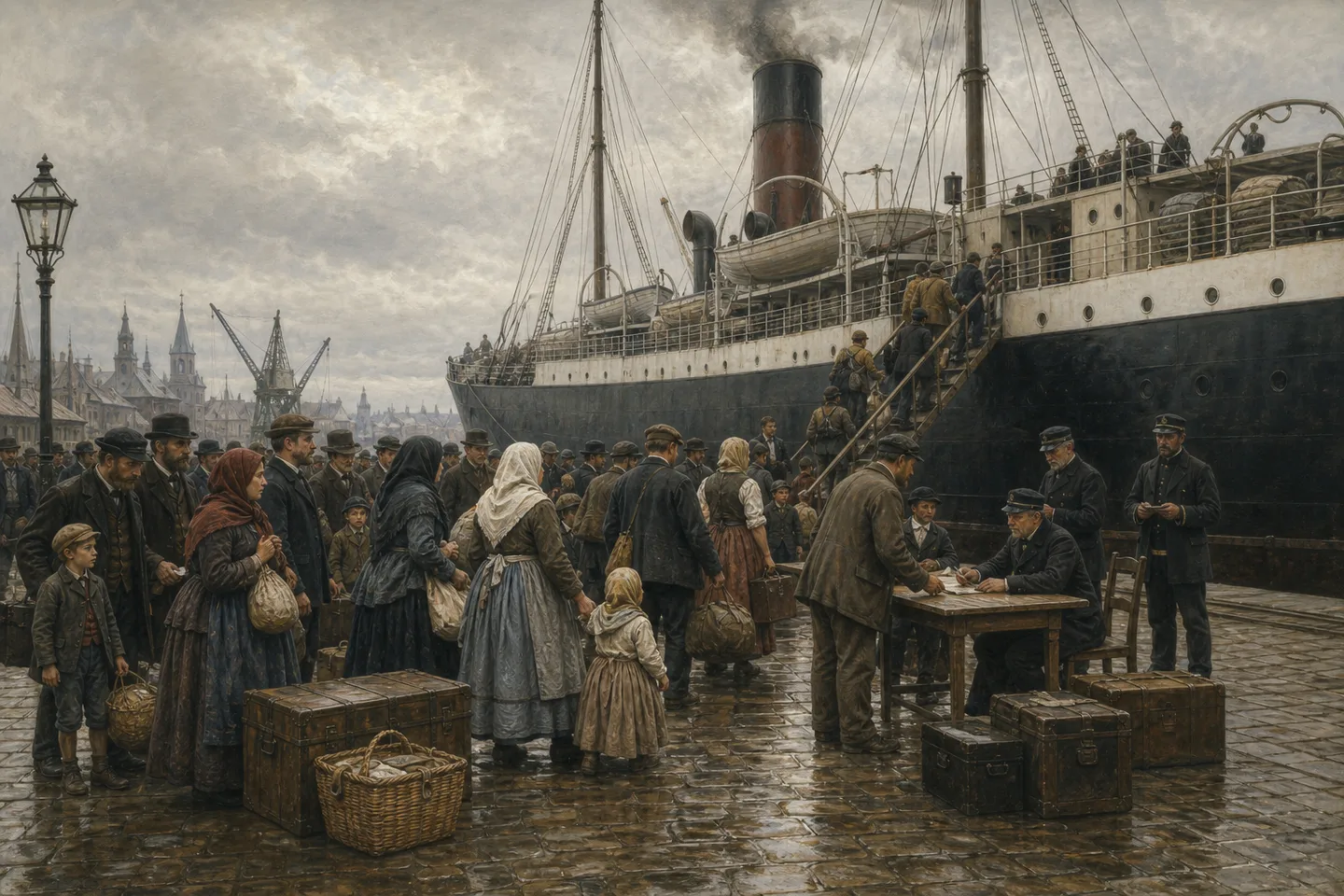
After wars slowed movement in the late eighteenth and early nineteenth centuries, immigration accelerated. By 1830 the flow had grown dramatically. Steamships shortened a crossing that had once depended on slower sailing vessels. Established routes linked ports to inland towns. Letters and remittances made America less abstract.
The 1850s became the clearest peak within this surge. The decade combined economic migration with the aftermath of the failed revolutions of 1848. Political refugees were often educated and publicly active, which made the Forty-Eighters unusually visible in newspapers, civic organizations and later historical writing. Most German immigrants, however, were not revolutionary leaders. They were families and individuals making decisions about land, wages, work, inheritance and their children’s prospects.
The movement did not stop with German unification. Economic and industrial change in the 1870s and 1880s continued to push migration, while American communities made the move easier to imagine. Census figures from this era are valuable, but they are not perfectly comparable. Borders changed, categories changed, and a person recorded under one country label in one decade might be classified differently in another.
World War I interrupted more than arrivals
World War I did not erase German ancestry in the United States, but it altered the public environment around it. German-language teaching, newspapers, place names and organizations came under pressure. Families sometimes stopped speaking German publicly or passed less of it to children. Immigration itself was constrained by war and later national quota systems.
This article keeps that episode short because its full ownership belongs to the later World War I cluster. In the timeline, its job is to show why a story of uninterrupted growth would be false. The war changed both movement across the Atlantic and what existing German-American communities felt safe displaying.
Refugees after 1933 were not another version of the 1850s

When the Nazi regime came to power, migration from Germany included people escaping state persecution. Jewish refugees, political opponents, writers, scholars, musicians and scientists sought entry. The United States admitted some, but quotas, paperwork, financial requirements and political resistance blocked many others.
That distinction should remain visible. A farmer considering land in the 1840s and a family fleeing antisemitic persecution in the 1930s were both migrants from German lands, but the moral urgency, legal barriers and available choices were not comparable. Combining them into one undifferentiated “German dream in America” would flatten the history.
Postwar arrivals continued the story
The years after 1945 brought displaced people, relatives, spouses, workers and others rebuilding their lives after war. Library of Congress chronology records substantial German immigration during the 1950s. Later flows became smaller relative to the nineteenth century, but they did not disappear.
By this point, newcomers entered a country where millions of people already had German ancestry, yet many German-American institutions were less visible than before World War I. Some immigrants joined old communities; others settled through work, marriage or ordinary metropolitan mobility. The history therefore moved away from a few easily mapped ethnic colonies toward a more dispersed pattern.
What records become available along the timeline
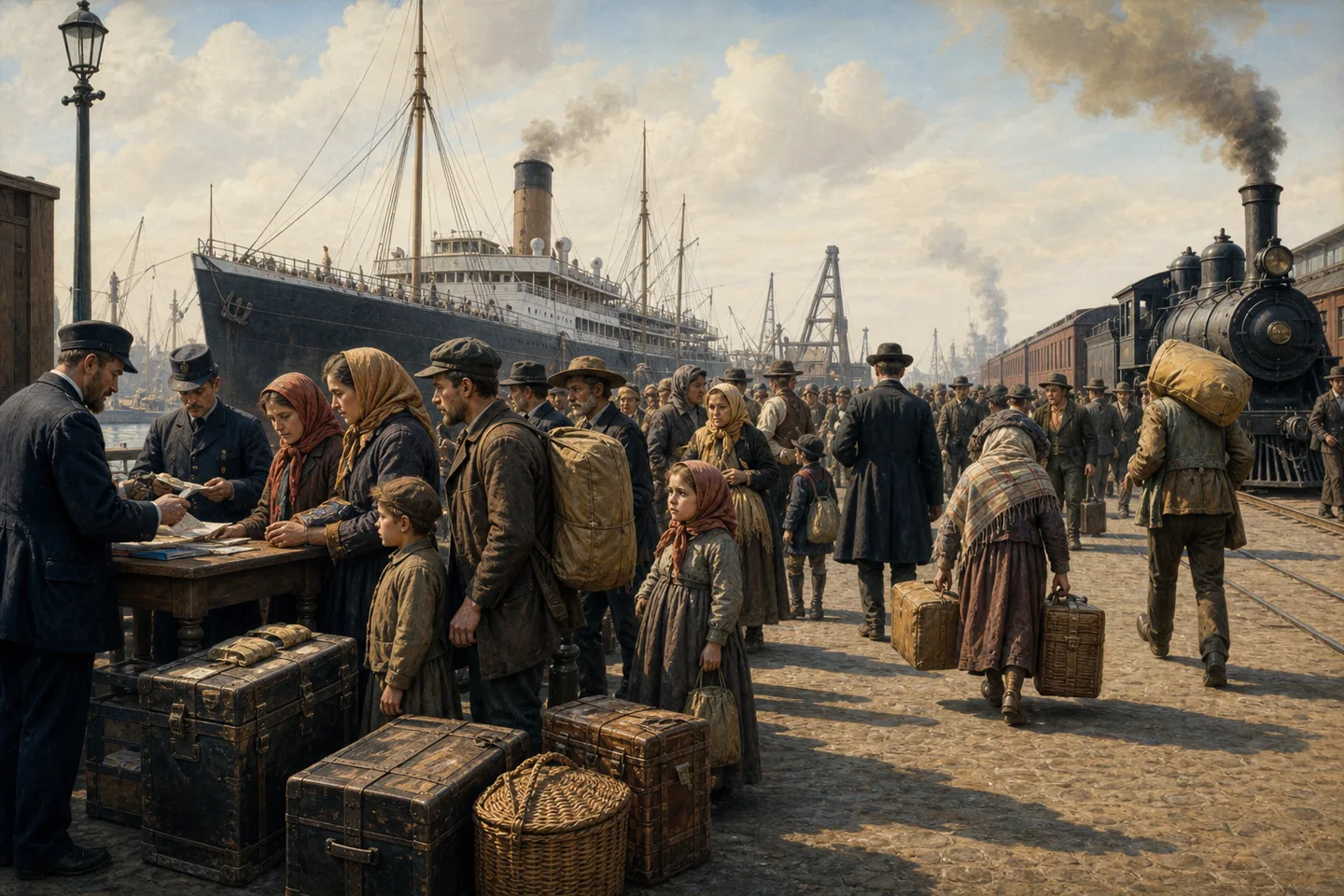
The historical record changes almost as much as the migration itself. Before 1820, there was no consistent federal passenger-list requirement. Researchers may need colonial port records, land transactions, church registers, tax lists, indenture documents, newspapers and private correspondence. Survival and indexing vary widely.
From 1820 onward, federal passenger arrival records provide a stronger framework, but they are not a perfect roster. Names may be misspelled, handwriting may be misread, ages may be approximate, and a person may have departed from a port outside the territory they called home. National Archives electronic datasets for the later nineteenth century are valuable finding aids, not replacements for checking an original image when available.
Census data begin asking nativity in 1850, adding another national view. Yet census country labels must be read against historical borders. A careful researcher uses the timeline to ask better questions: which government controlled the birthplace then, which port records survive, and which American community might have received the newcomer?
A timeline is the frame, not the whole story
Chronology prevents several common mistakes. It stops us from treating 1683 as the first individual arrival, the Forty-Eighters as every nineteenth-century immigrant, or Nazi-era refugees as simply another economic wave. It also shows why a modern family can carry German roots through very different paths.
For the next layer, read the explanation of why Germans came to America, then compare the major waves and the places German immigrants settled. Readers starting from identity rather than a date can return to the German Heritage guide.
How to use this timeline without flattening a family story
A national timeline is most useful as a set of checkpoints. Start with the person’s earliest confirmed American record, then ask which migration system was operating at that date. A colonial arrival may require church, land and court records. A person after 1820 may appear on a passenger manifest. Someone after 1850 may also be visible in a census that records birthplace. A refugee-era case may require visa, sponsorship and displaced-person documentation.
The timeline should not supply a motive automatically. An 1854 arrival occurred during a mass surge, but the person may have left for land, wages, family reunion, politics or several reasons at once. A 1938 arrival belongs to the Nazi-era refugee context, yet the exact persecution and route still require individual evidence. National patterns help frame a record; they do not replace it.
Place is equally important. An entry such as Prussia, Bavaria or Württemberg can be more useful than the later summary Germany. A town name can identify the church or civil authority that created the original record. When borders changed, the modern country and historical jurisdiction may both be needed.
Used this way, chronology becomes practical rather than ceremonial. It tells the reader what records are likely, which terms need qualification and which neighboring article owns the next question.
A careful timeline also leaves room for families whose route was indirect: through another European port, a Canadian residence, or a second migration inside the United States. Those cases belong in the chronology without being forced into its most common path.
An optional expression after the history
Carry the family story forward
These designs express a present-day connection to German-American roots; they are not historical evidence or a substitute for the sourced account.


Frequently asked questions
Common questions
Did German immigration to America begin in 1683?
1683 is the standard milestone for an organized, enduring German settlement at Germantown. Several Germans were already present at Jamestown in 1608, so it is not the first known individual presence.
When was German immigration to America at its largest?
The largest sustained movement occurred in the nineteenth century, especially from the 1830s through the decades before World War I. Exact totals vary with borders, date ranges and how German origin was recorded.
Were all early immigrants citizens of Germany?
No. Germany did not become a unified nation-state until 1871. Earlier migrants came from kingdoms, duchies, free cities and other German-speaking territories.
Do passenger lists cover every German immigrant?
No. Federal passenger arrival records generally begin in 1820, earlier records are uneven, and even later manifests can contain spelling, indexing and identification problems.