
On this pageWave 1: colonial community settlement, 1683 to the Revolution
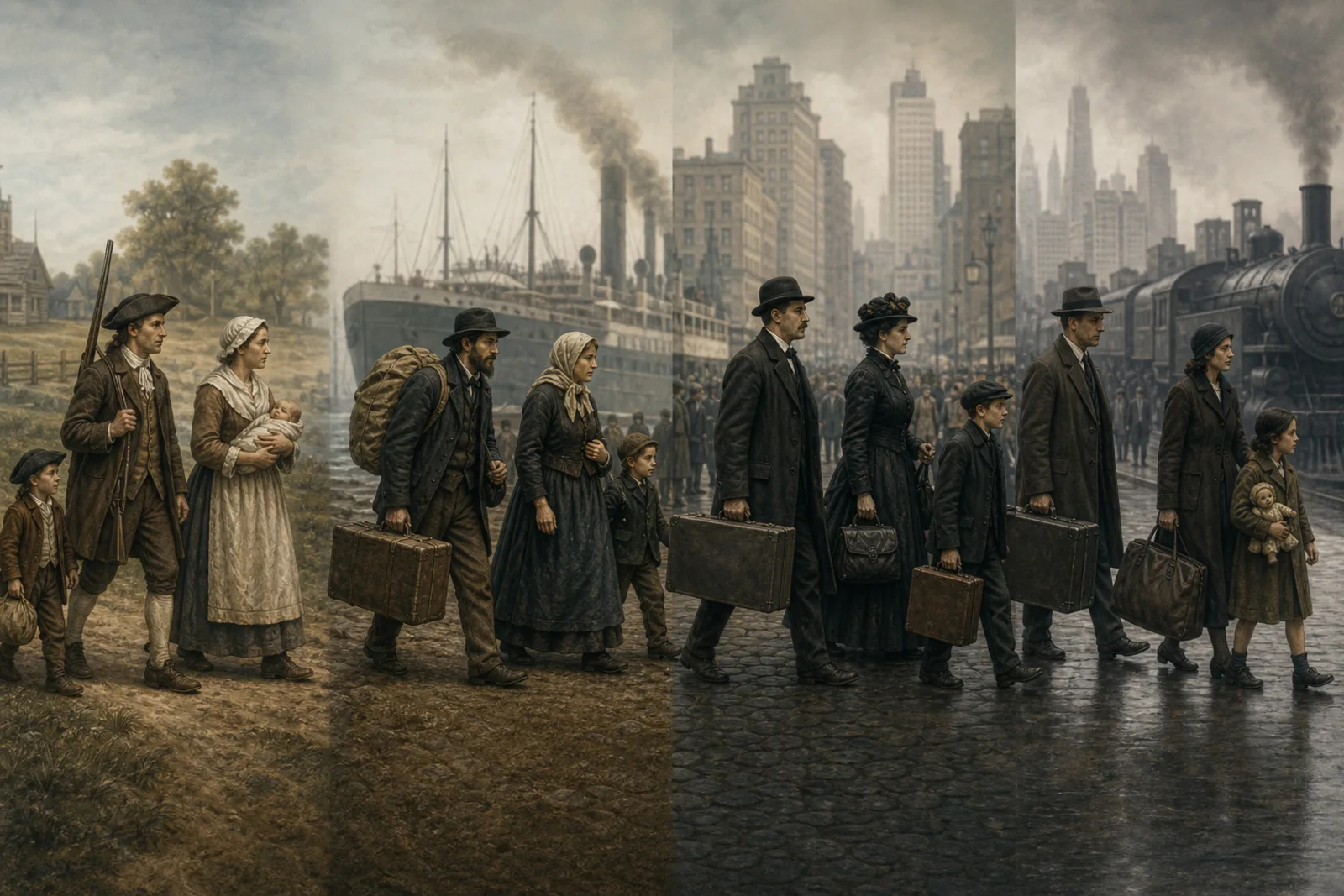
German immigration is easiest to understand as several overlapping movements rather than one four-century wave. This guide uses five: colonial settlement from 1683; renewed growth after the Napoleonic era; mid-century mass migration around 1848 and the 1850s; continued high immigration from the 1870s to World War I; and refugee/postwar migration from 1933 through the 1960s.
That model is an editorial tool, not an official classification. A family may cross two periods, and historians may draw the boundaries differently. The value of the model is that each wave changes at least three things: why people left, how many came, where they settled and what political map their records used.
What makes a migration wave useful?
- Scale
- Whether the movement involved a small community, a sustained mass flow or a narrower refugee stream.
- Dominant context
- The combination of religious, economic, political or safety pressures shaping departure.
- Settlement pattern
- The regions, cities, farms and institutions that received newcomers.
- Record environment
- The borders, citizenship labels, passenger records and census categories available in that period.
A wave is therefore more than a date range. It is a change in the migration system. The complete timeline holds the dates; this article explains why grouping them can reveal differences that a long list cannot.
Wave 1: colonial community settlement, 1683 to the Revolution
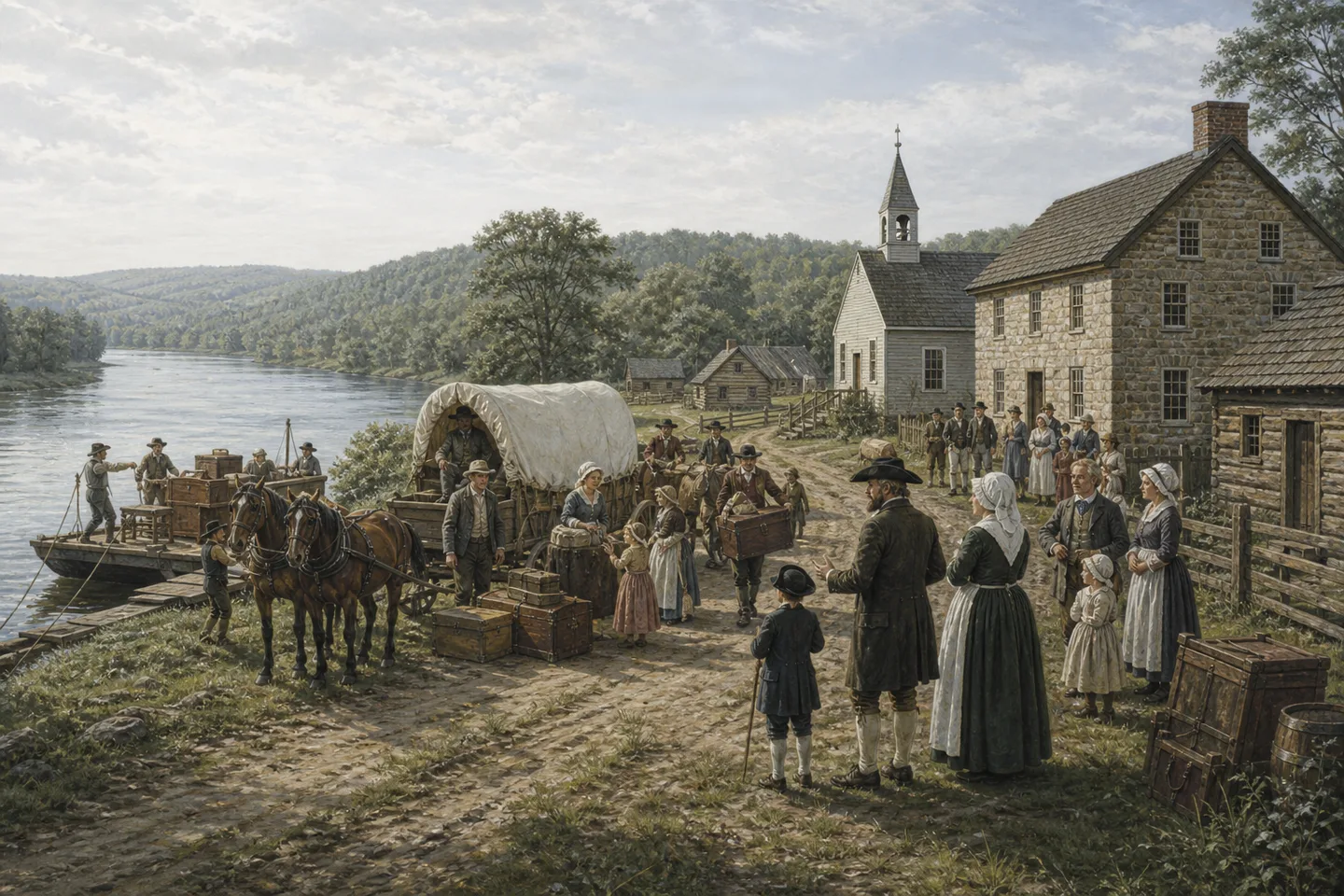
The first wave begins with Germantown in 1683 rather than the Germans at Jamestown in 1608. That choice is deliberate. Jamestown establishes early presence; Germantown begins organized family settlement that attracted further migration and built durable institutions.
Religious toleration was important for Mennonites, Quakers and other dissenting communities. Land and family opportunity also drew migrants from the Palatinate and other German-speaking territories. Pennsylvania became the strongest early center, with farms, churches, printers and towns that could receive later arrivals.
The movement was significant but still colonial in scale and structure. Travelers crossed under varied arrangements, including indentured labor. They did not leave a unified German nation-state, and they did not enter a United States that yet existed. Their records belong to colonial jurisdictions and religious communities.
A family in this wave may be described as Pennsylvania German generations before later mass immigration transformed the national German-American population. That regional identity deserves to remain distinct rather than treated as an early copy of a nineteenth-century immigrant neighborhood.
Wave 2: renewed growth and chain migration, about 1815 to 1848
European and American wars had slowed movement. After 1815, and especially after 1830, German immigration grew again. Population pressure, land constraints and economic change encouraged departure, while relatives in America supplied information and practical support.
Transport was changing. Steamships gradually made crossing times more predictable. American canals, rivers and roads helped newcomers move beyond eastern ports. Letters could direct a family to a specific farm district, congregation or trade network rather than an unknown continent.
This period sits between colonial settlement and the great 1850s crest. It is easy to overlook because it lacks one famous political event. Yet it built the routes that made the next wave possible. Each successful settlement created another address to write, another employer to name and another relative who could help pay passage.
Wave 3: revolution and mass migration, 1848 through the 1860s

The failed revolutions of 1848 gave this wave its most recognizable political label. Activists and supporters fled after demands for constitutional reform and political liberty were defeated. In America, the Forty-Eighters became journalists, educators, politicians, abolitionists and military leaders.
They were influential, but they were not the numerical center of the wave. The 1850s brought close to a million German immigrants, including farmers, artisans, laborers and families responding to economic pressure and opportunity. In 1854 alone, arrivals approached 200,000 in the Library of Congress account.
This is the point at which German immigration became unmistakably mass migration. Communities expanded through the Ohio and Mississippi valleys, around the Great Lakes and in cities such as Cincinnati, Milwaukee and St. Louis. Churches, newspapers, schools, mutual-aid societies and businesses made German-language public life highly visible.
The Civil War also entered the story. German immigrants and their descendants took different political positions, and any later article must avoid treating them as one bloc. For wave analysis, the important point is that newcomers arrived in a country entering a severe national conflict and participated in it as residents, citizens and soldiers.
Wave 4: industrial-era migration, the 1870s to World War I
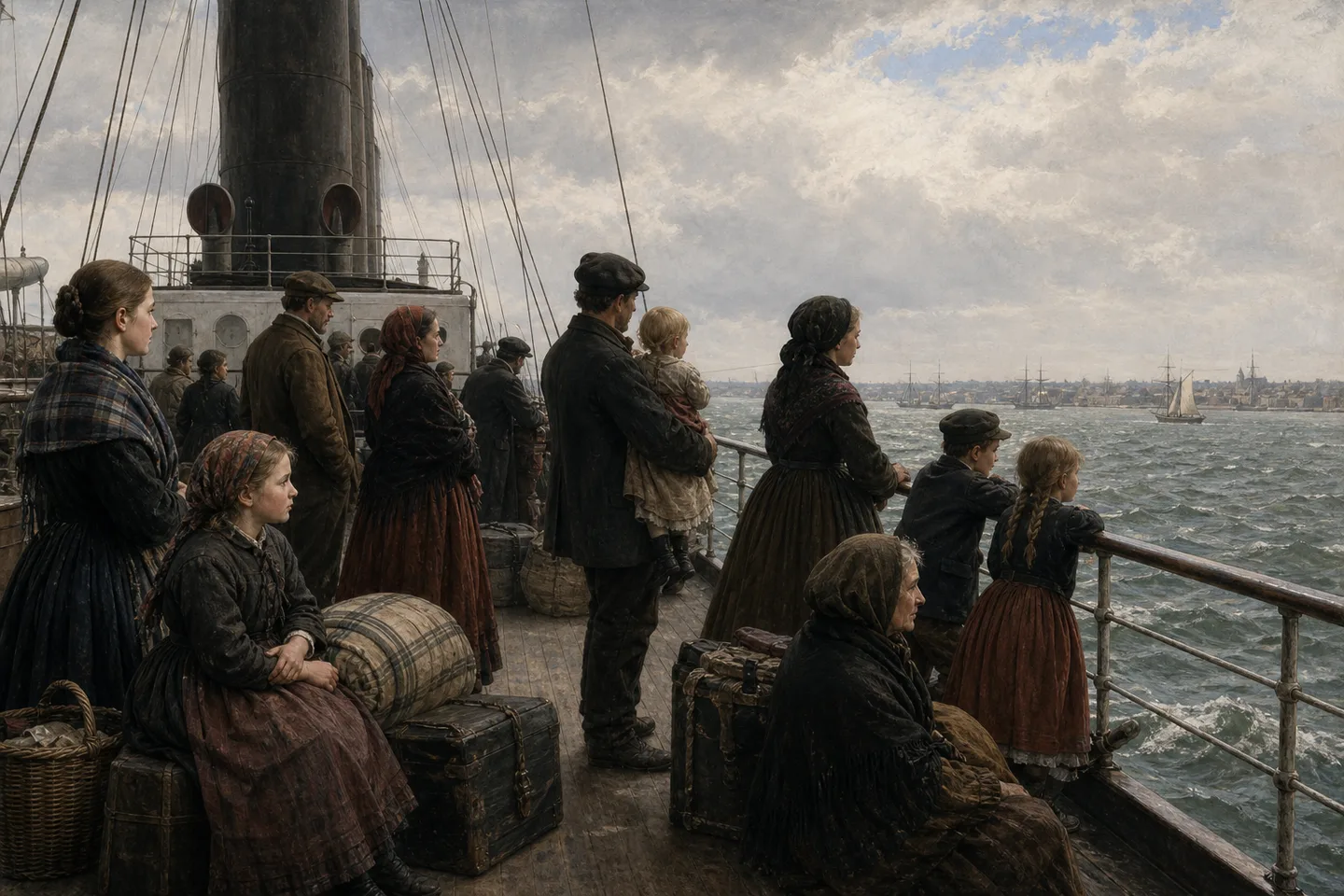
German unification in 1871 changed the political label but did not end migration. The new empire contained strong regional differences and uneven industrial development. Contemporary evidence from the 1870s and 1880s points to low wages, unemployment, declining older industries and political pressure alongside aspirations for greater independence.
By now, American German communities were mature enough to pull newcomers through dense networks. A migrant might arrive with a destination, an employer, a congregation and relatives already identified. The crossing was more regular, and inland rail connections expanded the choice of settlement.
The flow remained large, though its composition and destinations shifted. Some joined Midwestern farms and towns; others entered industrial cities or moved farther west. The Census Bureau’s historical country-of-birth data help track this period, but the series must be interpreted with changing boundaries and categories in mind.
World War I marks the practical end of this wave. War disrupted transatlantic movement, and the United States’ entry in 1917 intensified hostility toward German language and institutions. Later quota laws changed the immigration system again. The result was not simply fewer newcomers; public German-American life also became less secure.
Wave 5: refugees, war aftermath and postwar migration, 1933 to the 1960s

Nazi rule created a movement that cannot be described mainly through land and wages. Jewish people were stripped of rights and livelihoods and faced escalating persecution. Political opponents, scholars, writers, artists and others also fled. The United States admitted some refugees, but quotas and bureaucratic barriers shut out many who sought safety.
This refugee stream was narrower than the nineteenth-century mass migration, yet historically distinct. It brought people whose departure was forced by a persecuting state. Their professional and cultural contributions are part of the record, but celebratory summaries should never obscure the people who could not obtain visas or escape.
After World War II, additional arrivals included displaced people, relatives, spouses, workers and other immigrants rebuilding lives amid ruined cities and altered borders. The Library of Congress chronology records a substantial German flow during the 1950s. Immigration continued after the 1960s, but not at the earlier mass scale.
The postwar destination pattern was more dispersed. Some newcomers joined old German-American communities; many entered broader suburban and metropolitan America. English-language institutions and national labor markets mattered more, while the compact German-language districts of the nineteenth century were less common.
Five waves and what changed
Colonial community settlement
Religious toleration, land and family communities build a Pennsylvania center under colonial jurisdictions.
Renewed growth and chain migration
Economic pressure, letters, family networks and improving transport reconnect German regions with American destinations.
Revolution and mass migration
Political refugees arrive within a much larger flow of workers, artisans, farmers and families; the 1850s become a major crest.
Industrial-era high migration
German unification, economic change and mature American networks sustain large flows until war and restriction alter the system.
Refugee and postwar migration
Nazi persecution, war displacement, family rebuilding and later migration create a fundamentally different final wave in the model.
Why the boundaries overlap
A family network does not stop because a historian changes a label. Religious motives continued after the colonial period. Political pressure existed before and after 1848. Economic migration continued alongside refugees. Postwar immigrants could be both family migrants and people displaced by conflict.
The dates are therefore hinges, not walls. 1848 matters because political revolution changed the composition and visibility of migration, not because everyone arriving in 1847 was one type and everyone arriving in 1849 another. 1871 matters because German political geography changed, but regional identity and earlier migration routes remained.
This is why a family record should begin with its own date, place and people. The wave model supplies context only after the evidence establishes when and where the person lived.
There is no official universal wave count
Historians agree on one fixed number and exact dates for the waves of German immigration.
The evidence is continuous. Wave labels are analytical choices used to highlight changes in scale, motive, politics and settlement, so responsible models state their boundaries openly.
Before 1871, use states and towns—not only “Germany”
The first three waves took place before a unified German Empire existed. The 1871 constitution joined kingdoms, duchies, free cities and other states into a federation. An immigrant in 1845 might have identified with Bavaria, Prussia, Württemberg, Hesse, Saxony or a local town more immediately than with a single national state.
That historical geography is essential in genealogy. A wave label cannot substitute for the exact jurisdiction controlling a church or civil record. It also explains why American communities often retained regional foods, dialects or religious patterns that differed from those of neighbors who were equally called German.
How motives and destinations changed together
The reasons Germans came shifted with each wave. Colonial communities emphasized toleration and land. Early nineteenth-century movement relied increasingly on family networks and transport. Mid-century mass migration combined economic pressure with political exile. Later industrial-era migrants entered mature American institutions. Refugees after 1933 sought safety under restrictive admission systems.
The geography changed in parallel. Pennsylvania dominated early settlement. The Ohio, Mississippi and Missouri valleys and Great Lakes region became central during mass migration. Cities, Texas, the Dakotas and western destinations expanded the map. The dedicated article on where German immigrants settled keeps that question from overwhelming the wave model.
Why families do not fit the labels neatly
One household can cross a boundary in several ways. A brother may leave during the 1840s and send money for relatives who arrive in the 1850s. A person born in Prussia may migrate after 1871 and be recorded under Germany, while an older sibling appears in American records under Prussia. A family may first settle in Pennsylvania and then move to Wisconsin, making both wave and destination labels incomplete without a timeline of their own.
Mixed motives are equally common. An artisan could dislike political restrictions, face weak earnings and follow a cousin to Cincinnati. The model should help identify the setting of the decision, not assign one motive automatically.
That is why wave labels belong after the basic evidence: a name, date, place, relationship and record trail. They make a documented life more intelligible. They do not create the documentation.
Use the model as context, not proof
A person arriving in 1852 may fit the mid-century wave, but the date alone does not reveal motive. A refugee arriving in 1938 may have left under persecution, but a family history still needs documents rather than assumptions. One wave can contain different religions, classes, occupations and political beliefs.
The model is strongest when it prevents flattening. It separates colonial community building from mass industrial-era movement, and opportunity-led migration from forced refugee flight. It also gives readers a clean way to move between the first-arrival distinction and the more detailed timeline.
For families beginning with identity rather than records, the German Heritage guide offers the next path. Historical context can deepen a family story, but it should never be used to decide whether someone is “German enough.”
An optional expression after the history
Carry the family story forward
These designs express a present-day connection to German-American roots; they are not historical evidence or a substitute for the sourced account.
Frequently asked questions
Common questions
How many waves of German immigration were there?
There is no official universal count. Five waves are useful here because they separate changes in scale, motive, politics and settlement, but other historians may combine or divide the periods differently.
Were the Forty-Eighters a separate wave?
They can be treated as a distinct political stream, but they arrived inside the much larger mid-nineteenth-century migration. This guide keeps them visible without making them the whole wave.
Why does the model begin in 1683 rather than 1608?
1608 marks an early German presence at Jamestown. The wave model begins with Germantown because it represents organized family settlement and continuing community formation.
Is refugee migration after 1933 comparable to earlier economic migration?
It belongs in the immigration history but requires a separate frame. Nazi persecution forced people to seek safety, and restrictive U.S. quotas prevented many from entering.