
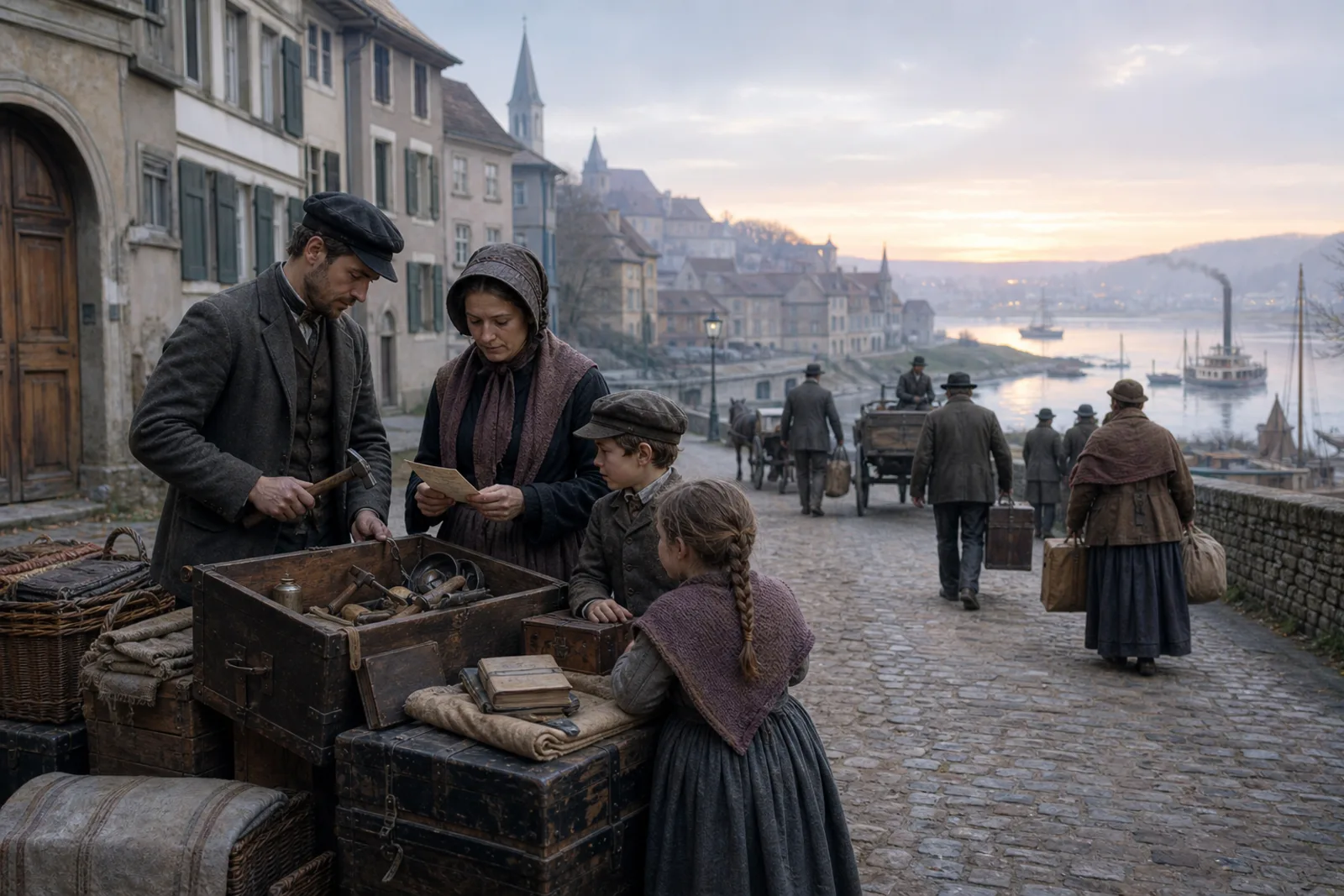
On this pageEarly communities sought room to worship and live together
Germans came to America for no single reason. Some early religious communities sought toleration. Many nineteenth-century migrants wanted land, steadier work or better prospects for their children. Political refugees left after the failed revolutions of 1848. Family letters and established communities made departure more practical. After 1933, persecution under the Nazi regime made escape a matter of safety.
Those motives often overlapped inside one household. A family could be short of land, worried about wages, encouraged by a brother already in Wisconsin and attracted by the right to worship more freely. A useful answer therefore asks two questions together: what made staying difficult, and what made a particular American destination appear possible?
A practical way to read migration motives
- Push factor
- A condition that made departure more likely, such as unemployment, land pressure, political repression or persecution.
- Pull factor
- A feature that made a destination attractive, such as land, work, religious toleration or an existing community.
- Enabling network
- People, money, letters, transport and institutions that turned a wish to leave into a journey a family could actually attempt.
The distinction is helpful, but real decisions were not a checklist. A person might endure the same low wages as a neighbor and still remain because parents needed care, passage cost too much or the family lacked a trustworthy contact overseas. Migration happened when pressure, possibility and practical means lined up closely enough.
Early communities sought room to worship and live together
In the seventeenth and eighteenth centuries, some German-speaking migrants belonged to religious minorities or dissenting Protestant groups. Pennsylvania’s reputation for toleration attracted Mennonites, Quakers and other communities. Germantown’s 1683 founders are the best-known example, but the colonial movement broadened beyond one congregation.
Religious freedom should not become a universal explanation. Migrants also considered land, inheritance, debt and work. Some crossed under labor contracts or indenture arrangements rather than arriving as independent landowners. Different German territories had different confessional rules, taxes and local economies, and families did not all experience them in the same way.
The American promise was also complicated. Settler access to land was tied to colonial expansion and the displacement of Indigenous peoples. Calling land a pull factor describes a migrant’s decision; it does not make the system behind that opportunity neutral or harmless.
Land and economic independence carried unusual weight
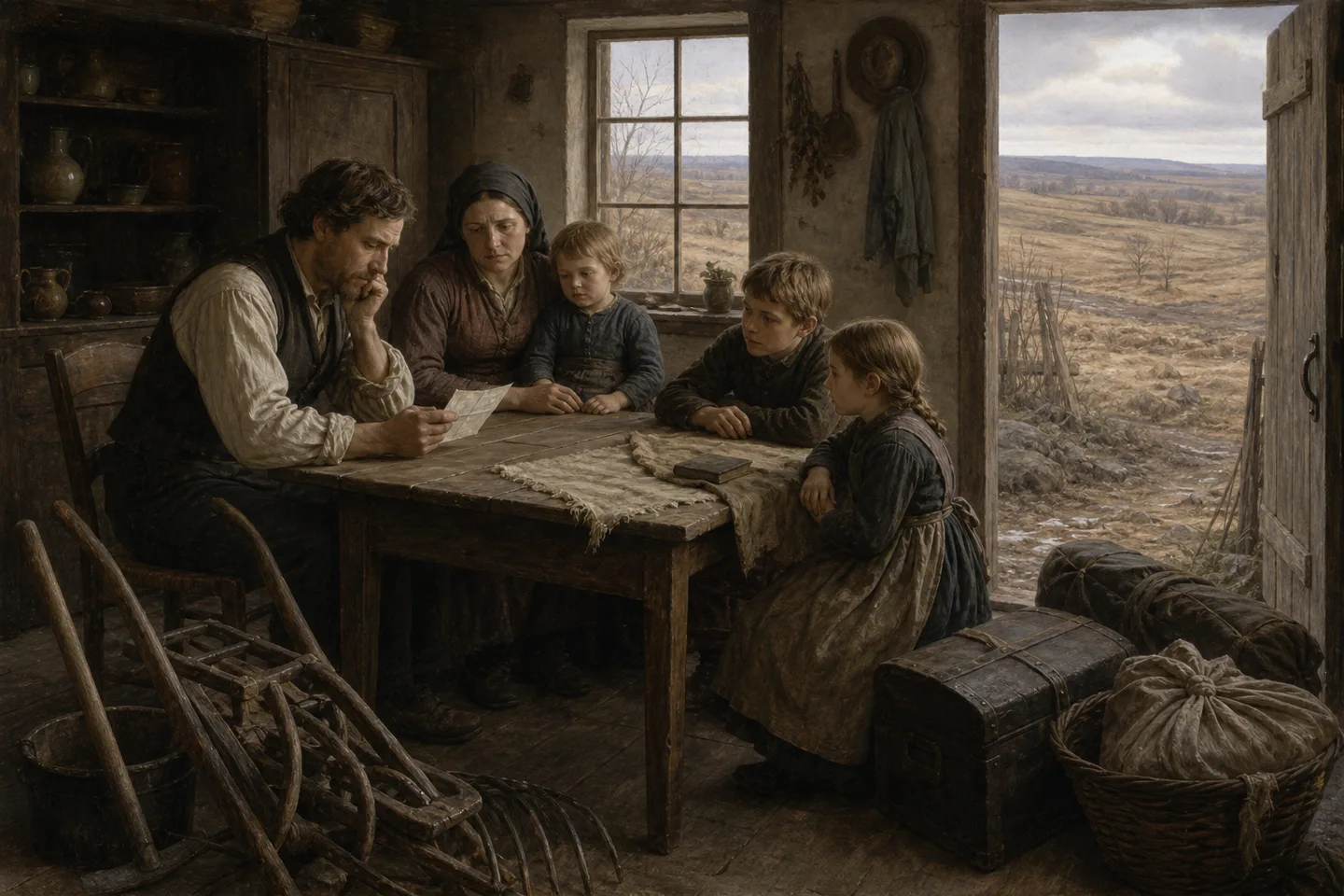
For rural families, the ability to acquire a farm or pass property to children could matter more than abstract national identity. In regions where holdings were divided, constrained or difficult to obtain, America appeared to offer a larger margin for independence. Established Pennsylvania German farming districts made that promise visible, and later settlement moved into the Ohio Valley, Great Lakes region, Missouri country, Texas and the Dakotas.
Land was not the only route. Artisans and tradespeople saw growing American towns. Bakers, printers, brewers, cabinetmakers, metalworkers and other skilled workers could enter communities where German-language customers and employers already existed. Urban opportunities helped explain why German settlement spread across both farms and cities.
The decisive point is not that America guaranteed prosperity. It did not. The attraction was comparative: a family might accept the cost and risk of migration because the future at home looked narrower than the uncertain future abroad.
Economic pressure changed with industrialization
By the nineteenth century, population growth, insecure employment, land pressure and competition from industrial production affected many regions. The Library of Congress describes working people dealing with land seizures, unemployment and competition from British goods before and around the 1848 revolution. A later German labor inquiry discussed low wages, limited employment and the decline of older industries in the 1870s and 1880s.
These were not identical crises. A rural laborer, a small master craftsman and an urban factory worker faced different risks. Some regions industrialized quickly while others remained agricultural. Some families left during downturns; others used savings from better years. The safest claim is that economic insecurity repeatedly pushed people toward migration, not that nineteenth-century Germany was uniformly poor.
Political liberty mattered most visibly after 1848
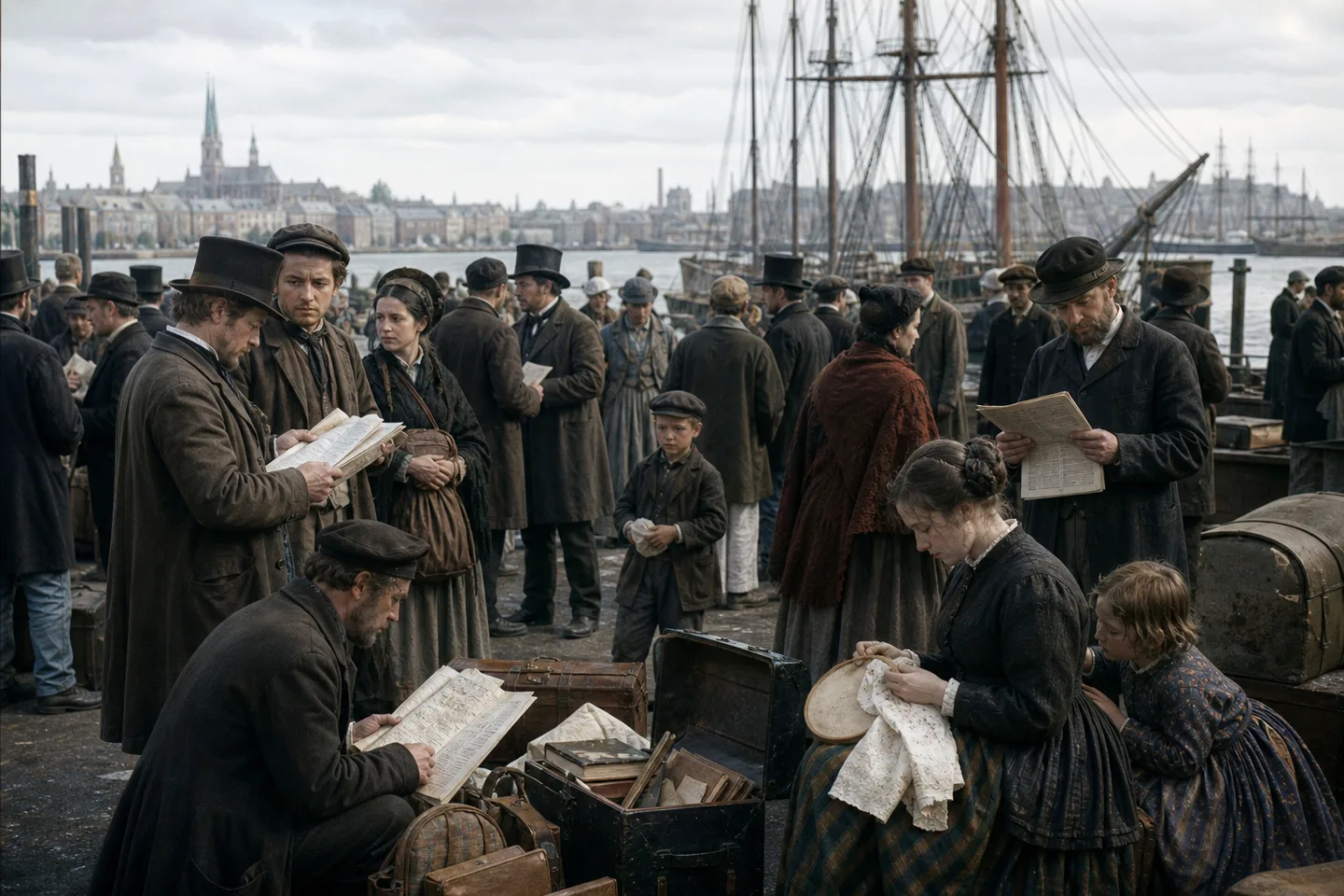
The revolutions of 1848 demanded constitutional reform, civil rights, national unity and other political changes across the German states. When the revolutions failed, some activists and supporters fled. In the United States they became known as the Forty-Eighters.
Their education and civic activity made them prominent. Many entered journalism, politics, education, abolitionism and military service. That visibility can distort the larger picture. The immigration timeline shows that the 1850s surge was much bigger than the political exile community alone. Most arrivals were not famous revolutionaries, and many left for mixed economic and family reasons.
Political motives also existed outside 1848. Restrictions on speech, association or political movements could shape later decisions, including pressure on social democrats in the German Empire. Yet politics usually interacted with livelihood and family rather than replacing them.
One famous group is not the whole migration
German immigrants in the mid-nineteenth century were mainly Forty-Eighter political refugees.
The Forty-Eighters were influential and visible, but they were a small part of a much larger migration made up of workers, farmers, artisans and families with mixed motives.
Family networks made America feel reachable
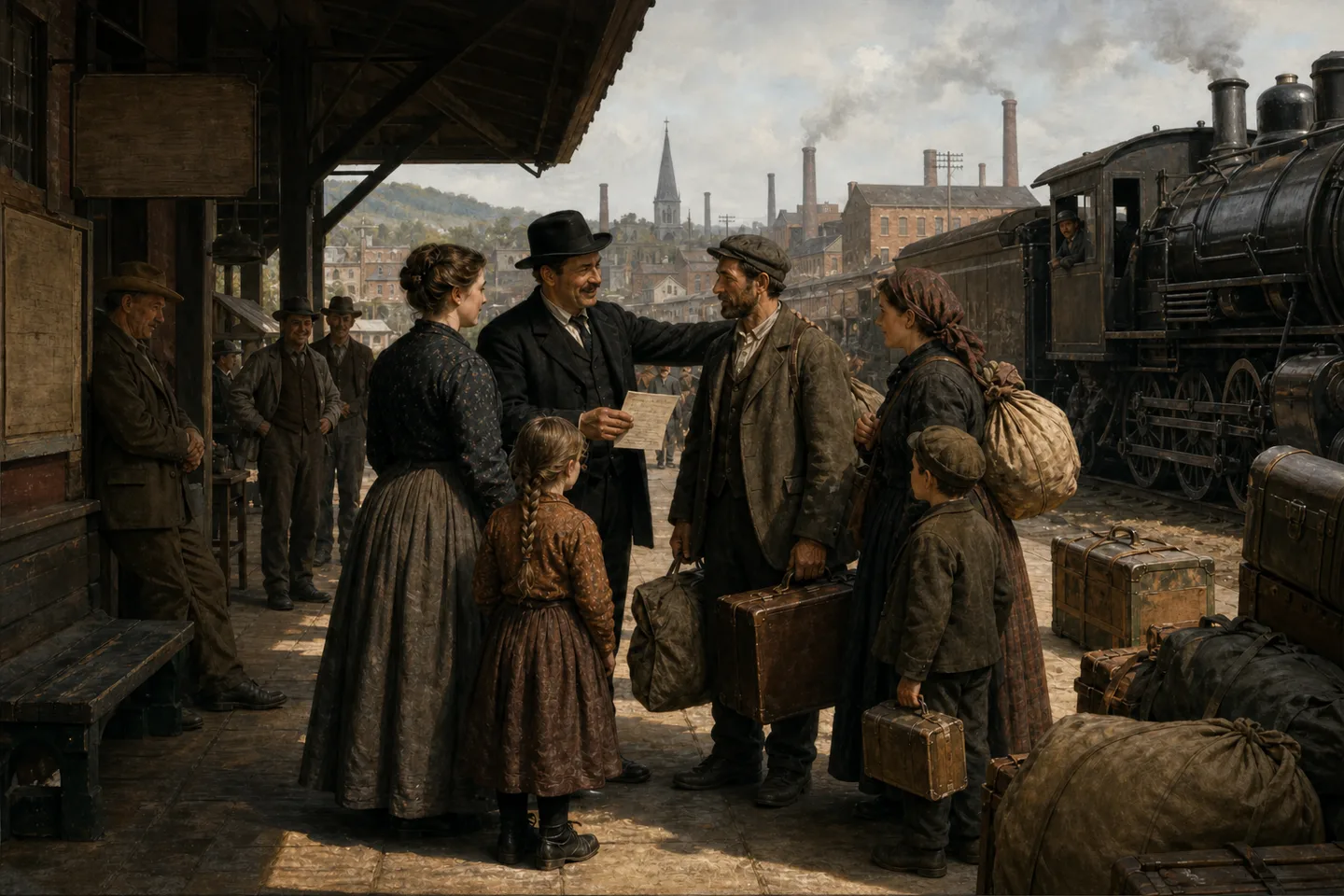
A distant country becomes a practical destination when someone trusted is already there. Letters could describe wages, land prices, churches, schools and travel routes. Remittances could pay part of a ticket. A relative could meet a newcomer, offer a room or introduce an employer. Even when letters painted an overly hopeful picture, they reduced uncertainty.
This is chain migration: one move changes the probability of the next. It helps explain why German communities clustered so strongly. Families did not choose “America” in the abstract. They chose Cincinnati because a cousin worked there, rural Wisconsin because neighbors from the same district had settled there, or a Texas town because an organized migration project directed them there.
Networks also preserved regional differences. People from one village, denomination or trade could form a local concentration that did not look like another German-American community two states away. The category German immigrant was broad; the route to a particular street or farm was often very specific.
Steamships changed what was possible
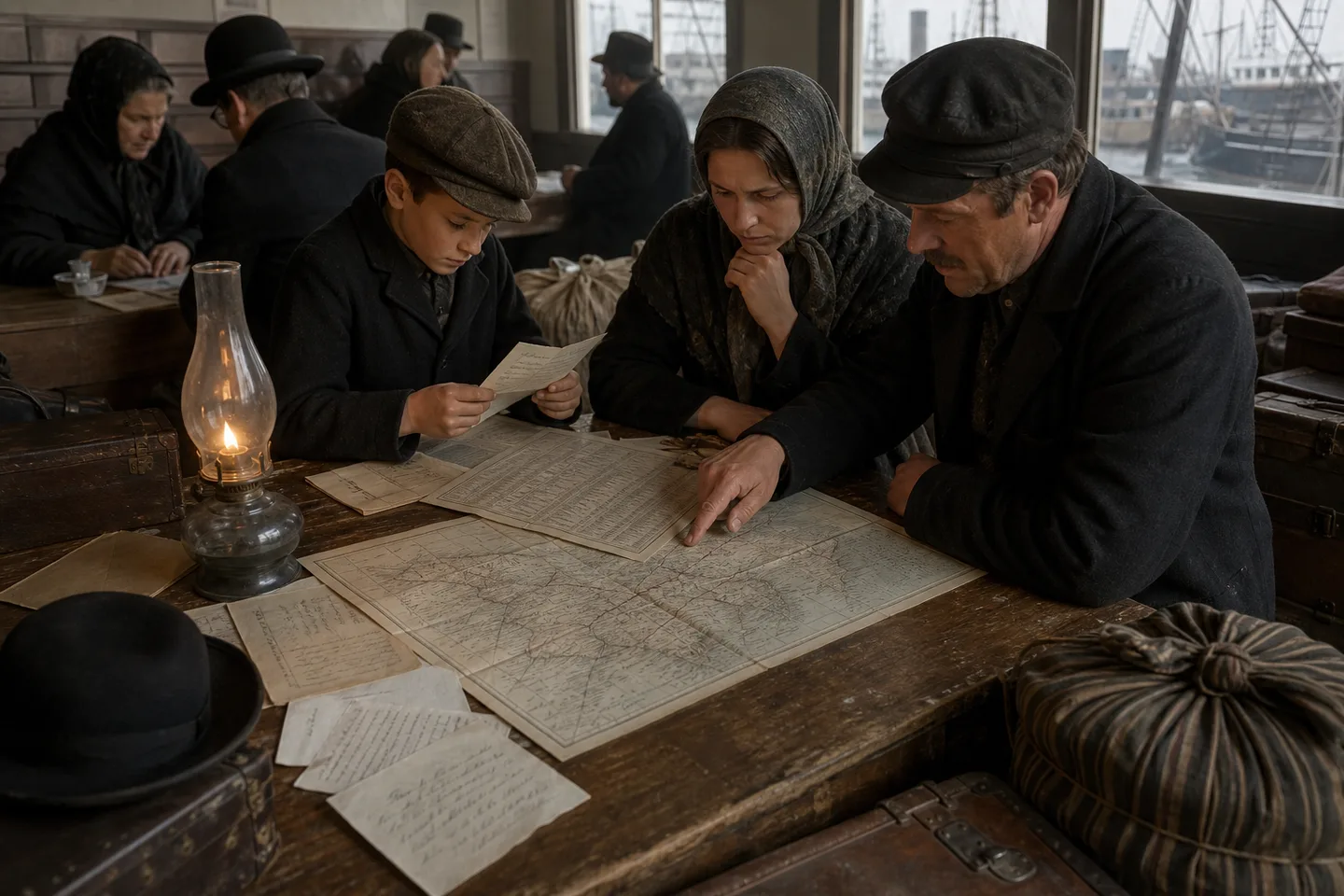
Technology did not create the reasons to leave, but it changed the threshold. Steamship service made Atlantic travel faster and more predictable than the older sailing passage. Regular routes connected European departure ports with American ports and inland transport. Shipping agents and migration companies marketed those routes, sometimes honestly and sometimes not.
A shorter crossing did not make migration easy. Tickets still cost money. Illness, fraud, overcrowding and separation remained real risks. But improved transport allowed information and people to move in a more regular cycle. Letters went back, relatives followed, and a local migration stream could become a sustained transatlantic network.
The major-wave model uses this transport change as one reason the early nineteenth-century movement should be distinguished from colonial migration.
Persecution after 1933 created a different kind of departure
Nazi rule turned citizenship, profession, religion and political opposition into grounds for exclusion and danger. Jewish people were progressively stripped of rights and livelihoods. Political opponents, artists, scholars and others also faced persecution. For many, leaving was not a wager on better wages; it was an attempt to survive.
The United States was not an open refuge. Quotas, visa documentation, financial sponsorship rules and administrative delays restricted admission. Many applicants could not secure a place. A history centered only on successful arrivals risks hiding those barriers and the people who were trapped by them.
This migration belongs within German-American history, but it should not be blended sentimentally into the earlier story of farms and opportunity. The choices available to a persecuted family were constrained by a state campaign against them and by the policies of countries deciding whether to admit them.
Postwar migration had its own mixture of reasons
After World War II, people moved through categories that included displaced persons, refugees, spouses, relatives, workers and ordinary immigrants. Cities were damaged, borders shifted and families had been separated. Some people joined relatives who had left earlier; others formed new connections through military service, marriage, study or employment.
The flow was substantial in the 1950s but smaller than the nineteenth-century mass migration. It also entered a different America: German ancestry was widespread, yet public German-language life had declined. Newcomers could find old institutions in some places, but many settled through broader metropolitan labor and family networks rather than a compact ethnic colony.
How the dominant reasons changed
Toleration, land and community
Some dissenting religious groups build settlements in Pennsylvania while other migrants pursue land, work or family opportunity.
Economic pressure meets chain migration
Land constraints, work insecurity, letters and improving transport make migration more common.
Political exile inside mass movement
The Forty-Eighters arrive within a much larger flow of workers, farmers, artisans and families.
Industrial and labor pressures continue
Low wages, unemployment, changing industries and established American networks sustain migration.
Persecution creates refugee flight
Nazi rule makes safety the immediate concern, while U.S. quotas and paperwork limit admission.
War aftermath and family rebuilding
Displacement, family ties, marriage, work and ordinary migration create a new postwar flow.
What did not explain every German immigrant
Several popular summaries fail because they turn one real motive into the whole answer. Not every German came for religious freedom. Not every family was poor. Not every immigrant wanted a farm. Not every Forty-Eighter was representative of the people arriving beside him. Not every refugee after 1933 was admitted. And not every person who left did so forever; return migration and transatlantic family ties also mattered.
A better family-history question is narrower: what was happening in this person’s home region and occupation, who had already migrated, what did the American destination offer, and what records show the decision? The answer can then be placed within the broader timeline without forcing one national explanation onto a particular life.
The durable pattern: pressure, possibility and connection
Across four centuries, the exact mix changed. Colonial dissenters valued toleration and community. Nineteenth-century families weighed land, work and their children’s prospects. Political refugees sought liberty. Chain migration and steamships made movement executable. Nazi-era refugees sought safety under severe legal constraints. Postwar migrants rebuilt lives through another set of routes.
What connects these cases is not one German character trait. It is the ordinary migration problem of comparing a difficult present with an uncertain alternative—and relying on people, information and institutions to cross the distance between them. Readers who want the identity path rather than a migration analysis can continue with the German Heritage guide.
An optional expression after the history
Carry the family story forward
These designs express a present-day connection to German-American roots; they are not historical evidence or a substitute for the sourced account.


Frequently asked questions
Common questions
Did most German immigrants come for religious freedom?
Religious toleration mattered greatly to some early communities, but it does not explain most nineteenth-century migration. Economic pressure, land, work, politics and family networks became more important in later periods.
Were the Forty-Eighters the main German immigrant group?
No. They were politically visible refugees after the failed revolutions of 1848, but they were one part of a much larger flow dominated numerically by ordinary families and workers.
Did Germans receive free land in America?
Land could be cheaper or more accessible than in parts of Europe, but it was not simply free, universally available or detached from Indigenous dispossession, credit, labor and legal constraints.
Why did German refugees come after 1933?
Nazi persecution forced Jewish people, political opponents and others to seek safety. U.S. quotas and documentation requirements limited how many could enter.