
On this pagePennsylvania was the first major center
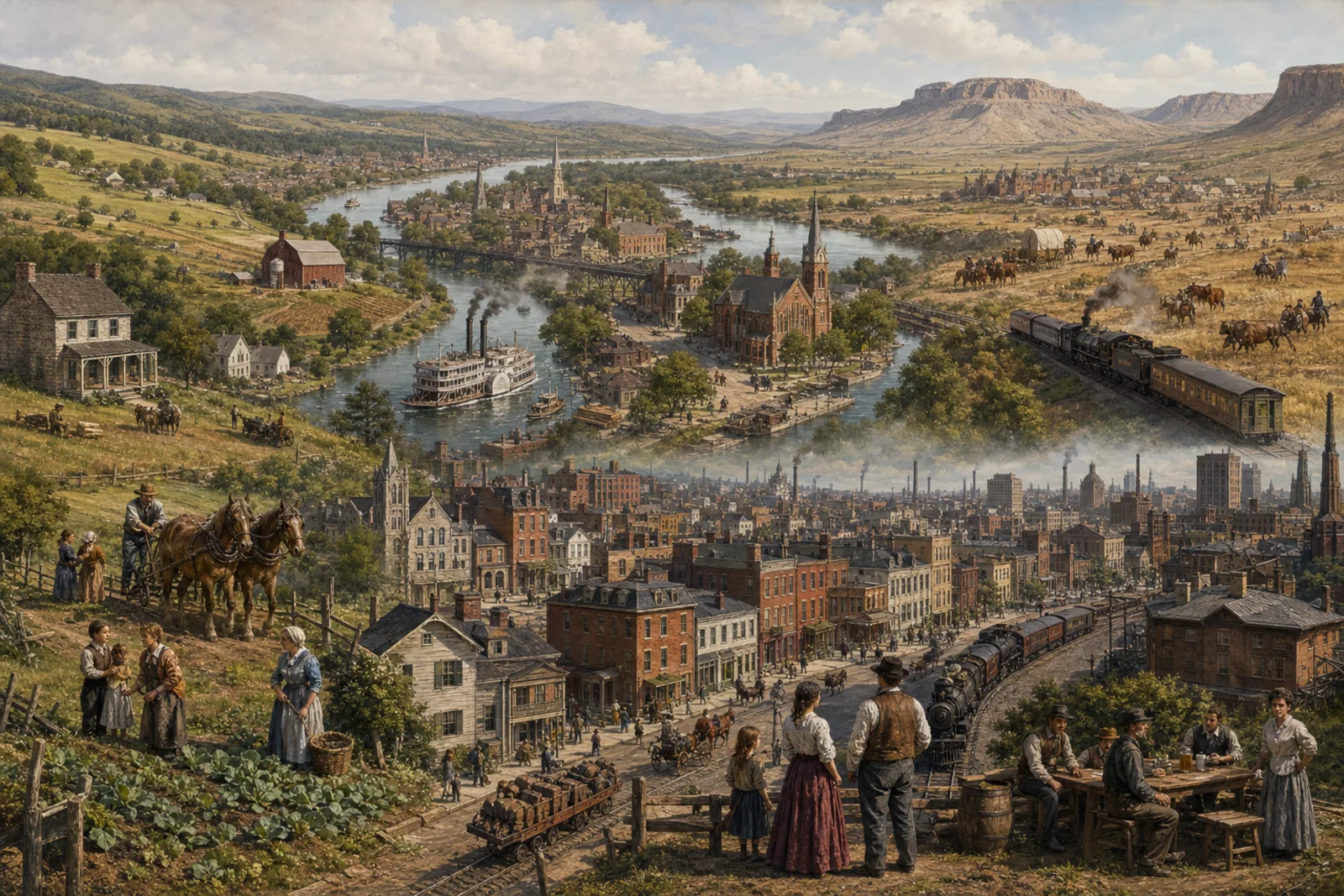
German immigrants first built a major colonial center in Pennsylvania. During the nineteenth century, settlement moved strongly through the Ohio, Mississippi and Missouri river valleys and around the Great Lakes. Large urban communities grew in Cincinnati, Milwaukee, St. Louis and St. Paul, while other migrants established towns and farms in Texas, the Dakotas, the Pacific Northwest and California.
That map was not random. Land, waterways, railroads, skilled work, churches, newspapers and relatives already in America all shaped destination choice. A family usually did not select a region because it was generically “German.” It followed a practical route to a person, congregation, employer or parcel of land.
How to read German settlement geography
- Settlement core
- A region with enough families and institutions to attract additional migrants over time.
- Chain migration
- Movement in which earlier migrants provide information, money or a destination for relatives and neighbors.
- Foreign-born count
- People born outside the United States; it does not include every American descendant of German immigrants.
- Ancestry count
- People reporting German ancestry, a different measure that can include many generations and multiple ancestries.
The distinction between foreign-born and ancestry matters. A map of people born in German lands in 1880 shows recent immigration. A modern ancestry map shows descendants and self-identification. Neither should be presented as the other.
Pennsylvania was the first major center
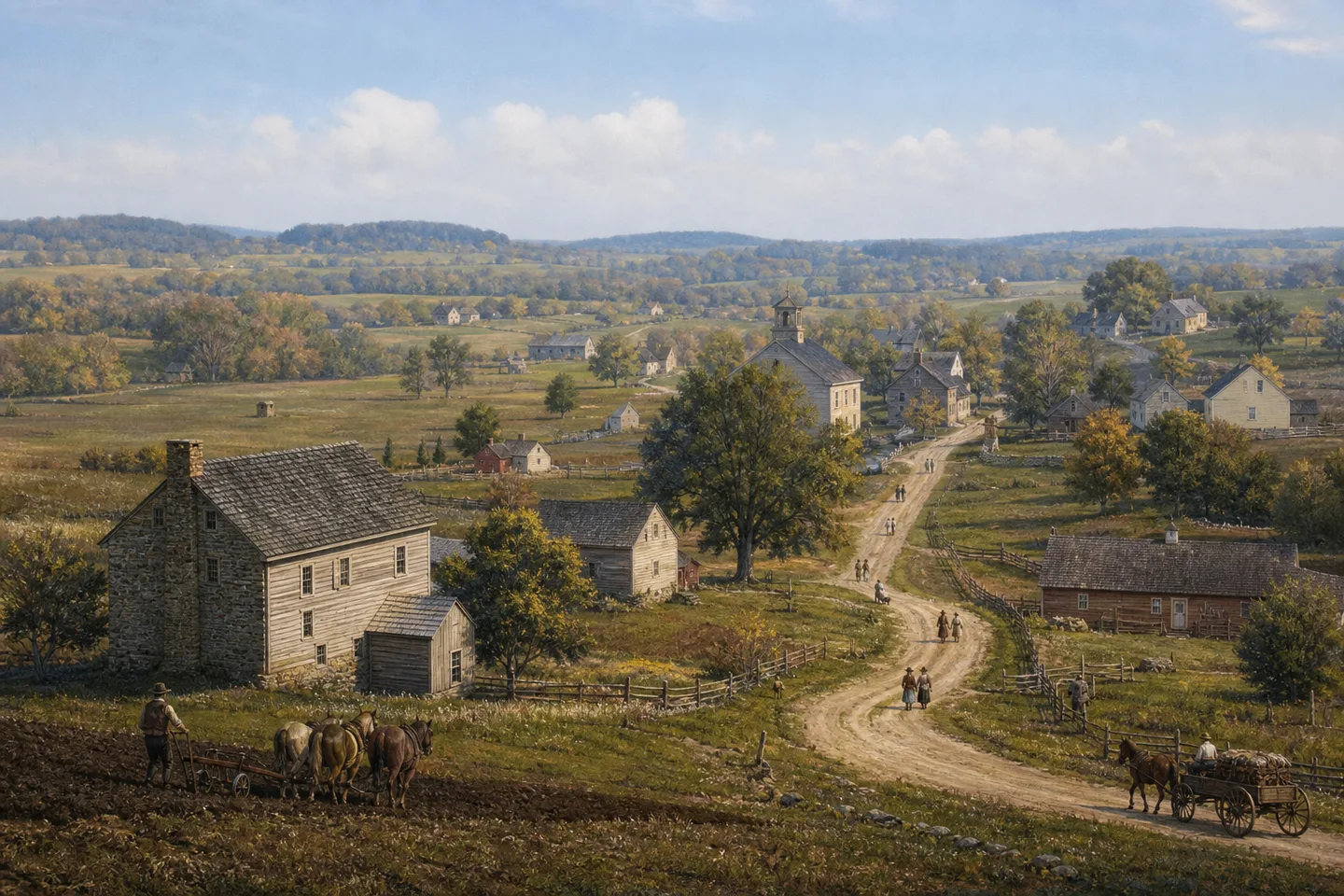
Germantown, founded near Philadelphia in 1683, became the most familiar starting point for organized German settlement. From there, German-speaking communities expanded through southeastern and central Pennsylvania. Farms, congregations, print networks and towns gave later arrivals a place where language and community support already existed.
The label Pennsylvania German grew from this regional world. It should not be treated as a simple synonym for every German-American or confused automatically with one religious group. Pennsylvania German communities included different denominations and local traditions, and their history began long before nineteenth-century German unification.
Land and toleration helped attract migrants, but the move could involve debt, indentured labor and hardship. The settlement story also sits within colonial expansion onto Indigenous land. A reader can recognize the opportunity that migrants saw without describing the process as empty land waiting to be claimed.
For the date distinction behind this center, see when Germans first arrived. Germantown was not the first German individual presence; it was the durable community milestone.
River valleys opened the interior
As nineteenth-century immigration grew, the American interior became central. The Ohio, Mississippi and Missouri rivers connected farms, towns and markets. The Great Lakes offered another transport system. Newcomers could move from eastern ports toward land and work without remaining on the Atlantic coast.
The Library of Congress describes this broad region as the nation’s breadbasket and notes that by the middle of the nineteenth century more than half of German-born Americans lived there. That statement is useful as a regional orientation, not a precise state ranking. The region contains different economies, cities and settlement periods.
River access mattered because bulky goods and farm products needed markets. Later railroads changed routes again. A German-speaking family could settle near a town with a church, school or newspaper while still farming beyond the city. Urban and rural settlement were connected rather than separate stories.
The Midwest became a dense German-American region
Ohio, Wisconsin, Missouri, Illinois, Minnesota, Iowa, Indiana, Michigan, Nebraska and neighboring areas all developed important German communities. The exact concentration differed by decade and county. Some districts drew farmers; others drew craftsmen, industrial workers or religious communities.
The deeper question—why so many Germans chose the Midwest—belongs to MF-026, the next batch’s dedicated owner. This national article keeps the answer proportional: the Midwest combined land, transport, growing cities, work and established migration networks. Once a cluster formed, it made the next arrival easier.
That self-reinforcing pattern can be seen in place names, congregational records and newspapers. A town might contain people from several German states, while a rural congregation could preserve a narrower regional or denominational connection. “German Midwest” is therefore a map of many local histories, not one uniform culture.
Cities offered trades, wages and institutions
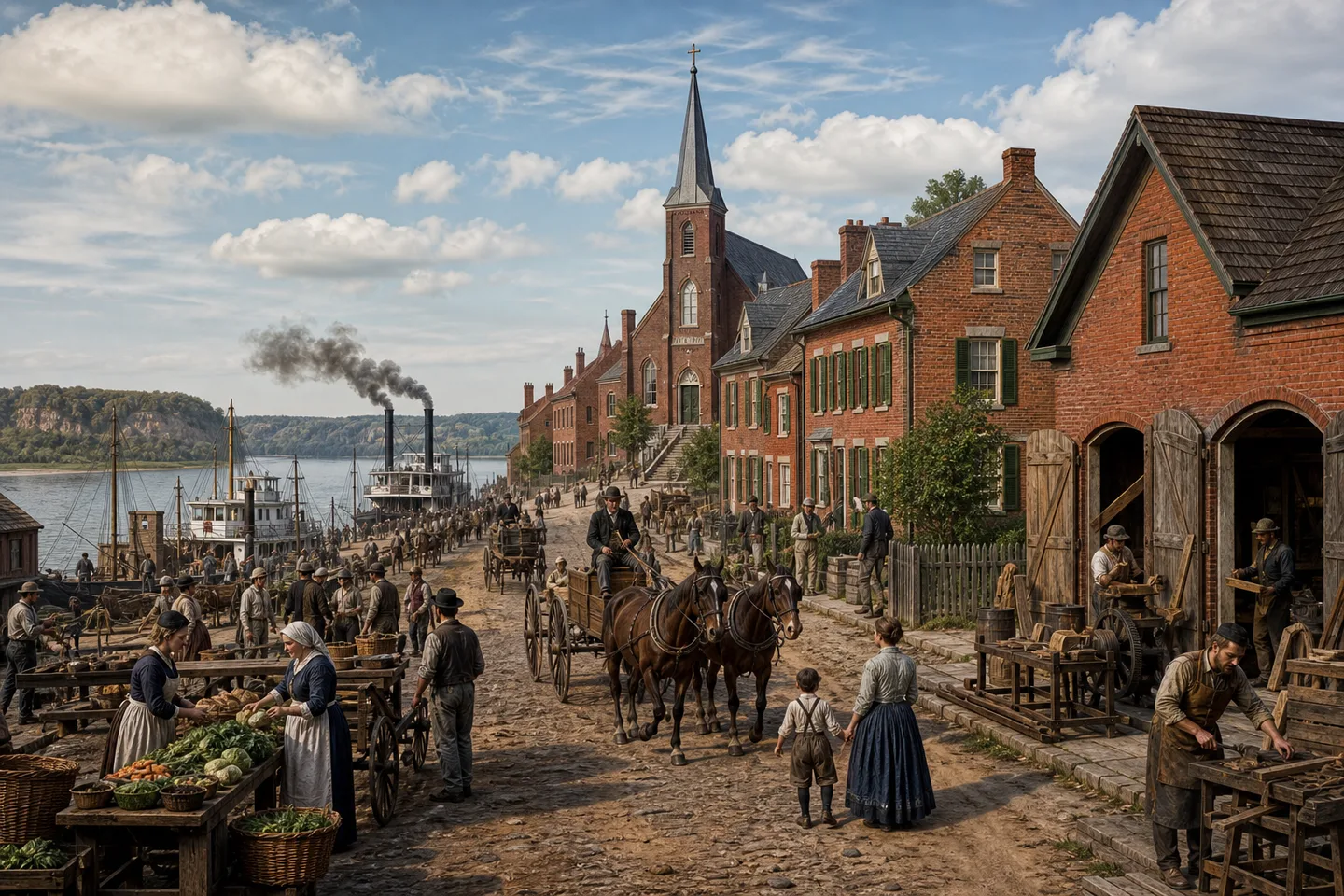
Not every German immigrant wanted a farm. The Library of Congress highlights Cincinnati, Milwaukee, St. Louis and St. Paul as major urban concentrations. These cities offered skilled trades, manufacturing, brewing, printing, retail and construction. They also supported German-language churches, schools, theaters, newspapers, clubs and mutual-aid organizations.
Cincinnati became known for a large German district and dense civic life. Milwaukee’s German population influenced industry, publishing, education and public culture. St. Louis combined river commerce with strong German institutions. St. Paul connected German settlement with the expanding Upper Midwest.
This is an illustrative list, not a complete one. Chicago, New York, Baltimore and other cities also contained substantial German communities. A national map should not turn four examples into an exclusive ranking.
Urban institutions were practical. A newspaper advertised jobs and rooms. A church recorded baptisms and marriages. A club offered insurance or social support. A German-speaking shopkeeper reduced the language barrier. These institutions help explain why new arrivals often chose a city where they had never lived but where someone from their network had already built a foothold.
Texas developed a distinct settlement story
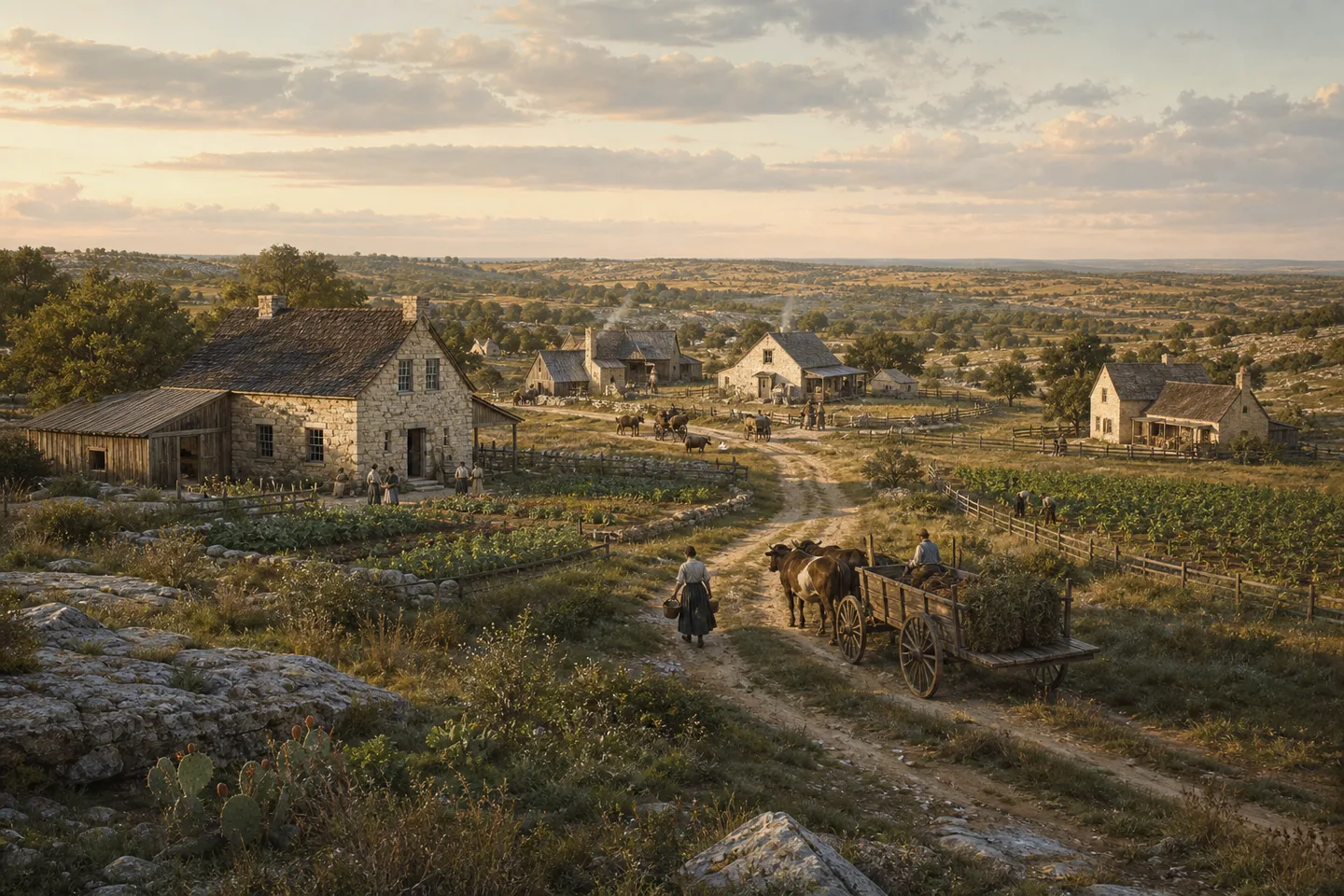
German immigration to Texas included organized projects as well as individual movement. New Braunfels and Fredericksburg became especially visible centers in the 1840s. Their history connected German-speaking migrants with the politics, land systems and dangers of the Republic and later state of Texas.
German-Texan identity did not become a miniature version of every German-American community. It developed through specific towns, families, dialects and institutions. Some practices remained strong; others declined or became heritage projects. The existing German Heritage guide uses German-Texan history as one example of why regional identity deserves its own evidence.
A settlement map can show that Texas mattered. It cannot claim that all Texas Germans came through one organization, shared one politics or preserved one culture. Local history remains necessary.
The Dakotas and Plains drew later agricultural settlement
As railroads and land policies opened additional territory to settler agriculture, German migrants and German-speaking communities moved into the Dakotas, Nebraska, Kansas, Colorado and other Plains areas. Some came directly from Europe. Others moved again after living in older American settlements.
Secondary migration inside the United States complicates a simple arrival map. A family counted in Pennsylvania in one decade might appear in Ohio or Wisconsin later. Children born in America could carry language and institutions into a new region even though they no longer counted as foreign-born.
Religious networks could be especially important in rural settlement. Congregations, colonies and kin groups sometimes moved together or recruited from familiar European regions. That pattern creates valuable record clusters but also means that a county should not be assumed to represent all Germans.
German settlement also reached the West
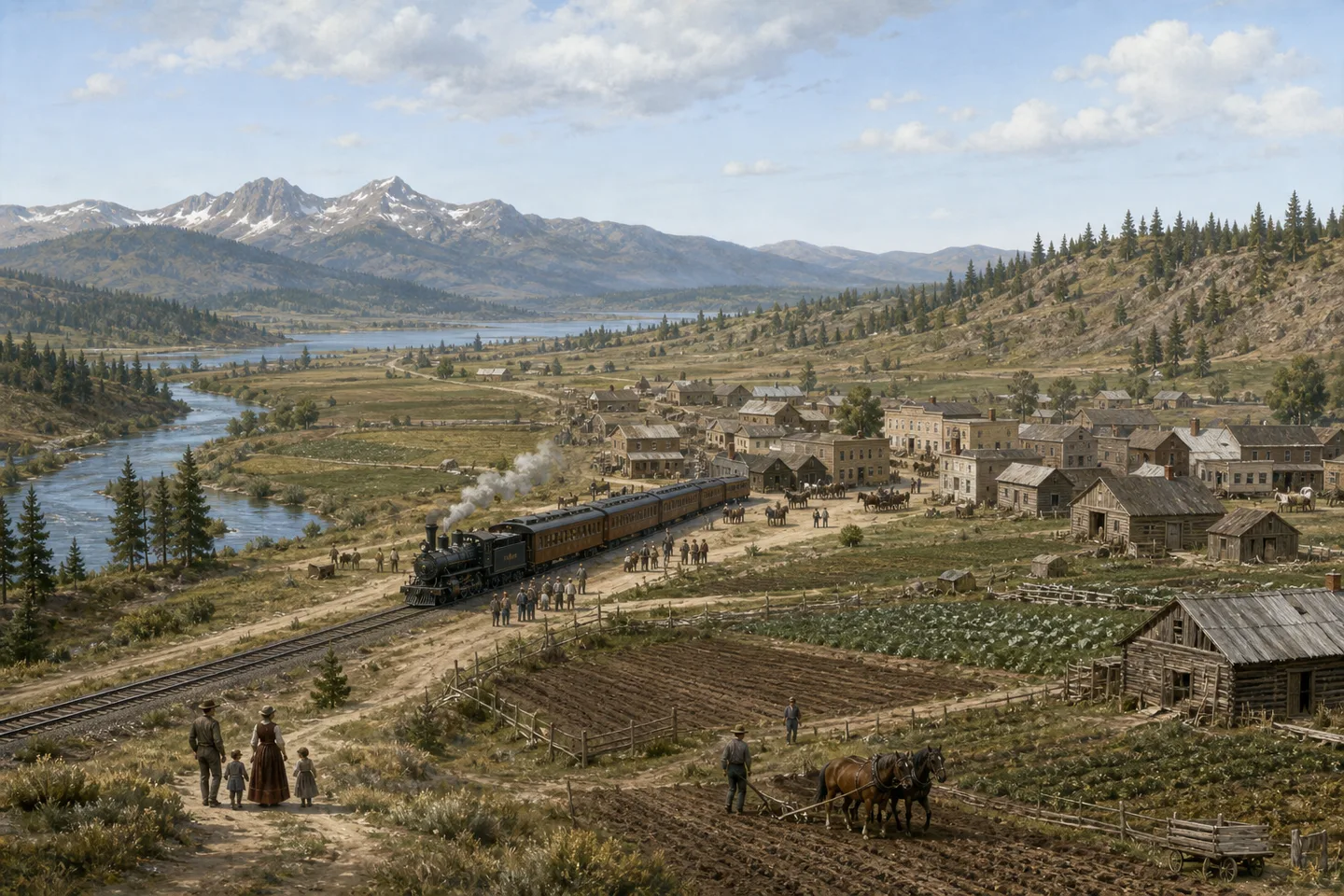
Later in the nineteenth century, Germans moved to the Pacific Northwest and California as well as mountain and plains states. Western cities offered trades and commerce, while agricultural areas attracted farmers, vintners and other specialists. Some western settlers were new immigrants; others arrived after years elsewhere in the United States.
The western story receives less attention because the Pennsylvania-to-Midwest arc was so large. It still matters. A family tradition that says an ancestor “went west” may refer to more than one move and more than one generation. Census, land, church and newspaper records should be followed across states rather than assuming the first American residence was final.
How German settlement expanded across the United States
Pennsylvania core
Germantown and later Pennsylvania communities create the strongest early center of German-speaking settlement.
Interior routes grow
Rivers, canals and overland routes connect eastern ports and Pennsylvania communities with the Ohio Valley and Great Lakes.
Midwest farms and cities expand
Mass migration strengthens rural districts and urban centers such as Cincinnati, Milwaukee and St. Louis.
Texas centers form
Organized and family migration builds communities including New Braunfels and Fredericksburg.
Plains, Dakotas and West grow
Railroads, land, work and secondary migration extend German settlement farther across the continent.
Why clusters formed
The reasons Germans came to America explain departure. Destination required another decision. Four forces repeatedly worked together.
First, land and work had to be plausible. Second, transportation had to connect the destination to an arrival port or earlier settlement. Third, information had to travel through letters, agents, newspapers or relatives. Fourth, a receiving community could lower the cost of starting over.
Those forces created feedback. A town with German-speaking workers attracted employers and businesses that could use their skills. A congregation attracted families of the same denomination. A newspaper made the community visible across the Atlantic. A successful farmer wrote home, and another family followed.
German settlement was broad, not confined to one belt
German immigrants settled only in Pennsylvania and the Midwest.
Those were major centers, but German communities also formed in Texas, the Dakotas, the Plains, the Pacific Northwest, California and many eastern and western cities.
What a national map cannot prove
A settlement pattern can guide research, but it cannot identify a family’s European hometown. A German-heavy county might contain people from Prussia, Bavaria, Württemberg, Saxony or border regions, along with several religions and migration dates. Surname spelling alone is not enough to choose one origin.
Historical census data also require caution. Country-of-birth tables measure immigrants, not all descendants. Borders and country labels changed. State boundaries and regional definitions changed. A modern map of German ancestry answers a different question from an 1880 foreign-born map.
The strongest use of geography is to generate record questions. Which churches served the neighborhood? Which German-language newspapers covered it? Did relatives live nearby? Which railroad or river route connected the town to a port? The major-wave model can then help explain why that route was active at that time.
Settlement maps also hide movement inside America
A first American address was often not the final one. Families moved from Pennsylvania into Ohio, from eastern cities toward Wisconsin or Missouri, and from older Midwestern communities into the Plains and West. Children born in the United States could become the people who carried German-language churches, newspapers or customs into a new county.
That secondary migration matters in records. A passenger list may identify the port and arrival, while a naturalization file, census sequence, land deed or obituary reveals the inland path. Looking only at the arrival state can miss the community that shaped the family’s longer American life.
It also explains why a later settlement may contain descendants from several earlier routes. The local German community was often assembled over decades rather than founded by one ship or one European region.
A connected map, not a single destination
German-American settlement grew from a Pennsylvania colonial core into a national network of farms, river towns, industrial cities, Texas communities, Plains settlements and western destinations. The Midwest became especially dense, but it was never the whole map.
That breadth is one reason German-American identity can look different from one family to another. A Pennsylvania German lineage, a Milwaukee urban family and a German-Texan community may share ancestry without sharing the same migration path or traditions. The immigration timeline places those paths in sequence; geography shows where they became local lives.
An optional expression after the history
Carry the family story forward
These designs express a present-day connection to German-American roots; they are not historical evidence or a substitute for the sourced account.
Frequently asked questions
Common questions
Did most German immigrants settle in Pennsylvania?
Pennsylvania was the strongest early colonial center, but nineteenth-century settlement expanded heavily into the Midwest, Great Lakes region, cities, Texas, the Dakotas and farther west.
Which American cities had large German communities?
Cincinnati, Milwaukee, St. Louis and St. Paul were major centers highlighted by the Library of Congress. Chicago, New York, Baltimore and other cities also received substantial German populations.
Why did so many Germans settle in the Midwest?
Land, river and rail transport, farming opportunity, skilled work and established family or community networks all mattered. A later dedicated article owns the deeper Midwest explanation.
Can a settlement map identify my ancestor’s German hometown?
No. It can suggest likely networks and records, but a family’s place of origin must be established through documents such as naturalization, church, vital, census and passenger records.