
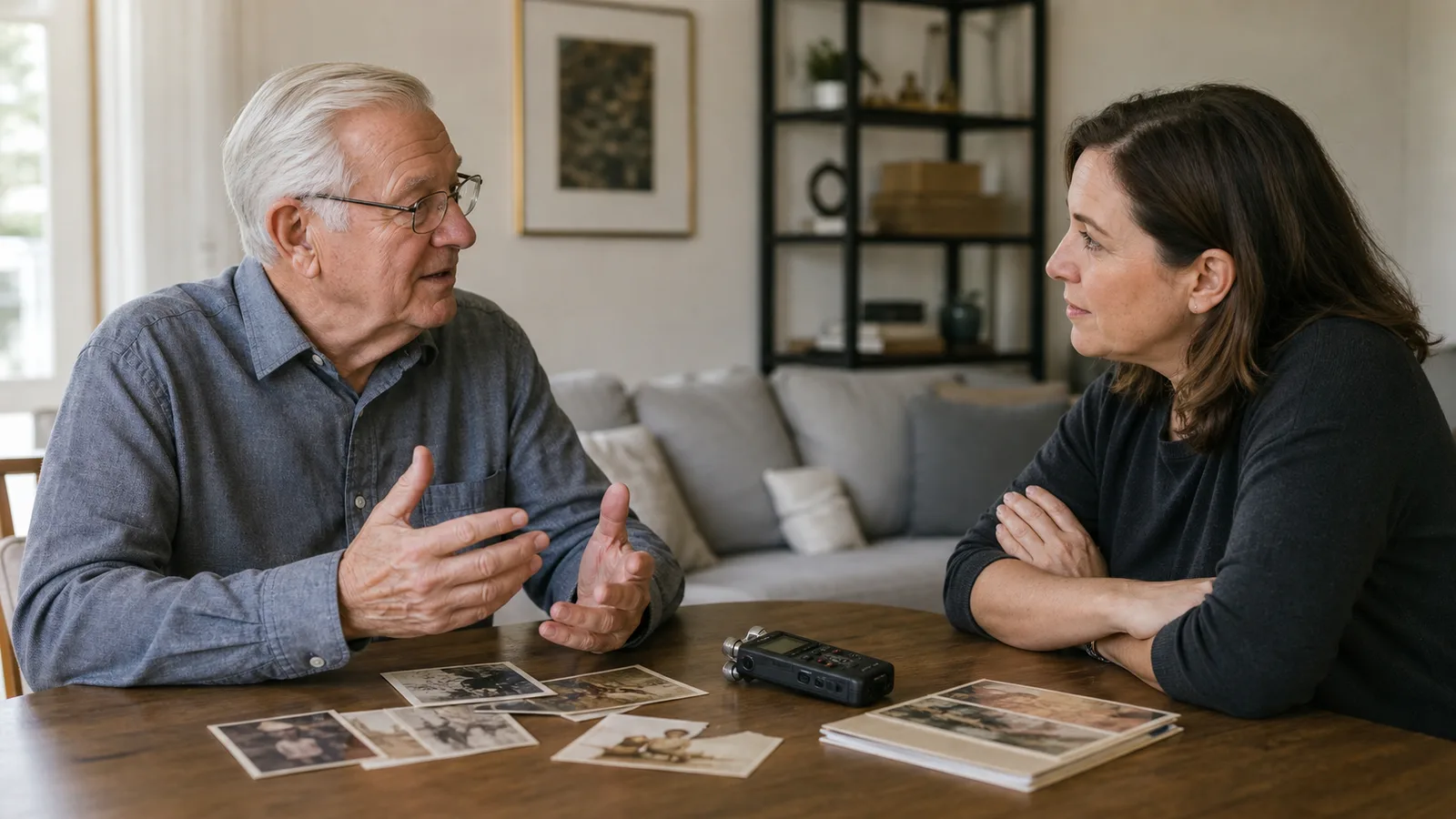
On this pageDecide what kind of conversation you are having
The best questions for an Opa or Oma are open enough to invite a story and specific enough to bring back real details. Start with childhood, people, places and ordinary routines before moving toward migration, loss or conflict. More important than any question list, however, is the narrator’s control over the conversation.
If “Opa” and “Oma” are the only German words that survived in the household, that is still useful context. Heritage without speaking German explains why fluency should not become the interview’s measure of authenticity.
Before recording, explain the purpose, the intended audience and where the file will be kept. Make clear that a question may be skipped, the recording may be paused, and sharing can be limited. Consent is not a single “yes” that removes every later choice.
Decide what kind of conversation you are having
A private family conversation, a recording shared among relatives and a public oral-history contribution are not the same project. Decide which one you are asking for.
A useful opening is:
I would like to record some of your memories so our family can understand them later. We can stop at any time. You can skip anything, and we will decide together who may hear the recording.
Do not promise public preservation, permanent privacy or institutional archiving unless you have checked the actual service and the narrator understands the terms. When using an app or online archive, review its current privacy and sharing settings before upload.
Prepare the interview before you press record
Choose a narrow purpose
Decide whether this conversation is about childhood, migration, family traditions, work, language or a particular person. A focused session is kinder and easier to preserve.
Agree on audience and access
Ask whether the recording is private, family-only, available after a date, or suitable for wider sharing. Write the answer down.
Preview sensitive areas
Mention topics such as war, displacement, discrimination, illness, adoption or conflict before asking about them. Give the narrator a simple way to decline.
Prepare open questions
Use prompts beginning with how, what, where or tell me about. Keep factual follow-ups nearby, but do not turn the conversation into an interrogation.
Test the room and device
Reduce background noise, place the device close enough to hear, record a short test and confirm that the narrator is still comfortable.
Plan immediate aftercare
Leave time to review restrictions, record names and spellings, copy the file and note who participated, when and where.
Open questions for your Opa or Oma
Use these as invitations, not a script. Follow the narrator’s language and pace, and ask for clarification without correcting the story while it is being told.
Purpose: Record a grandparent’s perspective on family life, German or German-American connections, change across generations and the details that future relatives would otherwise struggle to recover.
Before the interview
- Bring a short topic list rather than a rigid script
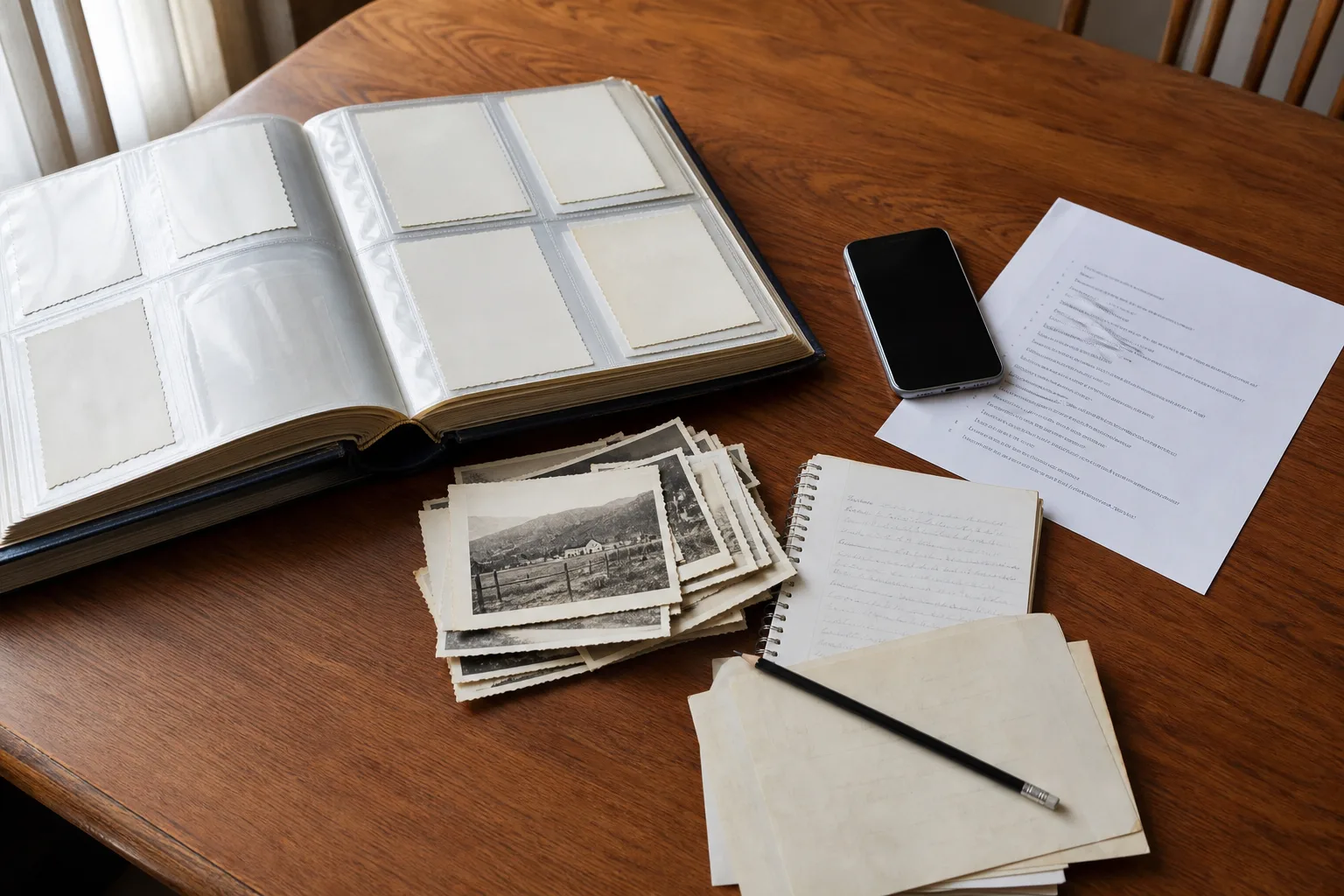
- Gather a few labeled photographs, letters, recipes or maps that may prompt memories
- Write down the narrator’s preferred name and the spelling of people and places
- Choose a quiet time when neither person needs to rush
- Have a charger, available storage and a second place for the backup
Childhood and home
- What is the first home you remember, and what did an ordinary day there feel like?
- Who lived nearby, and which relatives did you see most often?
- What sounds, smells or household objects bring that place back to you?
- What did adults expect children to help with?
Opa, Oma and family relationships
- What did you call your own grandparents, and what were they like with you?
- Which family member told the best stories, and what did they talk about?
- Were there family nicknames or forms of address that should be written down?
- What do you wish younger relatives understood about a person they never met?
Places and migration
- Which towns, villages, neighborhoods or regions were important in the family story?
- What were you told about why the family moved, and who told you?
- What changed after the move, and what stayed familiar?
- Are there place names whose spelling or pronunciation the family used differently?
Language and names
- Which German words or expressions were used at home, and by whom?
- Were there words you understood but did not speak yourself?
- How were family surnames, first names or place names pronounced?
- Did anyone change, shorten or translate a name, and what do you know about the reason?
Food and everyday traditions
- Which foods appeared at ordinary meals, not only holidays?
- Who cooked them, and did they use a written recipe or work from memory?
- Which family customs were kept, changed or dropped over time?
- Was there a tradition you did not appreciate until later?
Work, school and community
- What kind of work did family members do, and what did they say about it?
- What do you remember about school, church, clubs, neighbors or community events?
- Did German identity feel visible, private, ordinary or complicated where you lived?
- When did you first notice that your family did something differently from other families?
Change and what to carry forward
- Which part of family life changed the most during your lifetime?
- What was lost that you wish had been recorded?
- Which story, word, recipe or object would you most want the next generation to understand?
- Is there anything from this conversation you want kept private or explained more carefully?
Recording tips
- Ask one question at a time and leave room after the answer
- Use follow-ups such as 'What happened next?' or 'What do you remember about that person?'
- Say names and places aloud, then confirm spelling after the story rather than interrupting every sentence
- Note uncertainty in the transcript instead of silently resolving it
- Record a brief spoken introduction with date, place, participants and purpose when everyone agrees
After the interview
- Ask whether any section should be removed, restricted or reviewed again
- Record the preferred spelling of names, places and German terms
- Create a clear file name and a short note identifying who, when, where and why
- Keep at least one additional copy in a separate location
- Do not upload or circulate the recording beyond the agreed audience
- Return later for a separate follow-up rather than forcing every topic into one session
Let ordinary life come before the dramatic story
Interviewers often rush toward immigration, war or hardship because those subjects sound historically important. Ordinary life may reveal more of what the family actually carried forward.
Ask what breakfast looked like, who sat where, how children addressed adults, what was repaired rather than replaced, which songs were known, or how a holiday differed from the neighbors’ version. These details can explain values and adaptation without requiring the narrator to revisit painful material.
They also help distinguish family practice from a generalized cultural claim. “My Oma always served this dish” is a family memory. It does not establish that every German family served it, and it does not need to.
That recorded dish, phrase or custom can later support one of the meaningful ways to celebrate German roots without turning the interview itself into a performance.
Ask about migration without demanding a neat origin story
A family may have moved through several places, spoken a regional dialect, lived in an area whose borders changed, or used a place name that no longer appears in the same form. Let uncertainty remain visible.
Use questions such as “What place name did the family use?” and “Who told you that?” before asking for an exact modern location. A grandparent’s account may provide a crucial clue while still requiring later verification through records.
Avoid asking, “When did we come from Germany?” as though the family had one migration event. Different branches may have arrived in different periods, and some relatives may have identified with a region, language community or historical territory rather than the modern nation-state.
Keep the narrator’s original place wording and research it later. The guide to German ancestry versus German heritage helps separate a documented origin from the practices later generations retained.
Protect the narrator and people who are not in the room
An interview can contain information about adoption, parentage, political activity, medical history, relationships, legal matters or conflict involving living people. The narrator’s willingness to tell the interviewer does not automatically authorize public distribution.
Ask what may be shared and with whom. When a passage affects another living person, consider restricting it, summarizing it without identifying details, or keeping it private. This guide provides an ethical baseline, not legal advice. Recording and privacy law can vary by place, so check applicable requirements before recording or publishing when there is uncertainty.
Keep the interview open, voluntary and traceable
Do
- Explain purpose, audience and storage before recording
- Ask open questions and follow the narrator’s wording
- Label memory, uncertainty and later documentation separately
- Reconfirm sharing choices after the interview
- Preserve enough context that another relative can understand the file
Avoid
- Pressure a narrator to discuss trauma, conflict or a private relationship
- Treat silence, hesitation or a changed answer as evidence of dishonesty
- Publish because the recording feels historically important without permission
- Correct dialect, pronunciation or family wording into a cleaner version without noting the change
- Assume a platform’s default setting matches the family’s privacy decision
Give the recording context before the day ends
A file without context becomes difficult to trust and easy to lose. Record the narrator’s preferred name, interviewer, date, general location, language used, subject and agreed audience. Note any restricted segment and any uncertain spelling.
Use a file name that will still make sense outside the recording app, such as:
2026-08-05_anna-keller-interview_childhood-and-family_private-family.mp3
The example is only a naming pattern, not a required format. Avoid putting highly sensitive information into the file name itself.
Make a second copy after checking that the recording plays. Keep the original recording unchanged and create a separate working copy for trimming or transcription. Full preservation planning belongs to the family-story archive workflow; this interview guide covers the immediate steps needed to keep one conversation understandable and within the agreed access boundary.
Continue with the complete family-story preservation workflow to organize the audio, transcript, photographs, permissions and source notes together.
Before the interview is considered complete
- Purpose and audience were agreed
The narrator knows why the recording exists and who may hear it.
- The right to pause or decline was real
Sensitive topics were optional and the conversation stopped when needed.
- Names and uncertainty were recorded
Preferred spellings, place names and doubtful details are visible rather than silently corrected.
- Sharing restrictions were reviewed afterward
The family did not rely only on the decision made before unexpected topics appeared.
- The file has context
Date, participants, purpose, subject and access level are recorded with the audio.
- A separate backup exists
The only copy is not left inside one phone or one app account.
A good interview does not extract every possible fact. It leaves the narrator respected, the listener better informed and the recording understandable enough that another relative can use it without guessing what was agreed.
For a lighter, relationship-first approach outside a formal recording, see how to share German heritage with grandchildren. Parents building repeatable practices with younger children can start with how to pass German heritage to your children.
Frequently asked questions
Common questions
Do I need professional recording equipment?
No. A phone or simple recorder can be enough when the room is quiet and the speaker agrees. Test the device first and make a backup after the conversation.
Should I ask about war, migration loss or family conflict?
Only with care and permission. Name the topic before asking, make it easy to decline, and do not press for details. A person may choose to discuss the period without discussing trauma or private information about living relatives.
Can I share the recording with the whole family?
Not automatically. Agree on the intended audience before recording and review that decision afterward. Public posting, family-only sharing and private preservation are different choices.
What if Opa or Oma remembers a date differently from a document?
Preserve the account as memory and note the documented difference separately. An oral history records a person’s perspective; it does not by itself settle every historical or genealogical fact.